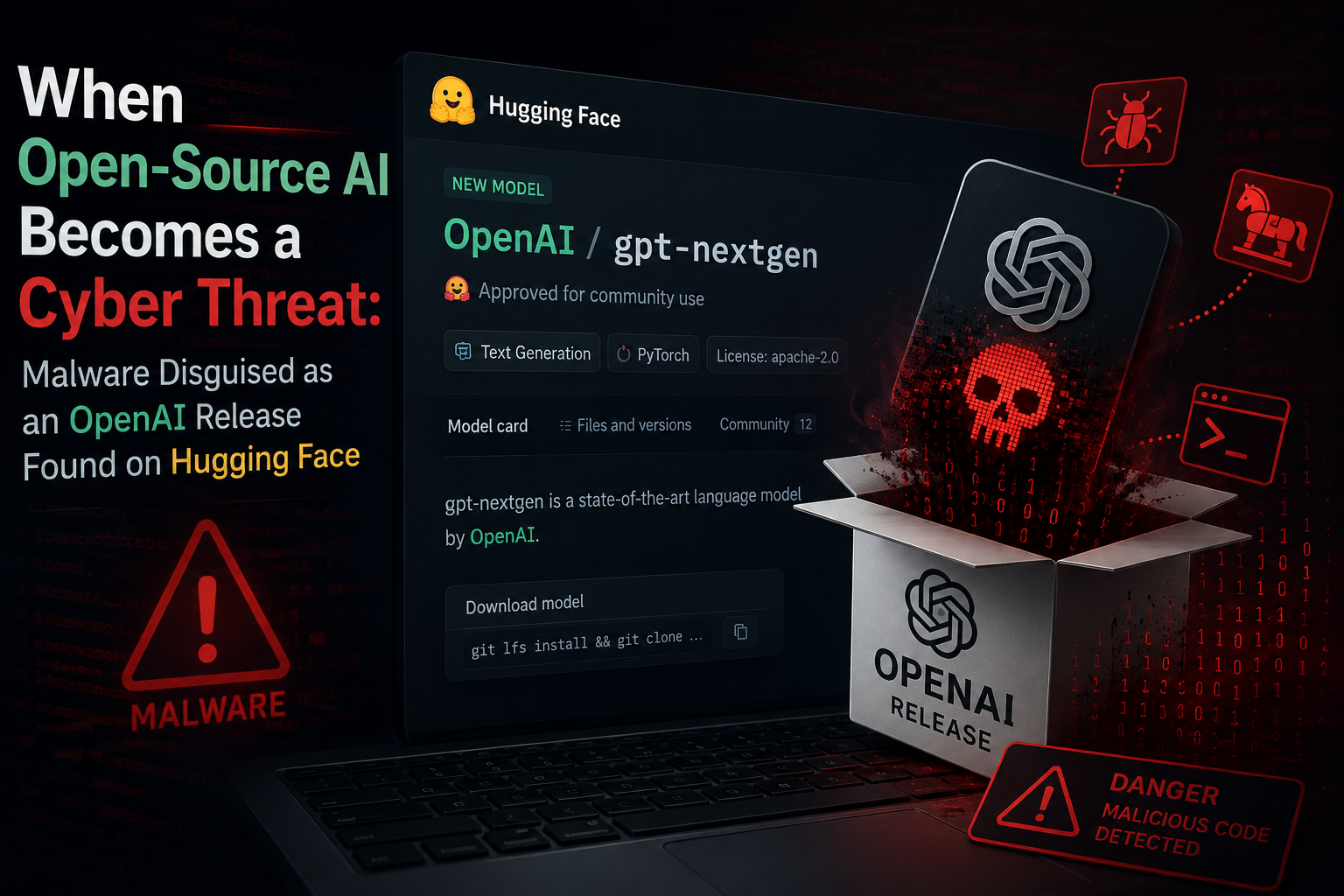
The rapid rise of open-source Artificial Intelligence has transformed innovation across industries. Developers worldwide now download models, datasets, and AI tools from platforms like Hugging Face with the same ease as installing a mobile app. But a recent cybersecurity incident has revealed a dangerous new reality: AI repositories themselves are becoming targets for sophisticated malware campaigns.
A malicious repository hosted on Hugging Face recently impersonated an official OpenAI release and successfully climbed to the platform’s top trending position before being removed. What appeared to be a legitimate AI tool was actually a malware delivery mechanism designed to steal sensitive user information.
The Fake OpenAI Repository That Fooled Thousands
The malicious repository, named “Open-OSS/privacy-filter,” closely mimicked a legitimate OpenAI project called “Privacy Filter.” Researchers discovered that attackers copied documentation nearly word-for-word and used typosquatting techniques to make the project appear authentic. (HiddenLayer)
The fake repository reportedly accumulated more than 244,000 downloads and hundreds of artificial likes within hours, pushing it to the #1 trending position on Hugging Face. Security researchers believe these engagement numbers were likely manipulated to create trust and legitimacy. (CSO Online)
At the core of the attack was a malicious loader.py file. Once executed, it downloaded additional malware payloads capable of:
- Stealing browser credentials
- Extracting cryptocurrency wallet data
- Capturing VPN and cloud login credentials
- Modifying Microsoft Defender exclusions
- Establishing persistent access on infected systems
The malware ultimately deployed an infostealer variant known as “Sefirah.” (TechRadar)
AI Supply Chains Are the New Battleground
This incident highlights a growing problem in the AI ecosystem: the rise of AI supply-chain attacks.
Traditionally, cybersecurity teams focused on malicious software packages in ecosystems like npm or PyPI. However, AI development introduces an entirely new attack surface. Developers increasingly download pretrained models, datasets, scripts, and checkpoints from public repositories without deeply auditing the code. (arXiv)
The trust-based nature of open-source AI ecosystems makes them especially vulnerable:
- AI repositories often execute scripts automatically
- Models may contain hidden malicious instructions
- Developers prioritize experimentation speed over security reviews
- Public “trending” systems can be gamed to amplify visibility
As AI adoption accelerates, attackers are exploiting the enthusiasm around new models and open-source releases.
The Bigger Cybersecurity Warning
This attack is not an isolated incident. Multiple reports now suggest that cybercriminals are rapidly integrating AI into offensive operations. (Reuters)
Recent investigations have revealed:
- AI-assisted vulnerability discovery
- AI-generated phishing campaigns
- Self-modifying malware
- Credential-stealing AI packages
- Automated exploit generation
Cybersecurity experts warn that public AI model hubs may evolve into the next major malware distribution channel if stronger governance and scanning systems are not implemented.
Researchers have already documented how malicious code poisoning attacks can hide inside pretrained AI models and evade traditional scanning tools. (arXiv)
Why This Matters Beyond Developers
The impact extends far beyond software engineers.
Organizations integrating AI into business workflows often grant models access to:
- Internal datasets
- API credentials
- Cloud infrastructure
- CI/CD pipelines
- Proprietary codebases
A compromised AI model can therefore become an entry point into an entire enterprise environment.
This changes the security conversation around AI adoption. Enterprises can no longer evaluate AI models solely based on performance benchmarks. Trust, provenance, verification, and repository governance are now equally critical.
Lessons for the AI Industry
The Hugging Face malware incident exposes a fundamental contradiction in the modern AI ecosystem: openness accelerates innovation, but it also lowers barriers for attackers.
To reduce future risks, organizations and developers must adopt stronger AI security practices:
- Verify repository authenticity
- Avoid blindly executing installation scripts
- Sandbox unknown AI models
- Use AI-specific malware scanners
- Audit dependencies and loaders
- Monitor unusual outbound network activity
- Prefer signed and verified releases
AI platforms themselves may also need stronger moderation systems, behavioral scanning, reputation verification, and anomaly detection to prevent malicious repositories from trending.
The Future of AI Security
As generative AI becomes mainstream, cyber threats are evolving alongside it. The Hugging Face incident is likely one of the earliest examples of a much larger trend where attackers weaponize trust in open AI ecosystems.
The future of AI will not be defined only by model intelligence or computational power. It will also depend on whether the industry can build secure, trustworthy, and resilient AI supply chains.
Because in the age of open AI, downloading the wrong model may become as dangerous as opening a malicious email attachment.