By 2026, India is no longer asking whether it can become an AI powerhouse. The question is how quickly it can translate its momentum into global leadership.
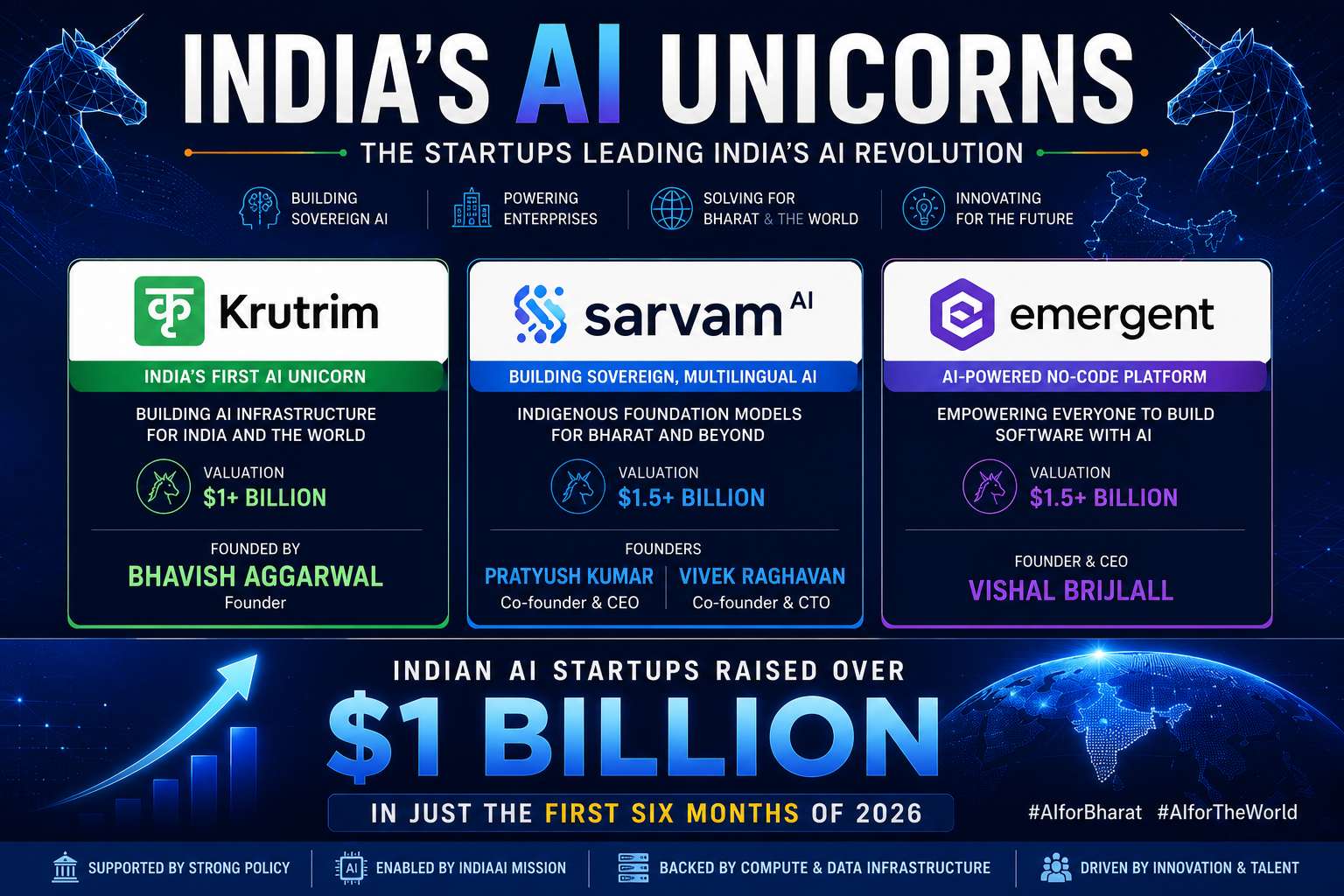
The first half of 2026 has marked a watershed moment for India’s artificial intelligence ecosystem. Indian AI startups collectively raised over $1 billion (approximately $1.067 billion) between January and June 2026—a 33% year-on-year increase and the strongest six-month funding performance ever recorded for the country’s AI sector.
While the headline figure reflects growing investor confidence, the real story lies beneath the numbers. Unlike previous technology cycles dominated by e-commerce, fintech, or SaaS, the current AI wave is being driven by companies building foundational AI models, sovereign AI infrastructure, multilingual language technologies, AI compute platforms, enterprise copilots, robotics, and autonomous agents.
This transformation did not happen overnight. It is the outcome of a deliberate combination of entrepreneurial ambition, maturing venture capital, world-class technical talent, and—most importantly—a series of government policies that have systematically laid the foundation for an indigenous AI ecosystem.
A Shift from AI Consumers to AI Creators
For years, India was recognized as one of the world’s largest consumers of digital technology but depended heavily on AI models and infrastructure developed elsewhere. Most Indian startups built applications on top of global AI platforms.
That paradigm is changing.
Today’s startups are investing in building their own foundation models, multilingual speech systems, vision-language models, AI infrastructure, and sovereign cloud platforms. Investors are increasingly rewarding companies with proprietary models, unique datasets, and defensible AI infrastructure rather than those simply integrating existing APIs.
This transition represents India’s evolution from an AI services market into an AI innovation economy.
Government Policy: The Catalyst Behind the AI Boom
Behind the surge in private capital is a coordinated public policy effort that has transformed India’s AI ecosystem over the past few years.
IndiaAI Mission: Building National AI Infrastructure
The launch of the IndiaAI Mission marked a turning point in India’s AI strategy. Rather than limiting itself to policy announcements, the mission invested in the critical building blocks required for AI innovation:
- Access to large-scale GPU compute infrastructure.
- Development of sovereign Indian foundation models.
- Creation of AIKosha, a national datasets platform.
- AI Compute Portal for startups and researchers.
- IndiaAI Application Development Initiative.
- Startup acceleration programs.
- AI skilling through FutureSkills and Mission Karmayogi.
- Public-private collaboration to develop indigenous AI technologies.
These initiatives addressed one of the biggest barriers for AI startups: access to expensive computing resources and high-quality datasets.
Democratizing Compute
Training frontier AI models requires thousands of GPUs—an investment that only a handful of companies globally can afford.
Recognizing this, the Government of India empanelled multiple infrastructure providers and enabled startups to access government-supported GPU compute through the IndiaAI Mission. Thousands of GPUs have been made available via approved cloud providers, significantly lowering the entry barrier for startups building large language models and multimodal AI systems.
This approach has enabled early-stage companies to focus on innovation instead of spending enormous amounts on infrastructure.
Encouraging Sovereign AI
Unlike many countries that rely entirely on foreign AI platforms, India has prioritized sovereign AI—developing AI models that understand Indian languages, cultures, governance systems, and societal needs.
The government’s support for indigenous foundation models has encouraged startups to build technologies optimized for India’s linguistic diversity instead of adapting Western-centric models.
This policy direction has also created opportunities for collaboration between startups, academic institutions, and government agencies.
India’s New AI Unicorns
The policy push has coincided with the rise of a new generation of AI unicorns.
Sarvam AI
Perhaps the biggest story of 2026 has been Sarvam AI, which joined the unicorn club after raising $234 million in a funding round led by HCLTech, achieving a valuation of approximately $1.5 billion.
Founded by AI researchers Pratyush Kumar and Vivek Raghavan, Sarvam AI is building multilingual large language models, speech AI, vision-language models, enterprise AI platforms, and sovereign AI infrastructure tailored to India’s linguistic and enterprise needs.
Sarvam’s journey closely aligns with national priorities. The company was selected under the IndiaAI Mission to contribute to India’s sovereign foundation model initiative and has benefited from access to government-supported compute infrastructure. Reports also indicate that the government has explored taking a minority stake in the company as part of its strategic support for indigenous AI innovation.
Emergent
Another standout is Emergent, a Bengaluru-based startup that reached unicorn status after raising $130 million in a Series C round at a valuation of around $1.5 billion.
Emergent focuses on AI-powered no-code software development, enabling users to build sophisticated web and mobile applications through natural language rather than traditional programming. Its rapid growth highlights investor confidence in AI-native software development platforms.
Krutrim
Earlier, Krutrim, founded by Bhavish Aggarwal, became India’s first AI unicorn. Since then, it has expanded into AI cloud infrastructure, foundational language models, AI assistants, and semiconductor initiatives, reinforcing India’s ambitions to develop an end-to-end sovereign AI ecosystem.
Together, these companies represent different layers of India’s emerging AI stack—from infrastructure and foundation models to enterprise software and developer platforms.
Why Investors Are Betting Big on India
Several structural factors are driving investor confidence:
- One of the world’s largest AI developer communities.
- Massive multilingual datasets and real-world deployment opportunities.
- Rapid enterprise adoption across banking, healthcare, manufacturing, education, governance, and legal services.
- Government-backed digital public infrastructure.
- Growing availability of AI compute and cloud resources.
- Increasing focus on open-source AI and sovereign models.
India is also uniquely positioned because AI solutions built for its multilingual, high-volume, low-cost environment are often applicable across other emerging markets.
Beyond Funding: Building an AI Nation
The significance of crossing the $1 billion funding milestone extends far beyond venture capital.
It signals the emergence of an ecosystem where startups, academia, industry, and government are working together to create long-term technological capability rather than short-term valuation gains.
Initiatives such as AIKosha, sovereign foundation models, GPU infrastructure, multilingual AI research, startup acceleration, and public-sector AI adoption are creating demand for homegrown innovation while lowering barriers for entrepreneurs. This integrated approach is helping build not just successful startups but an enduring national AI ecosystem.
Challenges Ahead
Despite this momentum, important challenges remain.
Indian startups must continue improving access to frontier compute, attract global capital, retain top AI research talent, strengthen semiconductor capabilities, and compete with well-funded global AI laboratories. Converting research into globally adopted products will be the defining test of the next decade.
The Road Ahead
Crossing $1 billion in AI funding within six months is more than a financial milestone—it reflects a strategic shift in India’s innovation journey.
What makes this moment unique is that it has been built on a partnership between visionary entrepreneurs, long-term investors, and forward-looking public policy. Government initiatives have provided the foundational infrastructure—compute, datasets, and enabling frameworks—while startups have transformed those resources into products, platforms, and globally competitive companies.
As AI becomes central to economic growth, governance, healthcare, education, manufacturing, and national competitiveness, India has an opportunity to become not merely one of the world’s largest AI markets, but one of its leading AI innovators.
If the current trajectory continues, 2026 may be remembered as the year India moved decisively from using artificial intelligence to building it for the world.