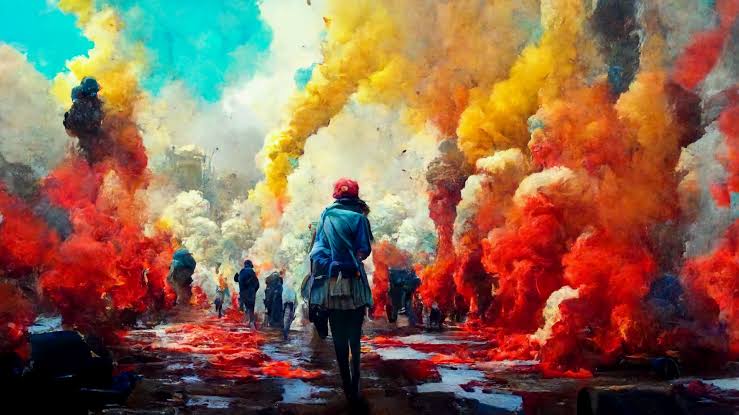
Protests were once organised through meetings, pamphlets, telephone calls and word of mouth. Social media transformed that model by making mobilisation instantaneous.
Artificial Intelligence is beginning to transform it again.
Recent protests around the world demonstrate that AI is no longer merely a technology operating in offices and data centres. It is increasingly becoming part of the information infrastructure surrounding public movements—helping create narratives, translate messages, analyse events, verify claims and, potentially, manipulate public perception.
The result is a new phenomenon: the AI-augmented protest.
From Social Media Mobilisation to AI Mobilisation
Social media made it possible for a message to reach millions within minutes. Generative AI dramatically reduces the effort required to create that message.
A single individual can now generate posters, slogans, videos, translations, social-media posts and campaign material at enormous speed.
Language barriers are also becoming less significant. AI-powered translation, speech recognition and text-to-speech technologies can make protest messages accessible across linguistic communities.
This can strengthen democratic participation, particularly in multilingual societies such as India.
But the same capability introduces a fundamental challenge:
AI democratises communication, but it also democratises manipulation.
When a Viral Image May Never Have Happened
The traditional misinformation problem was largely about misleading text or photographs presented without context.
Generative AI changes the scale of the problem.
Images can depict events that never occurred. Audio can imitate public figures. Videos can be altered or synthetically generated. Thousands of persuasive social-media messages can be produced almost instantly.
During a politically sensitive protest, even a few hours of misinformation can matter.
Imagine an AI-generated image apparently showing violence by protesters or authorities. By the time journalists or fact-checkers establish that it is synthetic, millions may already have seen it.
The correction rarely travels with the same emotional intensity as the original misinformation.
This creates what may become one of the defining governance challenges of the AI era:
How does society maintain public trust when seeing is no longer believing?
AI Can Amplify Protest — But Also Manufacture Consensus
There is another less visible dimension.
Generative AI can produce enormous quantities of online content cheaply. This makes coordinated influence operations easier to scale.
Hundreds or thousands of accounts repeating similar narratives can create an impression that an opinion is universally shared.
AI-assisted systems can generate different versions of the same argument, respond to trending hashtags and tailor messaging for different audiences.
Therefore, governments, journalists and citizens must distinguish between three different things:
a genuine public movement, organic digital amplification, and artificially engineered amplification.
These should never be treated as equivalent.
A protest involving genuine citizens exercising democratic rights cannot be dismissed simply because AI tools are present in the information ecosystem around it.
Equally, high social-media engagement should not automatically be interpreted as evidence of widespread public consensus.
The Government Can Use AI Too
The AI conversation should not focus exclusively on protesters.
Governments and public institutions can use AI for legitimate public-safety and administrative purposes.
AI systems can analyse traffic congestion around demonstrations, identify emergency routes, translate announcements into multiple languages, monitor publicly available information for rapidly developing situations and help authorities deploy medical or crowd-management resources.
Natural Language Processing can also analyse large volumes of publicly available information to identify emerging grievances.
Instead of merely asking “How do we control the protest?”, governments could use analytics to understand:
“Why are people protesting?”
That is potentially a much more valuable application of AI.
But Surveillance Creates a Dangerous Boundary
The same technology that provides situational awareness can become intrusive surveillance.
Facial recognition, behavioural profiling and large-scale monitoring can create serious questions around privacy, proportionality, freedom of expression and freedom of assembly.
Democratic governments therefore need clear boundaries.
AI should help protect citizens and public infrastructure—not create a society where participation in a lawful demonstration automatically produces a permanent digital profile.
Technology must remain subject to constitutional principles.
AI as a Fact-Checking Layer
Perhaps one of AI’s most valuable roles during protests could be real-time verification.
Imagine a public-interest AI platform analysing viral claims during a major demonstration.
A video begins circulating online.
The system could check when it first appeared, compare multiple recordings of the event, examine available metadata, search trusted news and official sources, identify signs of synthetic manipulation and present citizens with a confidence assessment.
Instead of simply showing:
TRENDING
digital platforms could eventually provide:
SOURCE VERIFIED
CONTEXT MISSING
POSSIBLY AI-GENERATED
CLAIM DISPUTED
Such systems would not eliminate misinformation, but they could introduce friction before misinformation becomes mass perception.
The Coming Battle Is Over Narrative
Historically, protests were battles over physical spaces—streets, universities, government buildings and public squares.
Today there is another battlefield:
the information layer.
Who controls the narrative?
What becomes viral?
Which video receives millions of views?
Which incident dominates public discussion?
Which facts disappear underneath emotional content?
AI increasingly influences each of these questions.
The danger is that future protests could simultaneously exist in two realities:
what actually happened on the street and what algorithms convinced millions of people happened.
The distance between those realities could become a serious threat to democratic trust.
India Needs AI-Era Protest Protocols
For India, with its enormous population, linguistic diversity and rapidly expanding digital ecosystem, this deserves particular attention.
A modern framework could encourage AI-assisted multilingual public communication, rapid deepfake detection, transparent fact-checking mechanisms, protection against coordinated synthetic misinformation and responsible use of AI by law-enforcement agencies.
Most importantly, safeguards should apply to everyone.
Technology should neither become a mechanism for suppressing legitimate dissent nor a tool for manufacturing artificial outrage.
AI Should Protect the Democratic Conversation
Protest is part of democracy.
So is disagreement.
The objective of AI should therefore not be to decide who is politically correct.
Its more valuable role is helping society establish what is factually real.
Was the video authentic?
Did the event actually happen?
Is a viral account operated by a real person?
Is online activity organic or coordinated?
Has an old photograph been presented as a current event?
These are questions technology can increasingly help answer.
The future of democratic protest will therefore not simply be about people versus institutions.
It will involve people, governments, platforms, algorithms and increasingly autonomous AI systems operating simultaneously.
And that creates a responsibility larger than any individual protest.
In the AI era, protecting democracy will require protecting not only the right to speak—but also society’s ability to distinguish authentic voices, genuine events and legitimate public sentiment from synthetic reality.