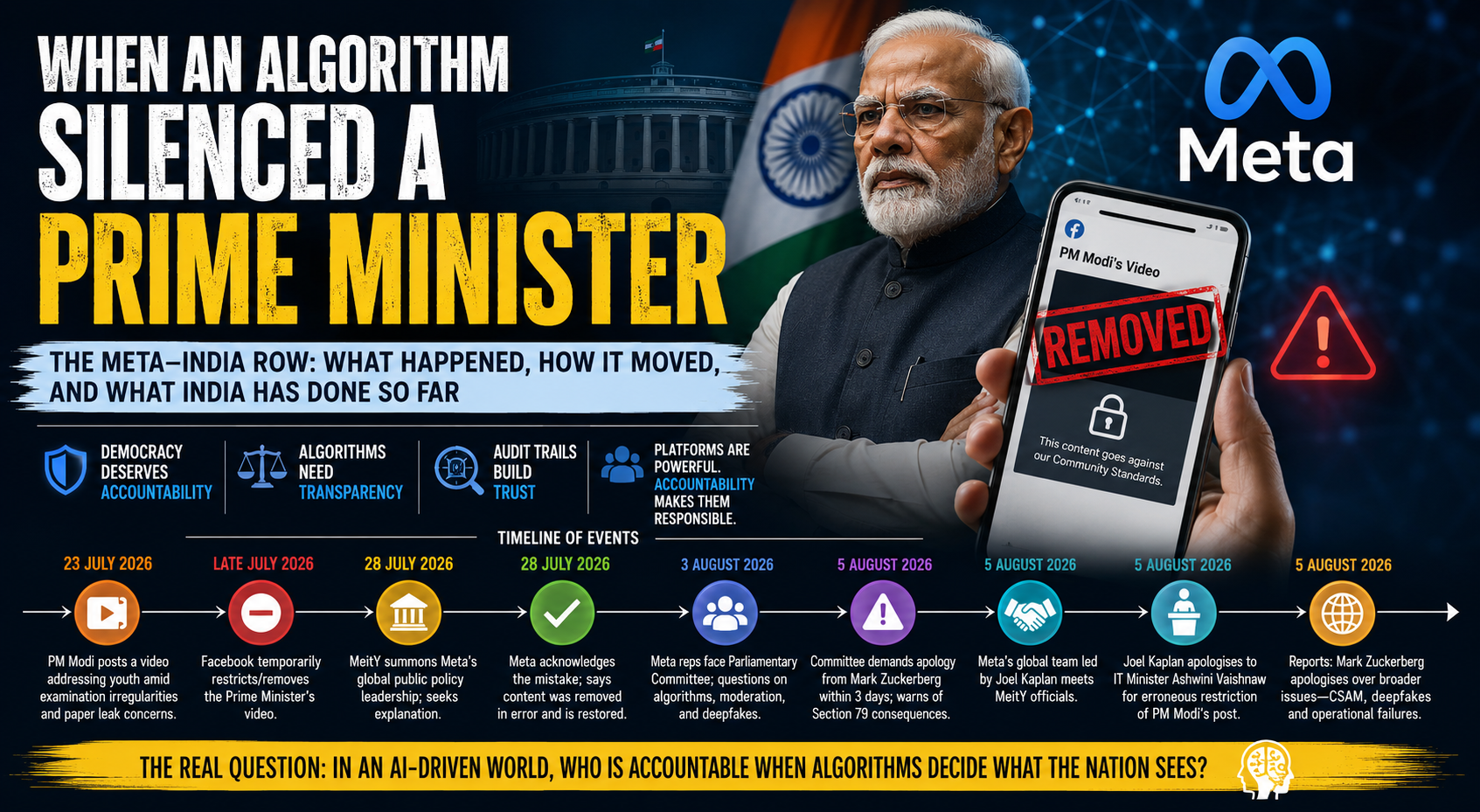
A Facebook post can disappear in seconds. But what happens when the post belongs to the Prime Minister of the world’s largest democracy?
The recent controversy between the Government of India and Meta raises a much larger question than the temporary removal of one video: How much power should a private technology platform—or its algorithms—have over public communication by elected governments?
The episode began with the temporary restriction of a video posted by Prime Minister Narendra Modi and quickly escalated into government summons, parliamentary scrutiny, demands for accountability and warnings over Meta’s intermediary protections under Indian law.
Here is how the controversy unfolded.
23 July 2026 — PM Modi Posts His Video
Prime Minister Narendra Modi posted a video message on Facebook addressing young Indians amid protests related to examination irregularities and paper leaks.
In the video, the Prime Minister acknowledged the seriousness of the issue and spoke about stronger measures against those involved in paper leaks.
The message therefore was not merely political campaign material. It was communication from the serving Prime Minister on an issue that had become a matter of significant public concern.
Shortly Afterwards — Facebook Restricts the Video
The controversy began when Facebook temporarily restricted/removed the Prime Minister’s video.
For an ordinary account, an erroneous moderation decision may become a customer-support problem.
For the official communication of a head of government, however, the implications are considerably larger.
Questions immediately emerged:
Was the removal triggered automatically?
Was the post mass-reported?
Was a human moderator involved?
Which Meta policy was invoked?
And most importantly, how could communication from the Prime Minister of India disappear without adequate safeguards?
Meta subsequently maintained that the action had been a mistake.
28 July — MeitY Steps In
The Ministry of Electronics and Information Technology did not treat the incident simply as another content-moderation error.
The government summoned Meta’s global public-policy leadership and sought an explanation regarding the circumstances in which the Prime Minister’s post had been removed.
Meta publicly acknowledged the mistake, saying:
“The content was removed in error and has since been restored.”
Reports also described Meta’s explanation as involving a technical or operational error.
The restoration solved the immediate visibility problem, but it did not answer the larger governance question: what exactly happened between publication, moderation and restoration?
3 August — Parliamentary Scrutiny Intensifies
The issue subsequently reached the Parliamentary Standing Committee on Communications and Information Technology.
Meta representatives faced questions not merely about the PM’s post, but about the broader functioning of its moderation systems.
According to reports, members questioned Meta about its algorithms, deepfake detection and the processes that resulted in the Prime Minister’s video being withheld.
Committee chairman Nishikant Dubey called for accountability from Meta’s top leadership.
At this point, the controversy had moved beyond a simple platform error.
It had become a debate about algorithmic accountability and the responsibilities of global technology companies operating at enormous scale in India.
5 August — Three-Day Ultimatum and the Safe-Harbour Question
The matter escalated further when the Parliamentary Committee demanded an apology from Meta CEO Mark Zuckerberg.
The committee chairman said Zuckerberg should apologise within three days and warned of consequences relating to Meta’s intermediary protection under Section 79 of the Information Technology Act.
The committee also reportedly sought something particularly important from a technology-governance perspective:
The audit trail.
Reports said the committee wanted the complete trail from the initial reporting/moderation of the PM’s video through its eventual restoration.
That is arguably more important than an apology.
An apology tells us that something went wrong.
An audit trail can tell us why it went wrong.
Was the decision made by an automated classifier?
Was it triggered by coordinated reporting?
Did an automated enforcement system act on those reports?
Was human review involved?
Which policy category was assigned?
How long did escalation take?
And what controls now exist to prevent the same mistake?
These are questions every major AI-driven platform increasingly needs to be capable of answering.
5 August — Meta’s Global Leadership Meets MeitY
The confrontation then moved to Meta’s senior global leadership.
A delegation led by Meta Chief Global Affairs Officer Joel Kaplan met senior MeitY officials, including Secretary S. Krishnan.
Kaplan subsequently confirmed that he had apologised to IT Minister Ashwini Vaishnaw on behalf of Meta over the erroneous restriction of the Prime Minister’s post.
Meta’s position remained that the restriction was an operational error.
The discussions also expanded beyond the Modi video to wider concerns surrounding harmful content, deepfakes and child sexual abuse material on Meta’s platforms.
Reports on 5 August said Mark Zuckerberg had separately conveyed an apology to the Indian government regarding these broader platform failures and operational issues.
This distinction is important.
Kaplan’s apology was directly connected with the PM Modi post episode, while reporting around Zuckerberg’s apology encompassed broader content-safety and operational failures.
Where Things Stand as of 6 August 2026
The immediate incident has largely been reversed:
The Prime Minister’s content has been restored.
Meta has acknowledged that the restriction was an error.
Meta’s global leadership has engaged directly with the Indian government.
An apology has been conveyed over the erroneous restriction.
The Parliamentary Committee has demanded higher-level accountability and raised the possibility of consequences involving intermediary protection.
But the larger issue remains unresolved.
India is effectively asking:
When an algorithm moderates democratic communication, who is accountable for the algorithm?
This Is Bigger Than One Facebook Post
There is a tendency to view disputes like this through a political lens—government versus Big Tech, BJP versus Meta, or Modi versus Zuckerberg.
That misses the more consequential technology-policy question.
Platforms such as Facebook, Instagram, YouTube and X increasingly function as critical infrastructure for public communication.
Governments communicate policies through them.
Citizens receive emergency information through them.
Political leaders communicate directly with millions of people through them.
News organisations distribute information through them.
And increasingly, AI systems determine what stays visible, what gets labelled, what gets demoted and what disappears altogether.
That creates enormous power.
If an algorithm can accidentally restrict the communication of the Prime Minister of a country with more than a billion citizens, the obvious question is what happens to millions of ordinary users who do not have a Ministry capable of summoning the platform.
India Should Push for Algorithmic Accountability, Not Algorithmic Privilege
The solution should not be a special moderation exemption for political leaders.
Instead, India can use incidents like this to establish stronger standards applicable to everyone.
Large platforms should maintain explainable moderation trails for consequential decisions.
For high-impact removals, platforms should be capable of providing a clear chain:
Content → Report/Detection → Policy Trigger → Algorithmic Decision → Human Review → Enforcement → Appeal → Restoration
For AI-driven moderation systems, independent auditing could eventually become as important as financial auditing is for corporations.
Platforms should also disclose whether major moderation actions were initiated by automated detection, user reporting, coordinated reporting behaviour or human intervention.
This becomes even more important as Generative AI enables synthetic videos, voice cloning and deepfakes at unprecedented scale.
The Real Lesson
The Meta–India controversy should not end with an apology.
It should become a case study in how democracies govern increasingly powerful algorithmic platforms.
India has more than a billion digital citizens and one of the world’s largest populations of social-media users. Decisions made by automated systems operating inside global platforms therefore have enormous social and democratic consequences.
The next phase of digital regulation cannot focus only on asking platforms to remove unlawful content faster.
It must also ask them to explain:
Why was something removed?
Which system made the decision?
What evidence triggered it?
Was a human involved?
Can the decision be independently audited?
Because in an AI-driven information ecosystem, transparency cannot stop at the content.
We increasingly need transparency of the algorithm deciding the fate of that content.
And perhaps that is the biggest takeaway from the Meta–India episode:
Big Tech may operate the platforms, but when those platforms become infrastructure for democratic communication, their algorithms cannot operate without accountability.
Timeline at a Glance
23 July 2026 → PM Modi publishes the video addressing young people amid the examination/paper-leak controversy.
Late July → Facebook temporarily restricts/removes the video.
28 July → MeitY summons Meta’s global public-policy leadership and seeks an explanation.
28 July → Meta acknowledges the mistake and restores the video, saying the content had been removed in error.
3 August → Meta representatives face scrutiny before the Parliamentary Standing Committee on Communications and IT; questions expand to algorithms, moderation and deepfakes.
5 August → Committee chairman Nishikant Dubey demands an apology from Mark Zuckerberg and warns about consequences involving Meta’s Section 79 intermediary protection.
5 August → Meta’s global delegation led by Joel Kaplan meets MeitY Secretary S. Krishnan and other government officials.
5 August → Kaplan says he apologised to IT Minister Ashwini Vaishnaw on Meta’s behalf for the erroneous restriction of PM Modi’s post.
5 August → Separate reports say Zuckerberg apologised to the Indian government over broader issues involving CSAM, deepfakes and operational failures.
6 August 2026 → The post remains restored and Meta has acknowledged the error, while the episode continues to raise broader questions over platform accountability, safe harbour and algorithmic transparency.