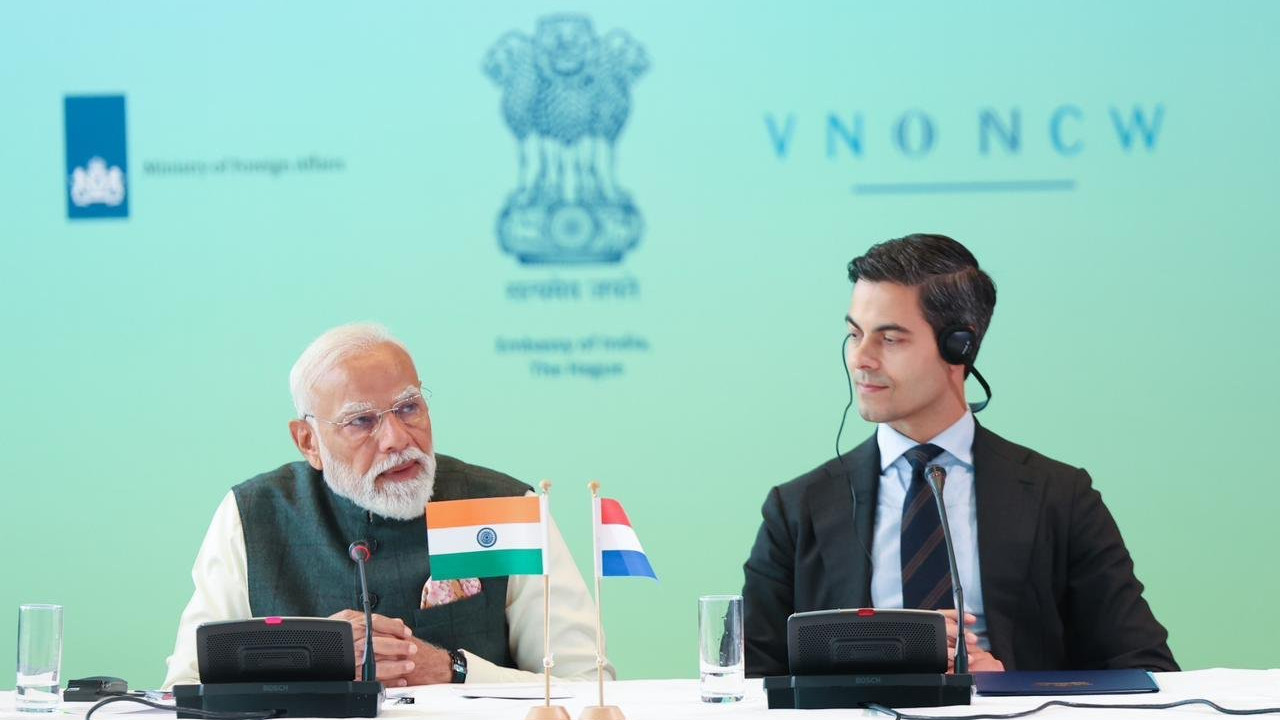
When Prime Minister Narendra Modi landed in The Hague during his recent European visit, the headlines initially focused on diplomacy, trade, and bilateral cooperation.
But behind closed doors, something far bigger was unfolding.
A deal that could quietly shape India’s technological future for decades.
At the center of that story stood one company:
ASML.
Most people outside the semiconductor industry may never have heard its name.
But inside the world of artificial intelligence, chip manufacturing, and global technology power, ASML is considered one of the most strategically important companies on Earth.
Because without ASML’s machines, the modern semiconductor industry cannot function. (The Economic Times)
And during PM Modi’s Netherlands visit, India moved one step closer toward entering that elite technological ecosystem.
The Day India’s Semiconductor Ambition Became Real
In the presence of Prime Minister Narendra Modi and Dutch Prime Minister Rob Jetten, Tata Electronics and ASML signed a landmark agreement to support India’s first front-end semiconductor fabrication plant in Dholera, Gujarat. (Reuters)
This was not just another corporate MoU.
It represented:
- India’s entry into advanced semiconductor manufacturing
- A strategic AI infrastructure milestone
- The beginning of India’s compute sovereignty journey
The planned semiconductor fabrication facility is estimated at nearly $11 billion and is expected to become India’s first major commercial front-end chip fabrication ecosystem. (Tom’s Hardware)
For years, India had strong software talent but limited semiconductor manufacturing capability.
This partnership changes that equation.
Why Semiconductors Suddenly Became India’s Biggest Strategic Priority
To understand the significance of this partnership, one must understand what semiconductors actually mean in the AI era.
Every modern AI system depends on chips.
From:
- ChatGPT
- Autonomous vehicles
- Defense systems
- Supercomputers
- Smartphones
- Data centers
- Robotics
- Healthcare AI
everything ultimately depends on semiconductor infrastructure.
And global power today increasingly depends on who controls:
- Compute infrastructure
- AI hardware
- Semiconductor supply chains
The world learned this lesson during:
- The COVID chip shortage
- U.S.–China semiconductor tensions
- AI compute wars
- Global supply chain disruptions
India realized something important:
A nation cannot become a true AI superpower while depending entirely on foreign semiconductor ecosystems.
That realization accelerated India’s semiconductor mission.
Why ASML Is So Important
ASML is not an ordinary technology company.
It is effectively the backbone of modern chip manufacturing.
The Dutch firm builds lithography systems — highly specialized machines used to manufacture semiconductor chips at microscopic scales. (Indian Embassy Netherlands)
These machines are among the most advanced engineering systems ever created.
Without ASML:
- Advanced AI chips cannot be manufactured
- High-performance processors cannot scale
- Modern semiconductor ecosystems cannot operate efficiently
This is why countries across the world closely monitor ASML’s partnerships and exports.
The company sits at the center of global semiconductor geopolitics.
For India, gaining access to ASML technology represents:
- Strategic trust
- Industrial capability transfer
- Entry into advanced semiconductor manufacturing
India’s Shift: From Software Nation to AI Infrastructure Nation
For decades, India was primarily viewed as:
- An IT services hub
- A software outsourcing destination
- A global technology talent provider
But AI is changing the global technology hierarchy.
The future belongs not only to nations that build software —
but also to nations that own:
- Chips
- Compute infrastructure
- Data centers
- Semiconductor supply chains
This is where PM Modi’s Netherlands visit becomes historically important.
India is now attempting to transition from:
Software Power
→
AI Infrastructure Power
The Tata-ASML partnership signals that India no longer wants to remain only a software consumer or talent supplier.
It wants to participate in the physical foundation of the AI economy itself.
The Dholera Semiconductor Fab: India’s Big Bet
The Dholera fabrication plant in Gujarat is expected to manufacture chips across multiple nodes including:
- 28nm
- 40nm
- 55nm
- 90nm
- 110nm technologies (Tom’s Hardware)
These chips will support:
- Automotive systems
- Mobile devices
- Industrial electronics
- Communications infrastructure
- AI applications
The facility is designed to eventually produce around 50,000 wafers per month. (Tom’s Hardware)
This matters because semiconductor fabrication is not only about manufacturing.
It creates:
- High-value engineering jobs
- R&D ecosystems
- Supplier networks
- Advanced industrial capability
- National technological resilience
The AI Connection Nobody Should Ignore
Most discussions around AI focus on:
- Chatbots
- Large language models
- AI apps
- Software innovation
But AI fundamentally depends on compute power.
And compute power depends on semiconductor infrastructure.
Countries that dominate AI infrastructure will likely dominate:
- Future economies
- Defense systems
- Digital ecosystems
- Technological influence
India’s semiconductor push is therefore directly connected to:
- IndiaAI Mission
- Digital India
- AI sovereignty
- National security
- Strategic technology independence
PM Modi’s Netherlands visit demonstrated that India now understands this connection at a national strategic level.
Why the Netherlands Matters to India
The India–Netherlands relationship is evolving far beyond traditional trade.
The Netherlands has become strategically important because it holds expertise in:
- Semiconductor manufacturing
- High-precision engineering
- Advanced technology systems
- Supply-chain innovation
During the visit, both countries elevated ties toward a stronger strategic partnership framework. (The Times of India)
Discussions expanded beyond semiconductors into:
- Artificial intelligence
- Resilient supply chains
- Green energy
- Advanced digital infrastructure (The Economic Times)
This signals India’s growing role in the global high-technology ecosystem.
The Global Context: The World Is Rebuilding Tech Alliances
The timing of this partnership is critical.
The world is currently facing:
- U.S.–China semiconductor conflicts
- AI infrastructure competition
- Supply-chain fragmentation
- Technology nationalism
Countries now want trusted technology partners.
India is positioning itself as:
- A democratic digital economy
- A trusted manufacturing destination
- A long-term semiconductor ecosystem partner
For Europe, India offers:
- Scale
- Talent
- Manufacturing growth
- Strategic diversification
For India, Europe offers:
- Advanced industrial technology
- Semiconductor expertise
- AI infrastructure partnerships
This makes the India–Netherlands partnership strategically valuable for both sides.
What India Gains From This Partnership
If executed successfully, this collaboration could deliver long-term benefits for India.
Strategic Benefits
- Reduced semiconductor dependence
- AI compute sovereignty
- Stronger national digital infrastructure
- Greater geopolitical resilience
Economic Benefits
- Massive investment inflows
- High-value manufacturing jobs
- Deep-tech startup growth
- Global semiconductor participation
Technological Benefits
- Semiconductor ecosystem development
- Talent development
- R&D acceleration
- AI infrastructure capability
A Defining Moment for India’s Tech Future
For years, India participated in the global digital economy largely through software and services.
The Netherlands visit signaled something different.
India now wants to build the infrastructure powering the next generation of artificial intelligence.
The Tata-ASML partnership is not merely about one factory in Gujarat.
It represents:
- India’s semiconductor ambition
- India’s AI infrastructure strategy
- India’s long-term technological sovereignty vision
The global AI race is no longer only about algorithms.
It is about who owns the chips, compute power, and infrastructure behind intelligence itself.
And with its semiconductor push through partnerships like the India–Netherlands alliance, India has officially entered that race.