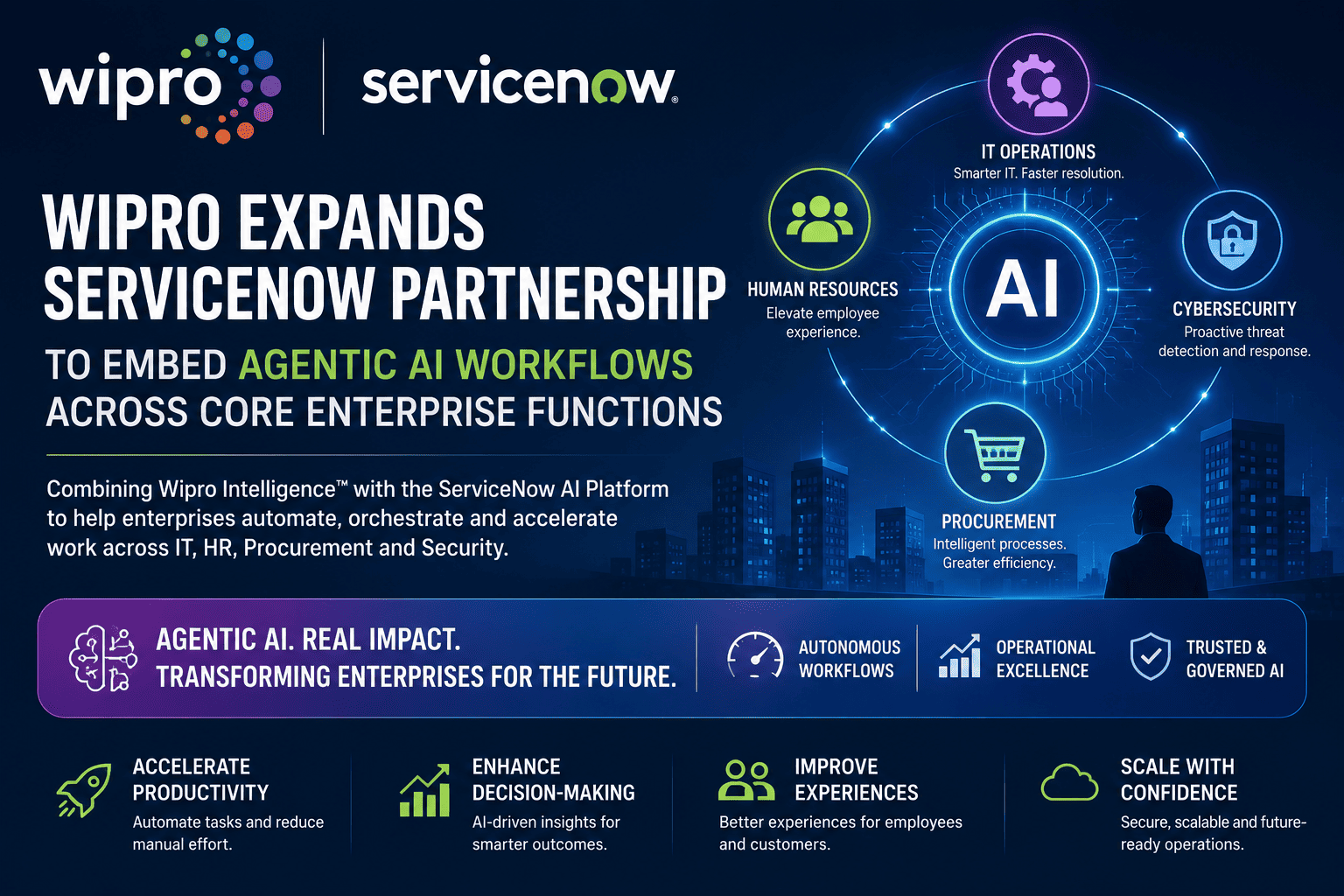
Expanded partnership signals a major shift in how global enterprises will automate IT, HR, procurement, and cybersecurity using autonomous AI systems.
The race to bring artificial intelligence into the core of enterprise operations is accelerating, and Indian technology giant Wipro is positioning itself at the center of that transformation.
In a move that reflects the rapidly evolving direction of enterprise AI, Wipro has announced an expanded partnership with ServiceNow aimed at embedding agentic AI workflows across critical business functions, including IT operations, human resources, procurement, and cybersecurity. The collaboration is designed to integrate Wipro Intelligence™, the company’s unified AI platform, with the ServiceNow AI Platform, enabling organizations to automate and orchestrate complex workflows at scale. (Wipro)
The announcement arrives at a time when enterprises worldwide are moving beyond generative AI experimentation and beginning to deploy AI systems capable of reasoning, coordinating tasks, making decisions, and executing work autonomously.
For years, enterprise automation focused primarily on predefined workflows and rule-based systems. The next phase, increasingly referred to as the age of agentic AI, introduces systems that can understand objectives, interact with software tools, coordinate actions across departments, and complete multi-step tasks with limited human intervention. (Winklix)
Industry analysts believe this shift could become one of the most significant transformations in enterprise technology since the adoption of cloud computing.
From Automation to Autonomous Workflows
Traditional enterprise systems were designed to digitize processes.
Agentic AI aims to execute them.
Instead of employees manually navigating multiple software platforms, generating reports, routing approvals, updating systems, and coordinating actions across departments, AI agents can increasingly perform many of those functions automatically.
The Wipro-ServiceNow partnership reflects this transition.
Under the expanded agreement, organizations will be able to deploy AI-powered workflows that streamline the initiation, orchestration, and execution of work across enterprise environments. The goal is not merely faster automation but a more intelligent operational layer capable of improving governance, accountability, efficiency, and response times across large organizations. (Wipro)
According to Wipro, the integration combines its Wipro Intelligence™ ecosystem with ServiceNow’s enterprise workflow capabilities, creating a framework where AI agents can operate across interconnected business functions rather than remaining isolated within individual applications. (Wipro)
Why Enterprises Are Moving Toward Agentic AI
The rise of generative AI over the past three years transformed how organizations access information.
The next challenge is operational execution.
Enterprises today face increasing pressure to:
- reduce operational costs,
- improve employee productivity,
- accelerate service delivery,
- strengthen cybersecurity,
- and manage growing complexity across digital systems.
Many organizations already operate hundreds of software platforms simultaneously.
As a result, employees often spend significant time switching between systems, gathering information, updating records, managing tickets, processing approvals, and coordinating workflows.
Agentic AI seeks to eliminate much of this friction.
Instead of simply providing recommendations, AI agents can perform tasks directly inside enterprise environments.
For example:
- resolving IT service requests,
- initiating procurement processes,
- handling employee onboarding,
- coordinating cybersecurity responses,
- updating business systems,
- and generating operational reports.
Industry experts increasingly describe this evolution as the transition from AI assistance to AI execution. (Winklix)
Wipro’s Expanding AI Strategy
The ServiceNow partnership forms part of a broader AI transformation strategy underway at Wipro.
Over the past year, the company has aggressively expanded investments across AI infrastructure, enterprise platforms, consulting services, and agentic AI solutions.
The company has launched multiple AI-focused initiatives, including collaborations with Google Cloud, enterprise AI transformation programs, AI-powered operating models, and industry-specific AI deployments. (The Economic Times)
Earlier partnerships focused on deploying hundreds of AI agents across sectors such as healthcare, banking, insurance, retail, manufacturing, and IT services. (The Economic Times)
The expanded ServiceNow alliance strengthens Wipro’s effort to position itself not only as a technology services provider but also as a key implementation partner for enterprise-scale AI adoption.
This is particularly important as traditional IT outsourcing models face increasing disruption from automation and AI-driven service delivery.
ServiceNow’s Vision for the Agentic Enterprise
For ServiceNow, the partnership aligns with its broader ambition to become the workflow operating system for the AI era.
The company has spent the past year introducing a range of AI-powered capabilities aimed at embedding intelligent agents directly into enterprise processes.
According to ServiceNow’s Enterprise AI Maturity Index, only a small percentage of organizations have successfully integrated AI workflows across multiple business functions despite growing investments in AI technologies. (ServiceNow)
This gap represents a significant opportunity.
Many enterprises have experimented with AI pilots, but relatively few have achieved organization-wide deployment.
Partnerships with large consulting and technology firms such as Wipro provide the implementation expertise needed to bridge that gap.
Industry observers increasingly view ServiceNow as one of the key platforms enabling agentic enterprise architectures, particularly in workflow-intensive environments. (Futurum)
Investor Confidence Reflects Growing AI Optimism
Financial markets responded positively to the announcement.
Wipro shares climbed as much as 4.5% following news of the partnership expansion, while the company’s American Depositary Receipts (ADRs) surged nearly 19% in U.S. trading. (Reuters)
The broader Indian IT sector also gained momentum, with investors viewing the partnership as evidence that major technology services firms are successfully adapting to the AI era. (Reuters)
For investors, the significance extends beyond a single partnership.
The market increasingly wants evidence that traditional IT services firms can evolve beyond labor-driven outsourcing models and participate meaningfully in the AI transformation underway across global enterprises.
The strong market reaction suggests growing confidence that Wipro’s AI strategy may help strengthen its competitive position in an increasingly AI-centric technology landscape.
The Challenges Behind Enterprise AI
Despite the enthusiasm surrounding agentic AI, significant challenges remain.
Deploying autonomous AI systems inside enterprise environments is considerably more complex than deploying consumer chatbots.
Organizations must address concerns around:
- governance,
- compliance,
- data privacy,
- cybersecurity,
- auditability,
- accountability,
- and operational risk.
Research institutions and enterprise AI experts have repeatedly warned that AI agents operating across interconnected business systems introduce new categories of risk involving hidden workflows, cascading effects, tool access, and decision transparency. (arXiv)
As AI systems gain greater autonomy, ensuring secure and controllable deployment becomes increasingly important.
This explains why enterprise AI platforms are focusing heavily on governance frameworks alongside automation capabilities.
The Beginning of the Agentic Enterprise Era
The broader significance of the Wipro-ServiceNow partnership lies in what it represents for the future of work.
The first wave of AI focused on generating content.
The second wave focused on assisting employees.
The third wave is increasingly focused on executing work.
Across industries, organizations are beginning to deploy systems capable of:
- coordinating operations,
- managing workflows,
- interacting with software,
- processing requests,
- and completing tasks autonomously.
This evolution is gradually transforming enterprise software itself.
Applications are no longer becoming merely smarter.
They are becoming increasingly capable of acting.
For technology providers, consulting firms, and enterprises alike, the race is no longer simply about adopting AI.
It is about operationalizing it.
As Wipro and ServiceNow deepen their partnership around agentic AI workflows, they are helping shape what many believe will become the next major phase of enterprise transformation—one where intelligent agents operate alongside employees, automate complex processes, and become embedded within the core systems that run modern organizations.
The era of the autonomous enterprise may still be in its early stages.
But partnerships like this suggest that its foundations are already being built.