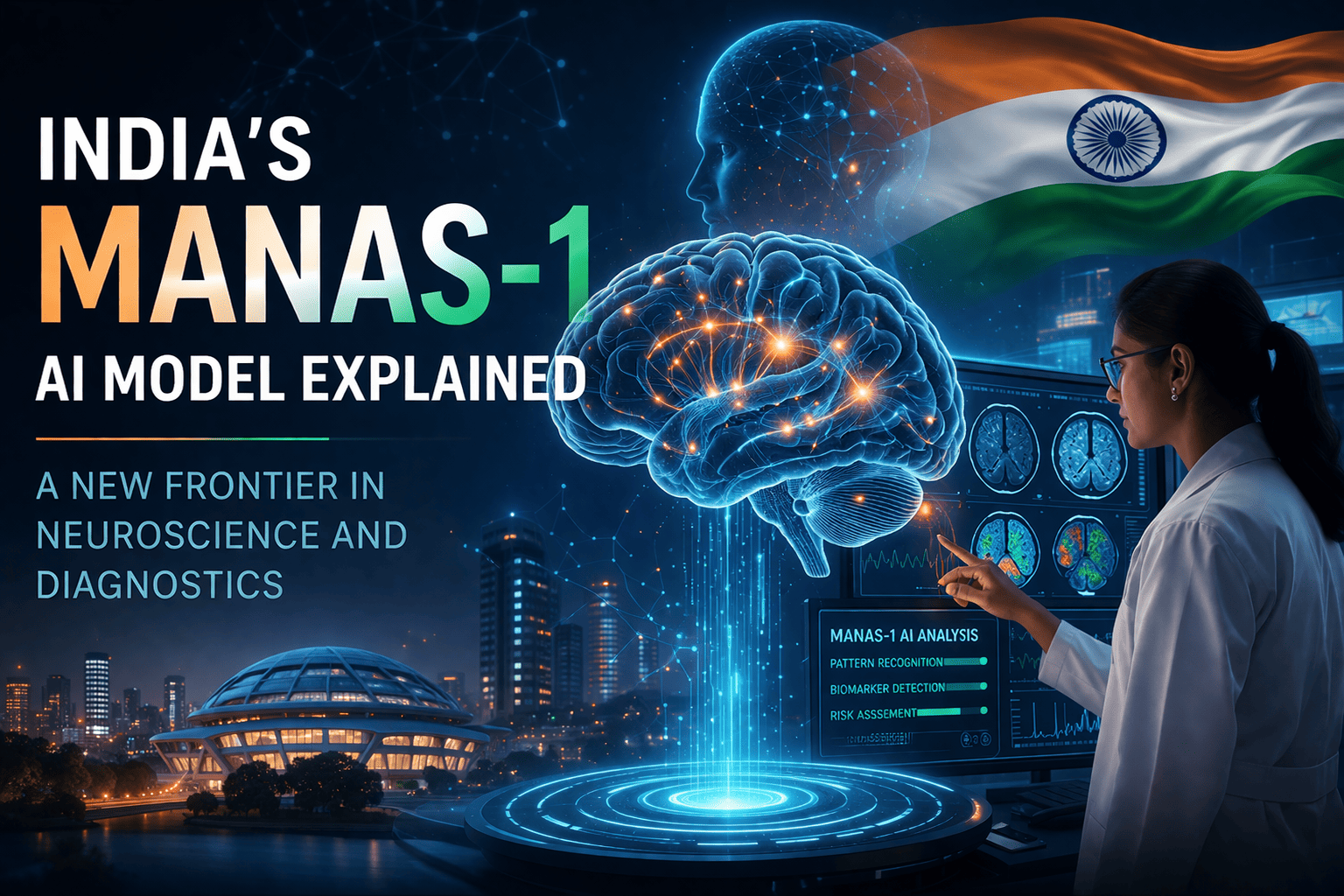
In a world where artificial intelligence is busy writing poetry, generating memes, and occasionally hallucinating facts, India has quietly pushed the frontier into something far more consequential: decoding the human brain. Enter MANAS-1—an AI model that doesn’t just process language or images but ventures into the intricate, messy, electrifying universe of neuroscience and medical diagnostics.
What is MANAS-1, really?
MANAS-1 isn’t your average chatbot cousin. It’s a specialized AI system designed to analyze neurological data—think brain scans, cognitive patterns, and biomarkers—with the goal of identifying diseases earlier and more accurately than traditional methods.
While most AI models are trained on text scraped from the internet (and the occasional conspiracy thread), MANAS-1 is built on clinical-grade datasets—MRI scans, EEG signals, and neurological assessments. Its purpose is clear: move from guesswork to precision in diagnosing brain-related conditions.
Why does this matter?
Because the brain is notoriously difficult to understand.
Neurological disorders like Alzheimer’s, Parkinson’s, epilepsy, and even mental health conditions often go undetected until symptoms become severe. By then, treatment options narrow, costs rise, and outcomes worsen.
MANAS-1 flips this script.
- Early Detection: It can identify subtle patterns invisible to the human eye.
- Faster Diagnosis: Reduces reliance on lengthy, multi-stage testing.
- Scalable Healthcare: Potentially brings advanced diagnostics to under-resourced regions.
In a country like India—where neurologists are scarce relative to the population—this is not just innovation; it’s necessity.
The tech under the hood
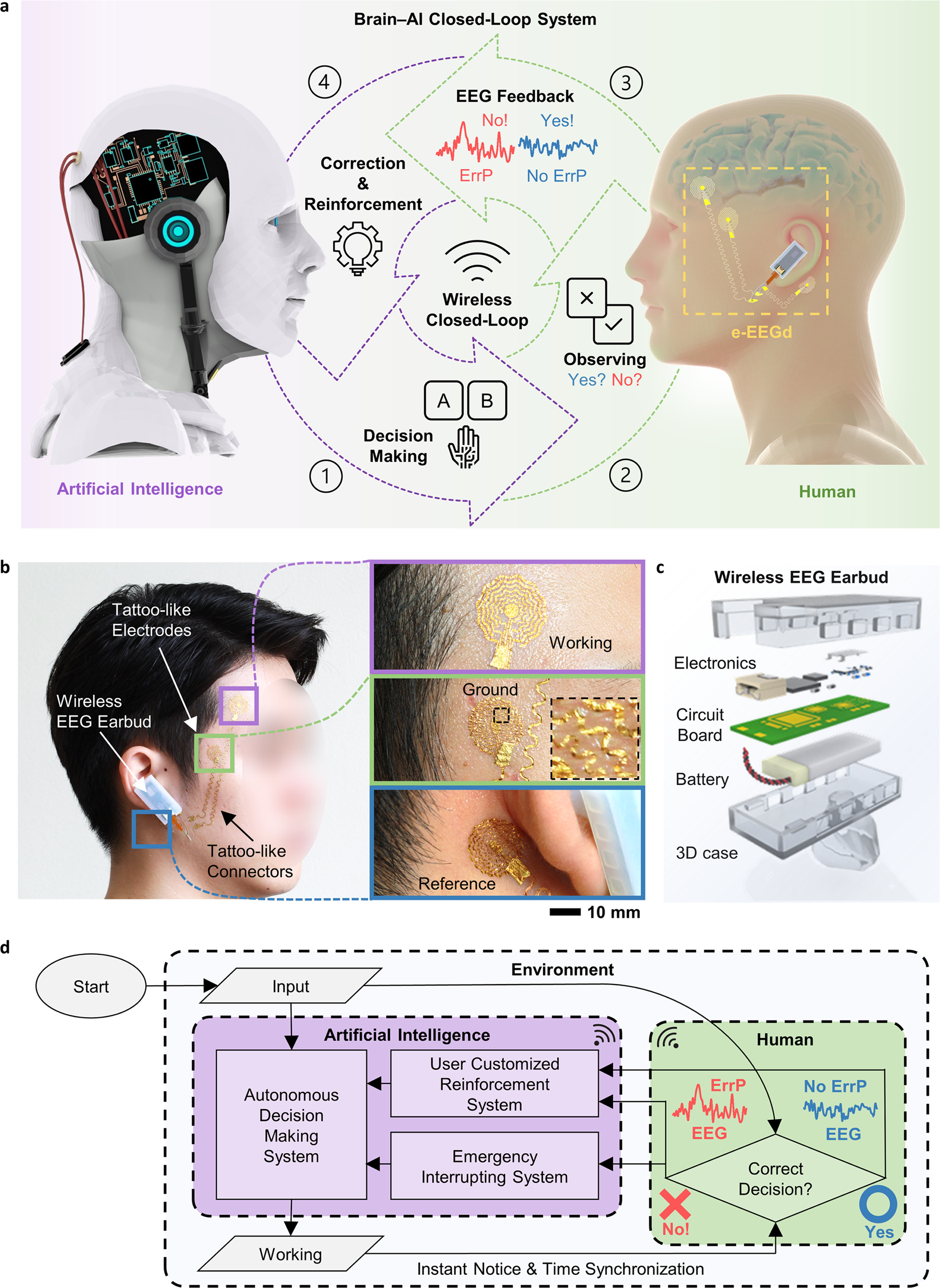
At its core, MANAS-1 combines:
- Deep Learning architectures trained on multimodal data
- Signal processing algorithms for EEG interpretation
- Computer vision models for MRI/CT scan analysis
The real magic lies in multimodal fusion—the ability to correlate different types of medical data into a single, coherent diagnostic insight. Instead of looking at one test in isolation, MANAS-1 connects the dots across multiple inputs.
Think of it as upgrading from a magnifying glass to a full forensic lab.
India’s strategic play
Let’s be honest—AI has largely been dominated by Western tech giants. But MANAS-1 signals something different: a domain-specific, healthcare-first AI approach emerging from India.
This aligns with broader national efforts in digital public infrastructure and AI-driven governance. Instead of chasing general-purpose AI glory, India seems to be asking a more practical question:
“What if AI actually solved real problems?”
And healthcare, especially neurological care, is about as real as it gets.
Challenges (because reality exists)
Before we crown MANAS-1 as the savior of neuroscience, a few caveats:
- Data Privacy: Medical data is sensitive; safeguards must be airtight.
- Clinical Validation: AI models need rigorous testing before real-world deployment.
- Adoption Barriers: Doctors need to trust—and understand—the system.
In short, building the model is step one. Integrating it into hospitals without chaos is step ten.
The bigger picture
MANAS-1 is not just a model; it’s a signal.
A signal that AI’s next phase may move away from chatbots arguing on the internet toward systems that quietly, accurately, and meaningfully improve human lives.
And if MANAS-1 succeeds, the future of AI might not be about generating better tweets—it might be about saving brains, one scan at a time.
If you want, I can also:
- Make a LinkedIn version of this (more formal, less sarcasm)
- Turn this into a news article / press release
- Or add India policy + Bhashini + AI ecosystem angle for deeper positioning