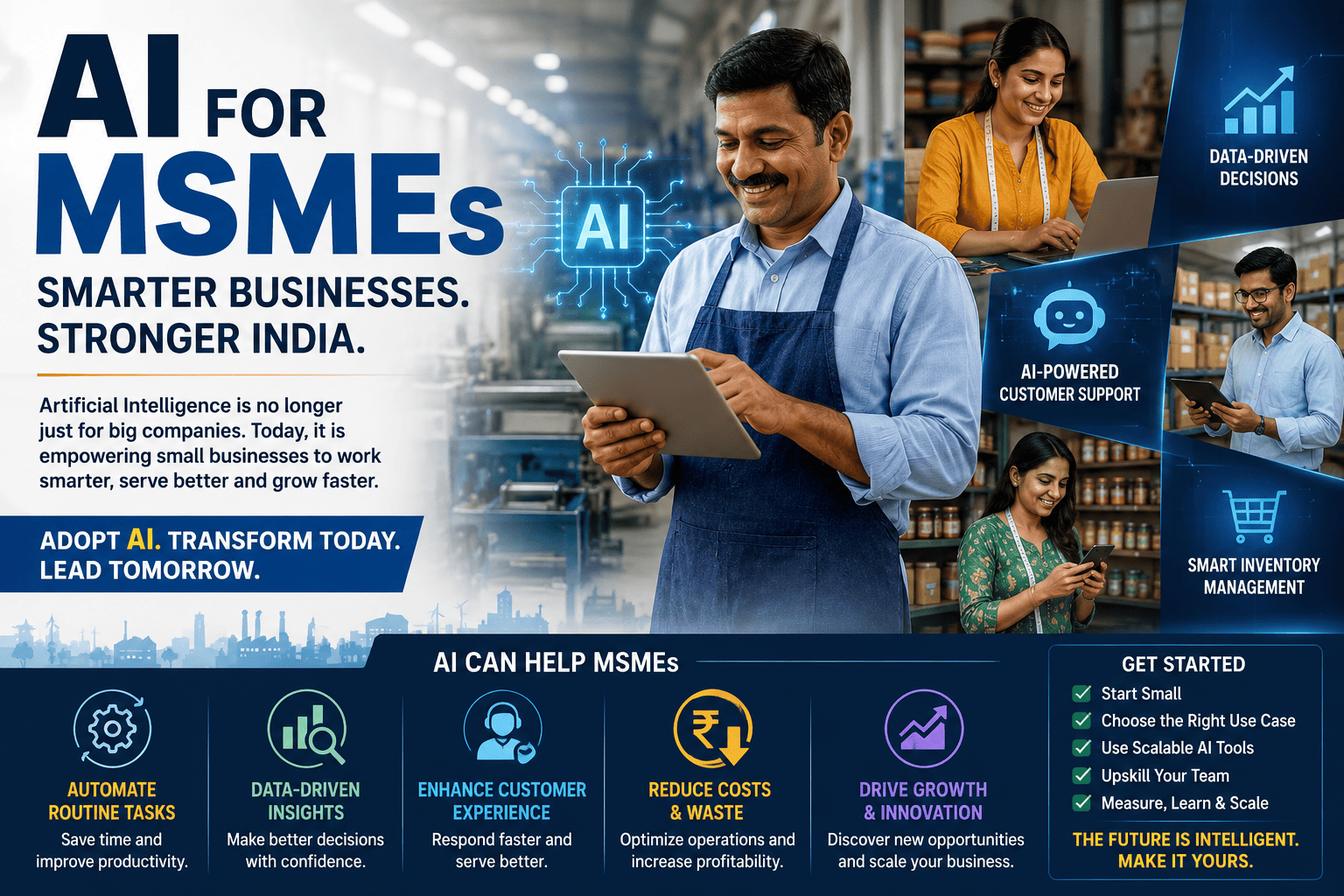
As artificial intelligence moves from boardrooms into factories, shops, warehouses, and service businesses, India’s MSMEs are discovering that AI is no longer a technology of the future—it is rapidly becoming a necessity for survival and growth.
For decades, India’s Micro, Small, and Medium Enterprises (MSMEs) have been described as the backbone of the economy. From manufacturing clusters in Punjab and Gujarat to textile units in Tamil Nadu, engineering workshops in Maharashtra, and service providers spread across every city and town, MSMEs have powered employment, innovation, and exports across the country.
Yet today, these businesses stand at the threshold of another major transformation.
The rise of Artificial Intelligence is fundamentally changing how companies operate, make decisions, engage customers, manage supply chains, and compete in increasingly digital markets. While large enterprises have spent billions of dollars implementing AI solutions, a growing number of experts believe the technology could have an even greater impact on MSMEs.
The reason is simple. Small businesses often operate with limited manpower, constrained budgets, and highly manual processes. AI has the potential to automate routine work, reduce operational inefficiencies, improve decision-making, and unlock productivity gains that were previously achievable only by much larger organizations.
The challenge, however, lies in adoption.
Many MSME owners still associate AI with expensive infrastructure, complex algorithms, and teams of data scientists. In reality, the AI landscape has changed dramatically over the last few years. Cloud computing, open-source models, low-code platforms, and AI-as-a-service offerings have made advanced AI capabilities accessible even to businesses with limited technology resources.
According to industry analysts, the biggest barrier to AI adoption among MSMEs today is not technology—it is awareness.
Many business owners remain uncertain about where AI can create value within their operations. Some view AI as a futuristic innovation rather than a practical business tool, while others fear that implementation costs may outweigh potential benefits. Yet organizations that have successfully deployed AI are already reporting improvements in productivity, customer engagement, inventory management, sales forecasting, and operational efficiency.
The most successful AI journeys typically begin not with technology, but with a business problem.
A manufacturing company struggling with equipment downtime may benefit from predictive maintenance systems that identify machine failures before they occur. A retailer receiving hundreds of customer inquiries every day may deploy AI-powered chatbots capable of responding instantly to common questions. Service businesses drowning in paperwork can use AI to summarize documents, generate reports, and automate administrative tasks.
Experts emphasize that MSMEs should resist the temptation to pursue large-scale AI transformations from the outset. Instead, businesses should focus on solving one clearly defined problem, measure results, and then expand adoption gradually.
Before implementing AI, however, organizations must evaluate their digital readiness.
Many MSMEs continue to rely on paper records, spreadsheets, WhatsApp communications, and fragmented systems for day-to-day operations. AI thrives on data, and without structured digital information, even the most advanced AI systems struggle to deliver meaningful outcomes.
For this reason, digital transformation often becomes the first step toward AI transformation.
Businesses that invest in enterprise resource planning (ERP) systems, customer relationship management (CRM) platforms, digital accounting software, and cloud-based workflows create the foundation upon which AI can operate effectively. Clean, accessible, and organized data significantly improves the performance of AI applications while reducing deployment complexity.
Once digital systems are in place, MSMEs can begin exploring various deployment options.
Cloud-based AI services have emerged as the preferred entry point for many organizations. Companies can access advanced AI capabilities from providers such as OpenAI, Microsoft Azure, Google Cloud, and Amazon Web Services without purchasing expensive hardware. These services offer subscription-based pricing models, making AI adoption financially feasible for smaller enterprises.
At the same time, the rise of open-source AI models has created new opportunities for businesses seeking greater control over their data and operations. Organizations can now deploy models such as Llama, Mistral, Gemma, and Qwen on their own infrastructure, allowing for customized solutions tailored to specific business requirements. While this approach offers flexibility and data sovereignty, it also demands greater technical expertise and infrastructure management.
A growing number of MSMEs are also adopting hybrid approaches, combining cloud-based services with local deployments. Sensitive business information remains within the organization while less critical workloads leverage cloud infrastructure. This model is becoming increasingly popular in sectors where privacy, compliance, and data security are critical considerations.
Despite these opportunities, significant challenges remain.
One of the most frequently cited obstacles is the shortage of AI talent. Most MSMEs do not employ machine learning engineers, data scientists, or AI specialists. As a result, business owners often struggle to evaluate technology vendors, select appropriate solutions, and manage deployments effectively.
The quality of business data presents another challenge. AI systems depend on accurate and consistent information. Organizations with fragmented databases, incomplete records, or poor data governance frequently encounter disappointing results during implementation.
Budget constraints continue to influence adoption decisions as well. Although AI technologies have become significantly more affordable, many small businesses remain cautious about investing in systems without clear and measurable returns. Experts recommend beginning with projects that offer immediate operational benefits, allowing organizations to build confidence and justify future investments.
Workforce concerns also play a critical role.
Employees often view AI as a threat to job security, leading to resistance during implementation. Industry leaders argue that successful AI adoption requires a focus on augmentation rather than replacement. The goal should be to eliminate repetitive tasks and enable employees to focus on higher-value activities rather than reducing workforce numbers.
Training and upskilling therefore become essential components of any AI strategy.
Forward-looking organizations are already investing in AI literacy programs, helping employees understand how to collaborate with intelligent systems, interpret AI-generated insights, and integrate automation into daily workflows. In the coming years, the ability to work effectively alongside AI may become as important as basic digital literacy is today.
Cybersecurity and privacy concerns add another layer of complexity. As AI systems gain access to customer information, financial records, and operational data, organizations must ensure that appropriate safeguards are in place. Compliance with data protection regulations, secure infrastructure practices, and robust governance frameworks will become increasingly important as AI adoption accelerates.
Fortunately, India’s broader AI ecosystem is beginning to provide support.
Government initiatives under Digital India, the IndiaAI Mission, Startup India, and various Ministry of MSME programs are creating pathways for businesses to access AI infrastructure, training, and innovation resources. Technology incubators, industry associations, and academic institutions are also launching programs designed to help smaller enterprises understand and adopt AI effectively.
These developments arrive at a crucial moment.
The competitive landscape is changing rapidly. Businesses that embrace AI are discovering new ways to increase efficiency, improve customer experiences, and scale operations without proportionally increasing costs. Those that delay adoption risk finding themselves at a disadvantage as competitors leverage intelligent systems to move faster and operate more effectively.
Perhaps the most significant aspect of the AI revolution is that it is reducing the traditional advantages enjoyed by large corporations. Historically, only enterprises with extensive resources could afford advanced analytics, automation systems, and sophisticated business intelligence tools. Today, many of those same capabilities are available to small businesses through affordable AI platforms and cloud-based services.
For India’s MSMEs, this represents more than a technology upgrade.
It is an opportunity to level the playing field.
A small manufacturer can now access predictive analytics. A local retailer can deploy intelligent customer support systems. A startup can build AI-powered products with global reach. A service provider can automate knowledge management and content creation using tools that were unimaginable just a few years ago.
As artificial intelligence becomes increasingly embedded in business operations worldwide, MSMEs face a defining choice. They can view AI as a distant technology reserved for large corporations, or they can embrace it as a strategic enabler of growth, efficiency, and innovation.
The businesses that choose the latter may well become the next generation of industry leaders.
In the end, the AI revolution is not about replacing human ingenuity. It is about amplifying it. For India’s MSME sector, that amplification could become one of the most significant drivers of economic growth and competitiveness in the decade ahead.