Billion-image vision model delivers breakthrough advances in pose estimation, body understanding, and digital human technology
While much of the artificial intelligence industry remains focused on large language models, autonomous agents, and AI-generated video, Meta has quietly released what many researchers believe could become one of the most important computer vision breakthroughs of the year.
The company’s newly unveiled Sapiens 2 family of models represents a significant leap forward in human-centric AI, introducing a foundation model trained on an unprecedented one billion human images. Designed specifically to understand people, movement, appearance, and physical interactions, Sapiens 2 is already setting new performance benchmarks across a wide range of computer vision tasks.
The release consists of five model variants ranging from 100 million to 5 billion parameters and supports native high-resolution processing at both 1K and 4K resolutions. More importantly, the models are capable of handling multiple human-understanding tasks from a single foundation architecture, eliminating the need for separate systems traditionally required for pose estimation, segmentation, geometry reconstruction, and appearance modeling.
Industry experts see this as a pivotal moment for computer vision.
For years, developers building applications involving human movement and body understanding have relied on fragmented pipelines, often combining multiple models trained for different purposes. One system would identify body joints, another would estimate depth, while yet another would perform segmentation or surface reconstruction. Sapiens 2 brings these capabilities together under a unified framework, much like large language models unified various language tasks into a single architecture.
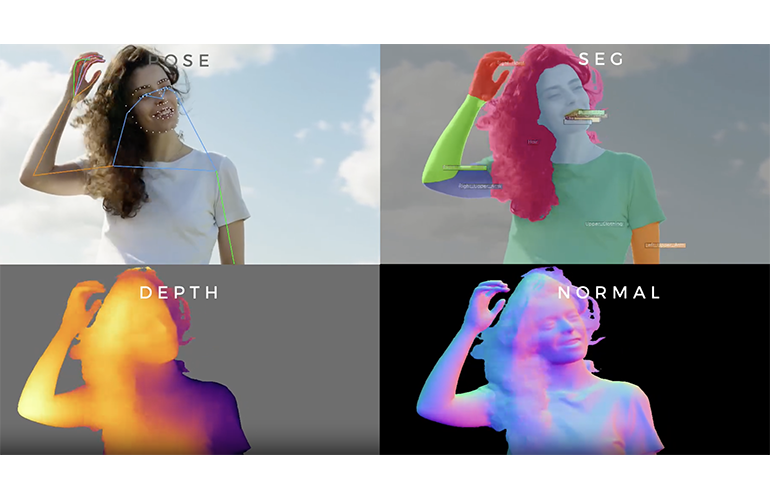
Among the model’s most notable capabilities is its advanced pose estimation system. Sapiens 2 can identify up to 308 whole-body keypoints, providing detailed understanding of body posture, facial landmarks, hand movements, finger positions, and skeletal structure. Such precision has significant implications for industries ranging from healthcare and fitness to animation and robotics.
The model also introduces highly accurate body-part segmentation across 29 classes, enabling AI systems to distinguish between different body regions with remarkable precision. This capability is particularly valuable for emerging technologies such as virtual try-on systems, digital fashion platforms, augmented reality experiences, and next-generation avatar creation tools.
Meta’s benchmark results suggest that Sapiens 2 represents more than just an incremental improvement. In pose estimation, the model achieves an impressive 82.3 mAP, surpassing the previous generation’s 78.3 score. In body-part segmentation, performance jumps dramatically from 58.2 mIoU to 82.5 mIoU, one of the largest improvements reported in recent years for the task.
The model also establishes new standards in surface normal estimation, a critical capability that allows AI systems to understand the geometry and orientation of human bodies in three-dimensional space. By reducing geometric reconstruction error from 10.73 degrees to 6.73 degrees, Sapiens 2 significantly improves the accuracy of digital human reconstruction and spatial understanding.
Another standout feature is the inclusion of pointmap generation, enabling the model to estimate XYZ coordinates and depth information directly from images. This functionality provides AI systems with a richer understanding of how people occupy physical space, an increasingly important capability for mixed reality environments, robotics, and spatial computing platforms.
Perhaps the most intriguing capability introduced by Sapiens 2 is its ability to perform albedo recovery. In simple terms, the model can estimate the true appearance of skin and surfaces independent of lighting conditions by separating shadows, reflections, and environmental lighting from the underlying material properties. This breakthrough has substantial implications for virtual humans, gaming, visual effects, digital content creation, and medical imaging applications.
However, what may ultimately make Sapiens 2 most impactful is not its largest model, but its smallest.
Meta reports that even the relatively lightweight 0.4-billion-parameter variant outperforms the previous generation’s largest systems, while remaining capable of real-time execution on consumer-grade GPUs. This dramatically lowers the cost of deployment and opens the door for widespread commercial adoption.
The implications for industry are substantial.
In the augmented and virtual reality sector, Sapiens 2 could enable more realistic avatars and natural digital interactions. Fitness and physiotherapy platforms may gain the ability to perform real-time posture analysis and movement correction without expensive hardware. Animation studios could automate complex motion-capture workflows, while game developers may generate realistic character movements using standard camera systems rather than specialized capture equipment.
Retail and fashion companies also stand to benefit. Accurate body understanding and segmentation could dramatically improve virtual try-on experiences, allowing consumers to visualize clothing with far greater realism and precision than existing systems.
The timing of the release is particularly significant. As technology companies increasingly invest in smart glasses, spatial computing platforms, humanoid robotics, and AI-powered digital assistants, understanding human behavior and movement is becoming as important as understanding language.
For years, large language models have dominated the AI conversation. Yet many experts argue that the next phase of artificial intelligence will require systems that not only understand words but also comprehend the physical world and the people inhabiting it.
With Sapiens 2, Meta appears to be positioning itself at the center of that future.
While the release may not have generated the headlines associated with chatbot launches or video-generation breakthroughs, its long-term impact could prove far greater. By creating a scalable, high-performance foundation model dedicated to human understanding, Meta has laid the groundwork for a new generation of applications that blur the boundaries between the digital and physical worlds.
In an industry increasingly focused on creating AI systems that can see, understand, and interact with humans naturally, Sapiens 2 may well be remembered as one of the defining vision models of this decade.