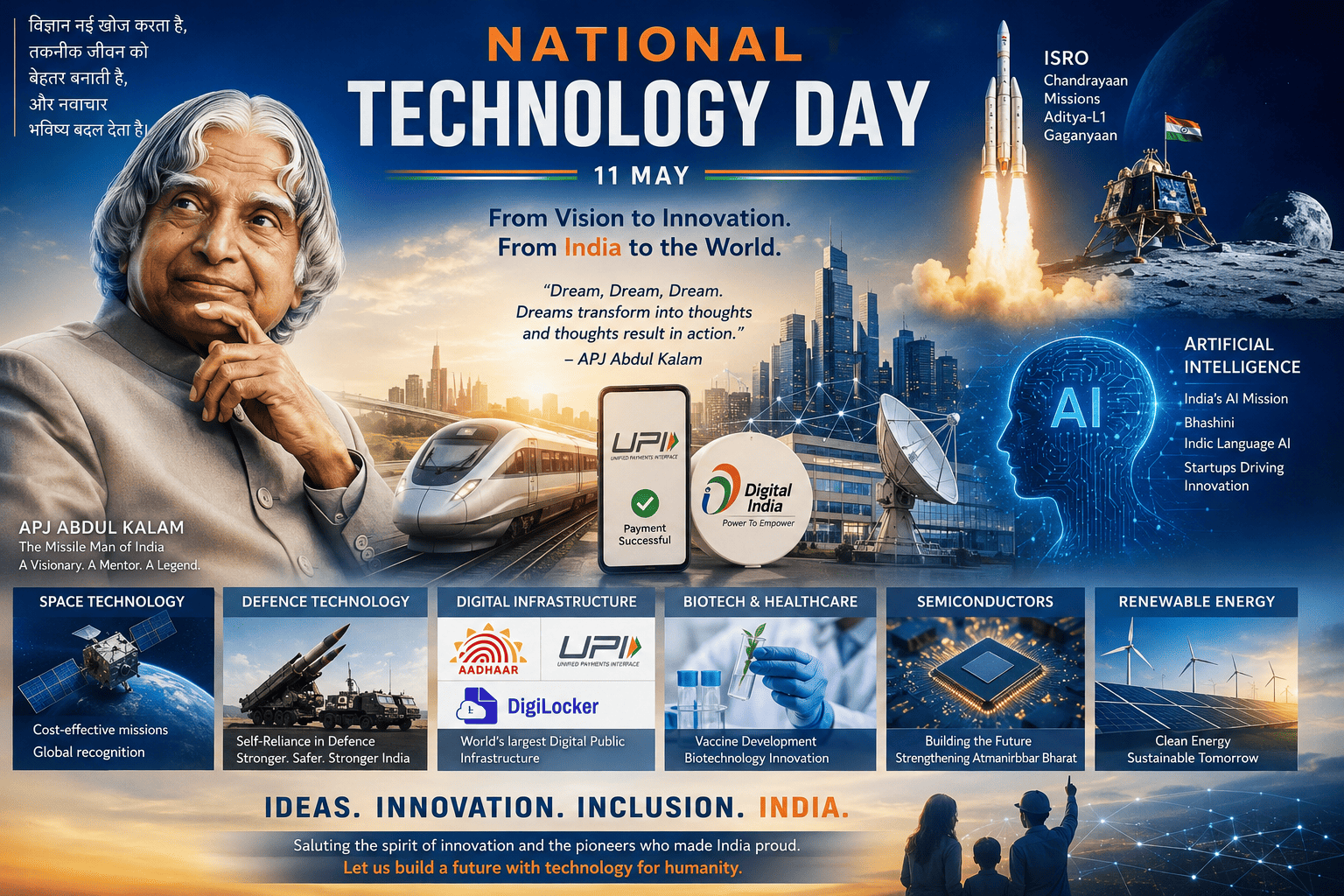
India’s technology journey has never been accidental.
It has been built through vision, sacrifice, scientific courage, and decades of relentless nation-building by scientists, engineers, innovators, and policymakers who believed India could stand shoulder to shoulder with the world’s greatest technological powers.
Every year on May 11, India celebrates National Technology Day — not merely as a ceremonial observance, but as a reminder of a historic national awakening.
It was on this day in 1998 that India conducted the Pokhran-II nuclear tests, announcing to the world that the nation possessed not just scientific capability, but strategic technological confidence.
At the heart of that defining moment stood one man whose vision transformed India’s scientific imagination forever — A. P. J. Abdul Kalam.
The Vision of Dr. APJ Abdul Kalam: Technology as National Strength
Dr. Kalam did not see technology as a luxury for elite laboratories.
He believed technology was the foundation of national sovereignty.
His strategy was clear:
- Build indigenous capabilities
- Reduce technological dependence
- Empower youth through science
- Connect innovation with nation-building
- Create long-term missions instead of short-term projects
Whether it was missile development, aerospace engineering, defence modernization, or scientific institution-building, Dr. Kalam pushed India toward self-reliance decades before the idea became mainstream.
Under his leadership and guidance, programs such as:
- Integrated Guided Missile Development Programme (IGMDP)
- Agni missile systems
- Prithvi missile systems
- Indigenous aerospace technologies
became symbols of India’s technological resilience.
But perhaps his greatest contribution was psychological.
He made young Indians believe that science could shape the destiny of the nation.
His vision document, “Technology Vision 2020,” emphasized that India’s future would be driven by:
- Information technology
- Advanced manufacturing
- Biotechnology
- Space science
- Energy innovation
- Education and digital empowerment
Today, nearly every major technological transformation unfolding in India echoes the strategic thinking he championed decades ago.
India’s Technology Revolution: A Nation Reimagining Itself
Modern India is no longer viewed only as an IT outsourcing destination.
It is becoming a global innovation ecosystem.
Over the last decade, India has built one of the world’s most ambitious technology infrastructures at population scale.
Digital Public Infrastructure: India’s Global Model
India’s digital revolution has transformed how governance, finance, healthcare, and commerce operate.
Platforms such as:
- Aadhaar
- UPI
- DigiLocker
- CoWIN
- ONDC
- Account Aggregator framework
have demonstrated that technology can empower billions when built inclusively.
UPI, in particular, has become a global benchmark in real-time digital payments — proving that India can create technology frameworks the world studies and adopts.
Space Technology: Reaching Beyond Earth
India’s achievements in space technology continue to inspire the world.
Under the leadership of Indian Space Research Organisation, India has achieved:
- Chandrayaan lunar missions
- Mars Orbiter Mission
- Aditya-L1 solar mission
- Affordable satellite launch systems
- Growing private space innovation
India has shown that scientific ambition does not require unlimited resources — it requires clarity of vision.
Semiconductor and Defence Ecosystems
As geopolitical realities reshape global supply chains, India is investing aggressively in:
- Semiconductor manufacturing
- Electronics ecosystems
- Cybersecurity
- Drone technologies
- Indigenous defence systems
- Strategic deep-tech infrastructure
The goal is not merely economic growth.
It is technological sovereignty.
Artificial Intelligence: India’s Most Important Technological Leap Yet
If Pokhran symbolized India’s strategic scientific confidence in 1998, Artificial Intelligence may define India’s technological destiny in the coming decades.
AI is no longer confined to research labs or Silicon Valley boardrooms.
It is reshaping:
- Governance
- Agriculture
- Education
- Healthcare
- Defence
- Media
- Languages
- Financial systems
- Creativity itself
And India is rapidly emerging as one of the world’s most important AI ecosystems.
India’s Unique AI Advantage
Unlike many countries focused only on English-first AI systems, India’s approach to AI is deeply connected to inclusion.
India’s real AI revolution lies in:
- Indic language models
- Speech-to-speech systems
- Real-time translation
- Voice AI
- Citizen-scale digital services
- Rural AI accessibility
The country’s linguistic diversity, digital public infrastructure, engineering talent, and startup ecosystem create a unique foundation for AI innovation at scale.
This is where India’s technology story becomes different from the rest of the world.
India is not merely building AI for productivity.
It is attempting to build AI for societal transformation.
The Rise of India’s AI Ecosystem
India’s startup ecosystem is now building globally relevant solutions across:
- Generative AI
- AI infrastructure
- Robotics
- Computer vision
- Healthcare AI
- Defence AI
- Educational AI
- Governance technology
- AI safety and ethics
Global technology giants are increasingly investing in India not just as a market, but as an innovation hub for the future of AI.
At the same time, Indian institutions and missions are beginning to focus on sovereign AI capabilities — ensuring the country remains technologically independent in the intelligent systems era.
The Responsibility of the AI Age
But technological power also brings responsibility.
As AI systems become more powerful, the world faces urgent questions around:
- Bias
- Misinformation
- Deepfakes
- Data privacy
- Algorithmic transparency
- Ethical governance
- Human oversight
India has the opportunity to shape a global AI framework that balances innovation with responsibility.
This may become one of the defining geopolitical and technological roles India plays in the 21st century.
From Dreams to Destiny
National Technology Day is not simply about celebrating past achievements.
It is about asking:
What kind of technological civilization does India want to become?
Dr. APJ Abdul Kalam once said:
“Dream is not that which you see while sleeping, it is something that does not let you sleep.”
Today, India stands at another historic threshold.
From the deserts of Pokhran to the age of Artificial Intelligence, the nation’s journey reflects one enduring truth:
Technology is no longer just a sector of the economy.
It is the foundation of national power, social transformation, and civilizational progress.
And as the world enters the era of intelligent systems, India is preparing not just to participate in the future —
but to help define it.