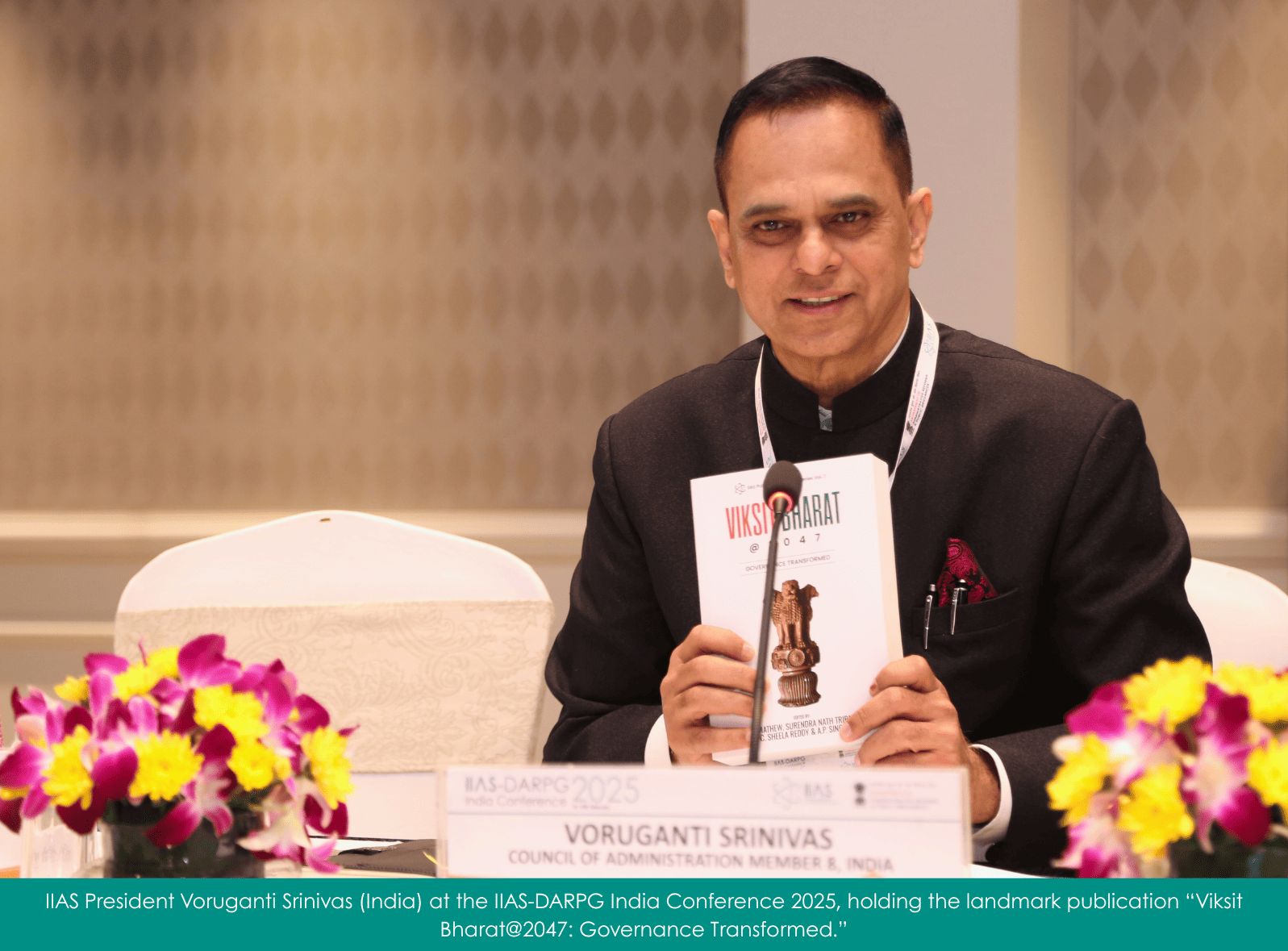
At a time when governments across the world were struggling with bureaucratic delays, citizen grievances, paper-heavy administration, and disconnected public systems, India quietly began building a new governance architecture — one that was faster, smarter, transparent, and technology-driven.
Among the senior administrators who played a significant role in this transformation was Srinivas Voruganti, an IAS officer known for pushing some of India’s most impactful governance and administrative reforms.
His leadership in the Government of India, particularly as Secretary of the Department of Administrative Reforms and Public Grievances (DARPG) and Department of Pension & Pensioners’ Welfare, became closely associated with India’s shift toward digital governance, accountability systems, and citizen-centric administration.
But what made his tenure stand out was not just policy-making — it was the practical transformation of how citizens interacted with governance itself.
Turning Public Grievances into a National Accountability System
For years, grievance redressal in India was seen as slow, fragmented, and heavily bureaucratic. Citizens often filed complaints without visibility into status, timelines, or accountability.
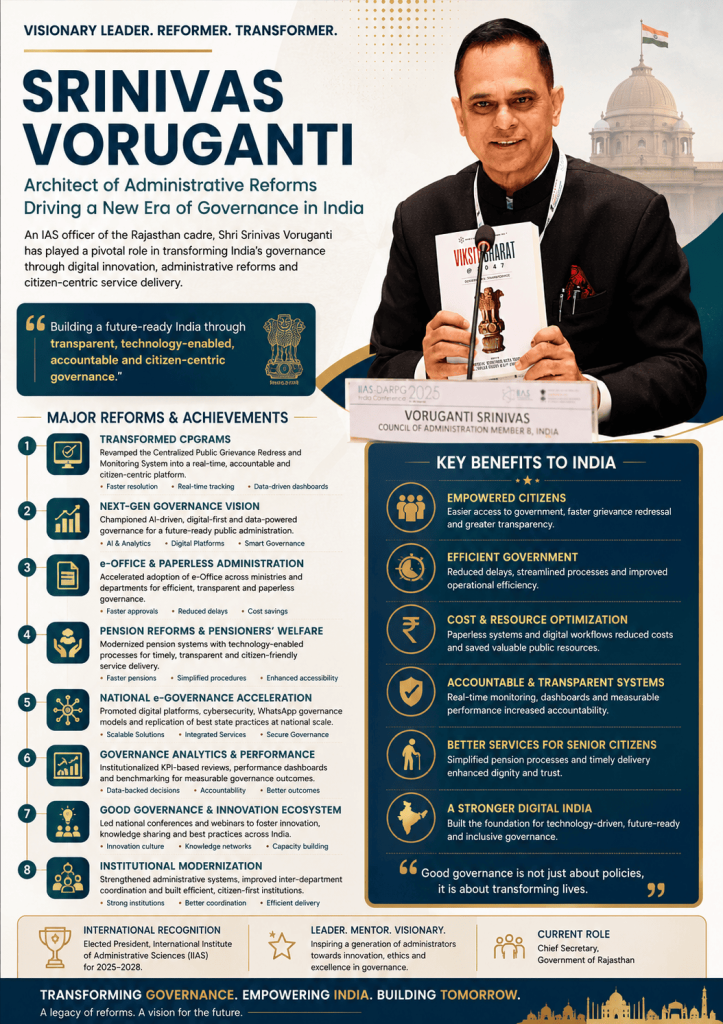
Under Srinivas Voruganti’s leadership, the Centralized Public Grievance Redress and Monitoring System (CPGRAMS) underwent a major transformation.
Instead of functioning as a passive complaint portal, CPGRAMS evolved into a real-time governance monitoring system.
The reforms introduced:
- Faster grievance tracking
- Ministry-wise accountability dashboards
- Time-bound resolution mechanisms
- Data analytics-driven monitoring
- Citizen visibility into complaint progress
The impact was significant.
Citizens gained:
- Greater transparency
- Faster response times
- Improved trust in digital governance
- Easier access to government systems
For the government, it created something equally important — measurable governance performance.
Departments could now be evaluated based on responsiveness and service delivery efficiency rather than only internal reporting structures.
Bringing India Closer to Paperless Governance
Another major shift during his administrative leadership was the acceleration of e-Office and digital workflow systems across government departments.
Traditionally, governance processes in India depended heavily on physical files, manual movement of documents, signatures, and lengthy approvals. These systems often created delays, inefficiencies, and lack of transparency.
Srinivas Voruganti strongly pushed the adoption of:
- Digital file movement
- Electronic approvals
- Workflow automation
- Digital records management
- Paperless administration systems
The benefits to India were enormous:
- Faster decision-making
- Reduced administrative delays
- Lower operational costs
- Improved transparency
- Better inter-department coordination
- Reduced dependency on physical infrastructure
These reforms became especially critical in enabling continuity during periods where remote governance and digital operations became necessary.
Modernizing Pension Systems for Millions
One of the most citizen-impacting reforms during his tenure came in the area of pension administration.
For years, pensioners across India often struggled with:
- Delayed approvals
- Complex paperwork
- Physical verification issues
- Administrative inefficiencies
Under his leadership, pension systems began shifting toward digital-first service delivery.
The reforms focused on:
- Simplified pension processing
- Technology-enabled pension approvals
- Faster grievance handling
- Improved accessibility for senior citizens
- Reduced dependency on physical paperwork
For millions of pensioners, these changes improved both efficiency and dignity in accessing post-retirement benefits.
Building the Foundation for AI-Driven Governance
Long before AI-driven governance became a mainstream discussion, Srinivas Voruganti was advocating “Next-Gen Governance” — a model where technology, analytics, automation, and digital infrastructure would become central to administration.
His vision promoted:
- Data-driven governance
- AI-assisted public systems
- Digital service delivery
- Governance analytics
- Real-time performance monitoring
- Citizen-centric technology platforms
This helped India strengthen its position as one of the world’s fastest-growing digital governance ecosystems.
Many governance modernization conversations during his tenure revolved around:
- AI in administration
- Smart governance systems
- Integrated citizen platforms
- Digital public infrastructure
- Technology-enabled accountability
These reforms aligned closely with India’s broader Digital India mission and accelerated the country’s transition toward digitally empowered governance.
Creating a Culture of Governance Innovation
Beyond individual reforms, Srinivas Voruganti helped create a larger ecosystem of governance innovation.
Under his leadership:
- Best practices from states were documented and replicated
- Governance innovation conferences were expanded
- Administrative modernization became a policy priority
- Ministries were encouraged to adopt technology-driven reforms
This created an important cultural shift inside bureaucracy itself.
Governance was no longer seen only as administration.
It was increasingly viewed as:
- Service delivery
- Citizen experience
- Technology transformation
- Institutional efficiency
- Public accountability
The India That Emerged from These Reforms
The long-term benefits India gained under such reform-oriented leadership are visible today:
- Faster digital governance
- Improved grievance redressal
- Greater administrative transparency
- Reduced bureaucratic delays
- Better pension accessibility
- Data-driven public administration
- Stronger digital governance infrastructure
- Increased citizen trust in government systems
Most importantly, these reforms helped prepare India for a future where governance increasingly depends on technology, automation, AI, and scalable digital public infrastructure.
A New Era of Indian Bureaucracy
Srinivas Voruganti represents a generation of Indian administrators who moved beyond conventional bureaucracy and helped shape governance as a modern transformation engine.
His work reflects the evolution of India’s public administration from:
- File-driven systems
to - Data-driven governance
From:
- Slow bureaucratic structures
to - Technology-enabled citizen services
And from:
- Reactive administration
to - Proactive governance innovation
In many ways, his administrative journey mirrors India’s own transformation into a digitally empowered governance ecosystem prepared for the future.