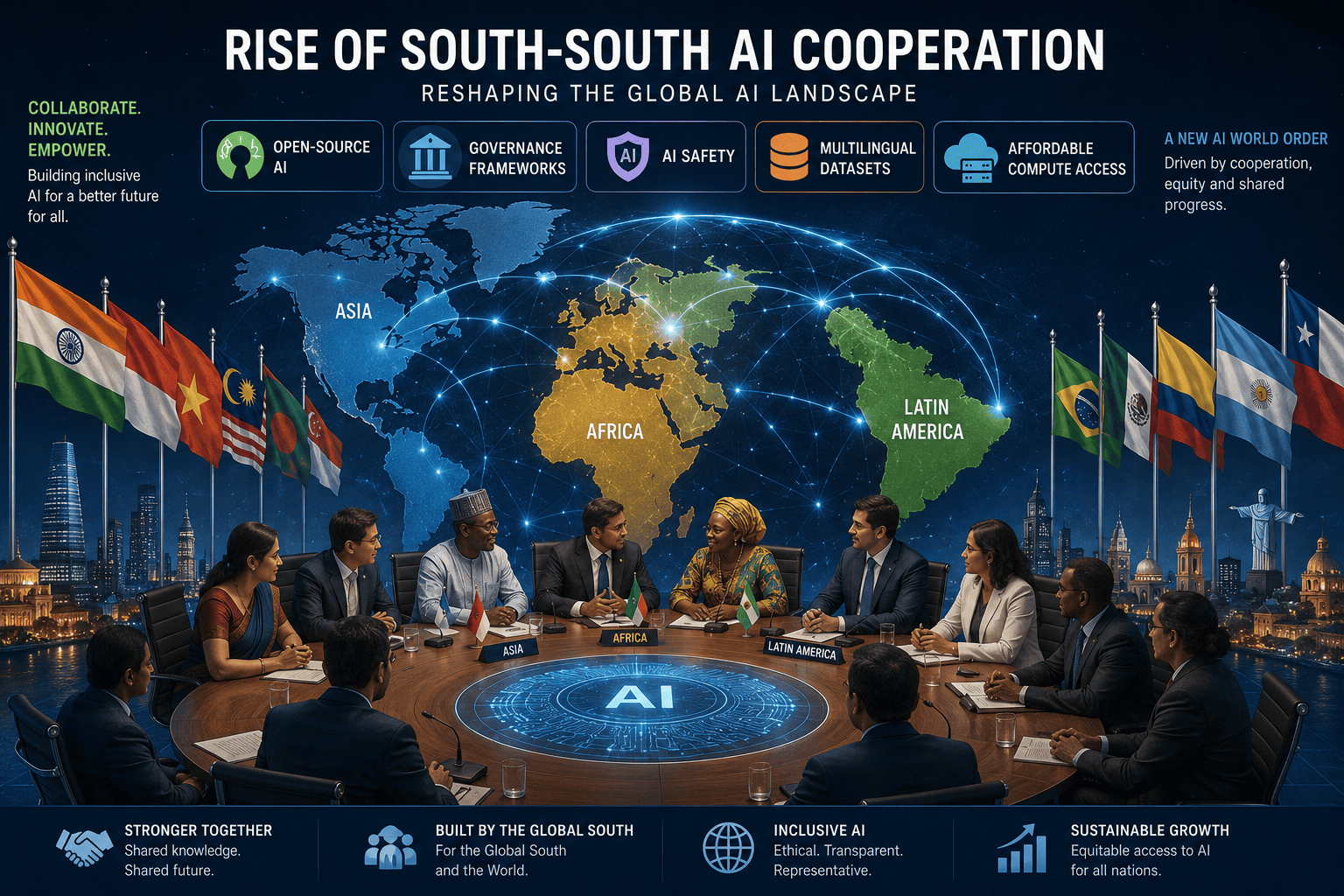
For nearly a decade, the global artificial intelligence race has largely been framed as a contest between the United States and China, with Europe attempting to shape the regulatory architecture around it. But a quieter and potentially more transformative movement is now emerging across Asia, Africa, and Latin America — the rise of “South-South AI cooperation.”
Governments across the Global South are beginning to collaborate directly on artificial intelligence development, governance, and infrastructure, creating a new geopolitical and technological alignment that could fundamentally reshape the future of AI.
Unlike traditional technology partnerships dominated by Western corporations or Chinese state-backed platforms, this new wave of cooperation is centered around shared developmental realities: affordability, multilingual populations, limited compute access, digital sovereignty, and inclusive innovation.
At the center of this shift is a growing realization that AI cannot remain controlled by a handful of nations and corporations.
Countries across the Global South increasingly believe that dependence on foreign AI infrastructure could create a new form of digital colonialism — one where access to intelligence, computation, and data becomes concentrated in a few global powers.
As a result, nations are now collaborating on five critical pillars of AI sovereignty.
The first is open-source AI.
Several countries are supporting open AI ecosystems to reduce dependence on proprietary Western models. Open-source AI allows governments, startups, universities, and researchers to customize systems for local languages, cultures, and governance requirements without paying massive licensing costs.
India’s multilingual AI initiatives, Brazil’s open research ecosystems, and Africa’s growing open-data collaborations are becoming important building blocks for this movement.
The second pillar is AI governance frameworks.
Rather than simply adopting regulations created in Washington, Brussels, or Beijing, emerging economies are beginning to design governance structures tailored to their own social and economic realities. This includes ethical AI guidelines for agriculture, healthcare, public welfare delivery, and multilingual populations.
South Africa’s recent AI strategy proposing a National AI Commission and Ethics Board is one of the clearest examples of this new thinking.
The third area of collaboration is AI safety.
As frontier AI systems become more powerful, countries in the Global South are increasingly concerned about bias, misinformation, data exploitation, and unequal access. Cooperative frameworks are emerging around responsible AI deployment, especially in public-sector applications such as education, policing, and welfare systems.
The fourth and perhaps most important pillar is multilingual datasets.
Most advanced AI systems today remain heavily biased toward English and a few dominant global languages. But billions of people across Africa, India, Southeast Asia, and Latin America communicate in languages that remain poorly represented in AI training systems.
Governments and institutions are now collaborating to create localized language datasets, speech models, and cultural AI systems capable of representing diverse societies more accurately.
India’s Bhashini initiative and multilingual AI programs are increasingly being viewed as potential models for broader Global South collaboration.
The fifth challenge is affordable compute access.
AI infrastructure today is extraordinarily expensive. Training large-scale models requires advanced GPUs, massive electricity capacity, and sophisticated cloud infrastructure — resources concentrated largely in the United States and China.
To overcome this barrier, Global South nations are exploring shared compute infrastructure, regional supercomputing alliances, and sovereign cloud ecosystems that can reduce dependence on foreign technology monopolies.
This marks a significant geopolitical transition.
For decades, developing countries were primarily consumers of technology built elsewhere. Today, they are beginning to position themselves as co-creators of the next global digital order.
Think tanks and policy researchers now describe South-South AI cooperation as one of the most important emerging trends in global technology governance. Instead of a bipolar AI world dominated by Washington and Beijing, a multipolar AI ecosystem may gradually emerge.
India is uniquely positioned to become one of the central architects of this transformation.
With its success in Digital Public Infrastructure, multilingual AI systems, open-source innovation, and population-scale technology deployment, India has the scale, talent, and geopolitical trust needed to lead collaborative AI ecosystems across the Global South.
The next phase of AI competition may therefore not simply be about who builds the most powerful model.
It may be about who builds the most inclusive, affordable, and trusted AI ecosystem for the majority of humanity.