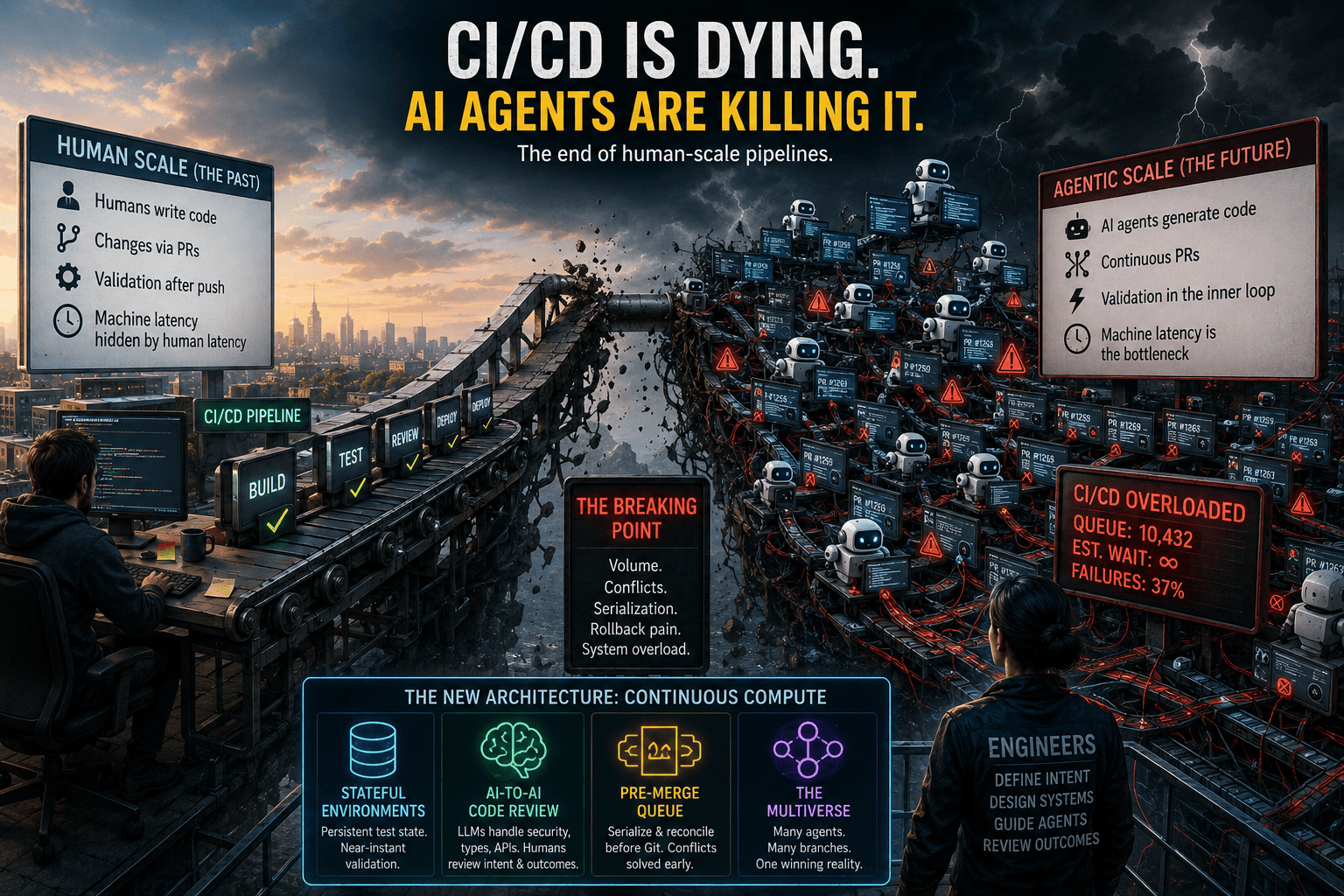
For years, the software industry treated CI/CD as the ultimate engineering achievement.
Continuous Integration and Continuous Deployment promised a world where developers could ship faster, automate testing, reduce human error, and deploy code at unprecedented scale. It became the backbone of modern software companies — from startups pushing daily releases to hyperscale cloud platforms operating across millions of users.
But a new threat is emerging from inside the very systems CI/CD was designed to accelerate.
AI coding agents.
And unlike previous technology shifts, this one is not simply improving software delivery. It may fundamentally overwhelm it.
The Problem Nobody Prepared For
Traditional engineering pipelines were built around one core assumption:
Humans are slow.
Developers write code gradually. Pull requests arrive in manageable batches. Teams review changes carefully. Testing pipelines operate in the background while humans think, discuss, and iterate.
The delays inside CI systems were acceptable because humans themselves created natural pauses.
AI agents remove those pauses entirely.
Modern coding agents can already generate production-ready code continuously, across multiple repositories, APIs, services, and infrastructure layers simultaneously. What once took a team of engineers several days can now be generated in minutes.
That sounds revolutionary.
Until the system responsible for validating those changes starts collapsing under the volume.
CI/CD Was Never Designed for Machine-Speed Development
The software industry often talks about faster code generation as if deployment systems will naturally scale alongside it.
They will not.
Every generated change still requires:
- Security validation
- Dependency checks
- Type verification
- Integration testing
- Performance analysis
- Rollback safety
- Merge conflict resolution
At human scale, these processes are manageable.
At agentic scale, they become a computational bottleneck.
A single autonomous engineering workflow could soon produce hundreds — potentially thousands — of pull requests per day. Not because companies suddenly hired more engineers, but because software creation itself has become nearly free.
This creates a dangerous imbalance:
Code generation is accelerating exponentially.
Validation infrastructure is not.
And when validation cannot keep up, the entire foundation of software reliability begins to crack.
The Coming Merge Conflict Crisis
Most engineering organizations already struggle with merge conflicts, flaky pipelines, and deployment instability.
That pain exists at human scale.
Now imagine autonomous agents continuously modifying the same services, libraries, APIs, and infrastructure configurations simultaneously.
The consequences become alarming:
- CI queues become permanently congested
- Merge conflicts multiply uncontrollably
- Rollbacks become more frequent and harder to trace
- Infrastructure drift accelerates
- Dependency trees destabilize in real time
- Human reviewers lose visibility into what is actually changing
The industry is approaching a future where software systems may evolve faster than humans can reasonably audit them.
That is not an efficiency issue.
It is a governance problem.
AI Reviewing AI: A Dangerous Dependency
One proposed solution is even more unsettling.
If humans cannot review machine-generated code fast enough, then AI systems will review other AI systems.
Security models validating autonomous commits.
LLMs reviewing architecture decisions.
Automated agents approving deployments.
At first glance, this seems inevitable.
But it introduces a deeply uncomfortable question:
What happens when the entire software supply chain becomes machine-supervised instead of human-supervised?
Modern software already suffers from hidden vulnerabilities, dependency attacks, supply chain compromises, and unnoticed configuration errors. Adding layers of autonomous agents reviewing other autonomous agents could create a false sense of confidence while amplifying invisible systemic risks.
A flawed human reviewer misses one bug.
A flawed autonomous review system could approve thousands of flawed changes per hour.
At that scale, failure propagation becomes catastrophic.
The Rise of “Continuous Compute”
To survive agentic engineering, the industry is beginning to explore entirely new architectures.
Not better CI pipelines.
Completely different operational models.
The next generation of engineering systems may rely on:
Stateful Validation Environments
Persistent testing systems where environments never fully restart, allowing agents to validate changes instantly instead of waiting through repeated pipeline execution.
Pre-Merge Serialization Layers
Intelligent coordination systems that reconcile conflicts before code reaches the repository instead of after merge attempts fail.
Autonomous Branch Experimentation
Multiple AI agents testing parallel implementations of the same feature simultaneously, with only the “best” result surviving.
AI-Orchestrated Engineering Fleets
Human engineers overseeing swarms of specialized coding, testing, security, and optimization agents instead of writing most implementation code directly.
These concepts sound futuristic.
But they are rapidly becoming necessary.
Because traditional CI/CD cannot economically survive infinite code generation.
The Human Cost Nobody Wants to Discuss
The industry narrative around AI development tools focuses heavily on productivity.
Much less attention is being paid to what happens to engineering roles themselves.
As validation, testing, review, and implementation become increasingly automated, engineers may gradually move away from direct creation into oversight roles.
That transition carries serious risks:
- Junior engineers may lose opportunities to develop deep implementation skills
- Human understanding of complex systems may erode over time
- Organizations could become dependent on systems they no longer fully comprehend
- Accountability becomes blurred when autonomous systems make critical technical decisions
The software industry may soon face the same challenge aviation encountered decades ago:
What happens when humans become supervisors of automation rather than operators of systems?
In high-stakes environments, overreliance on automation has historically created dangerous failure modes precisely because humans lose situational awareness.
Software engineering may be walking directly into the same trap.
The Most Dangerous Part: Nobody Knows If This Works
Despite growing excitement around agentic development, many of the proposed solutions remain largely unproven.
Stateful build systems have existed for years without widespread adoption.
Large-scale autonomous branching systems remain experimental.
Existing merge queue platforms solve only fragments of the coordination problem.
And most companies are nowhere near handling the scale these architectures assume.
Yet the pressure to adopt AI-assisted development continues accelerating.
Which means the industry may begin deploying autonomous engineering systems before fully understanding how to control them.
Historically, technology sectors move cautiously when infrastructure stability is at risk.
AI development is moving at the opposite pace.
The Real Threat Is Not AI Writing Code
AI generating code is not the dangerous part.
The dangerous part is what happens when machines begin evolving software ecosystems faster than humans can monitor, validate, or understand them.
CI/CD pipelines were designed for human-speed engineering.
AI agents operate at machine-speed iteration.
Those are fundamentally incompatible worlds.
And unless software infrastructure is radically redesigned, the systems that power modern engineering may soon become the weakest link in the AI era itself.