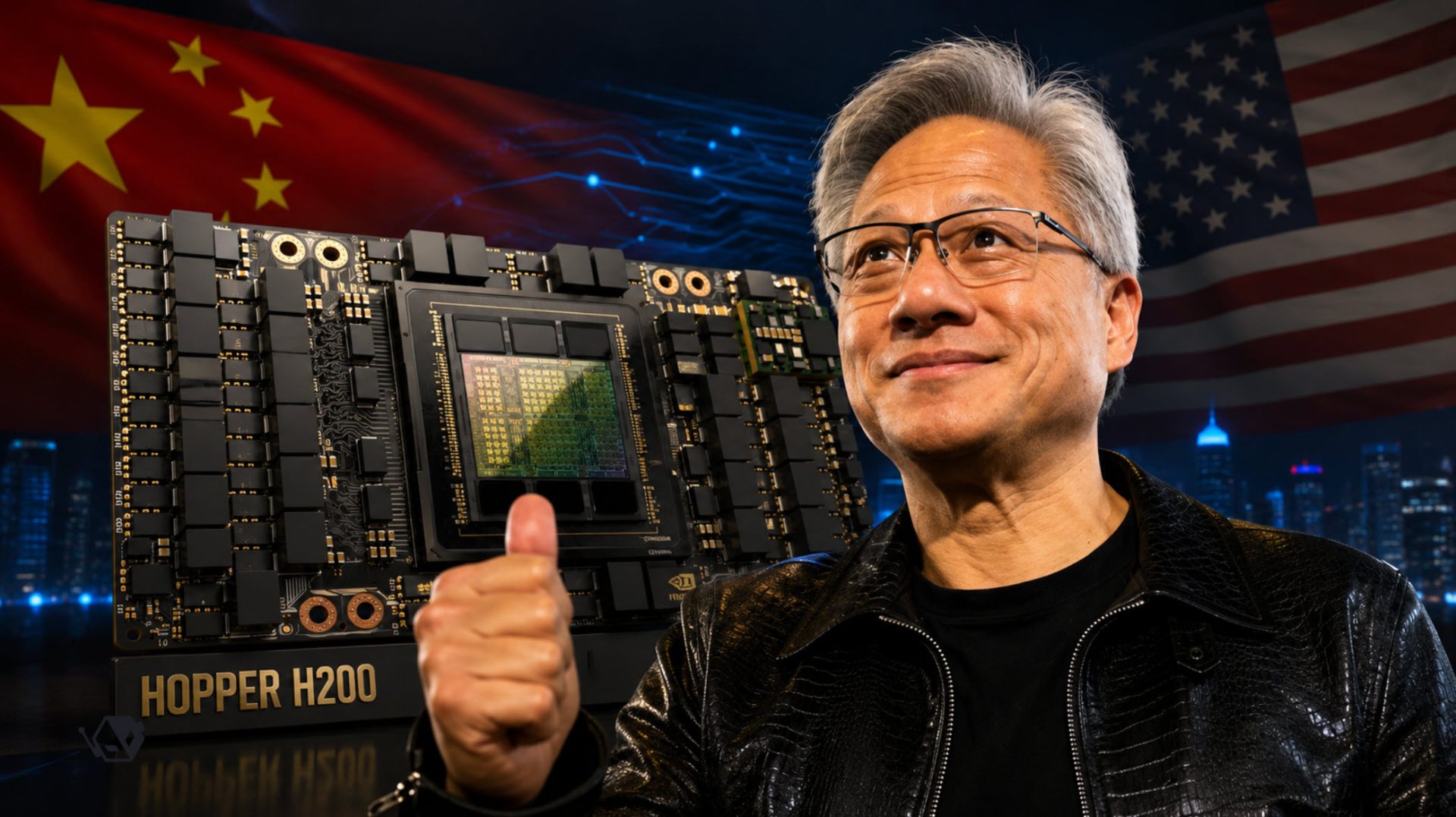
When U.S. President Donald Trump recently visited China alongside some of America’s biggest technology leaders, many in the global semiconductor industry expected one thing:
A breakthrough.
The assumption was simple:
If diplomacy improved, Nvidia — the world’s most powerful AI chip company — would finally regain access to the massive Chinese AI market.
Nvidia CEO Jensen Huang was deeply involved in the discussions surrounding AI chip trade and export approvals. The U.S. had already relaxed some restrictions and even cleared exports of Nvidia’s H200 AI chips to selected Chinese firms. (Reuters)
But something unexpected happened.
China still said no.
Even after diplomatic meetings, trade discussions, and high-level engagement, Beijing refused to fully approve Nvidia’s return into the Chinese AI ecosystem.
And that decision revealed something much bigger than business.
This is the story of why China no longer wants to depend on Nvidia — and why the global AI race has now become a battle for technological sovereignty.
Phase 1: Nvidia Once Powered China’s AI Revolution
A few years ago, Nvidia was everywhere in China.
Chinese tech giants, universities, cloud providers, AI startups, and research labs relied heavily on Nvidia GPUs to:
- Train AI models
- Build data centers
- Develop military-grade simulations
- Run generative AI systems
- Power autonomous technologies
At one point, Nvidia reportedly controlled over 90% of China’s AI accelerator market. (The Times of India)
China’s AI boom was effectively running on American silicon.
And for years, that relationship worked.
Until geopolitics entered the picture.
Phase 2: America Started Restricting AI Chips
The turning point came when the United States realized something critical:
Advanced AI chips are not ordinary hardware anymore.
They are strategic assets.
Washington feared that China could use Nvidia’s advanced GPUs for:
- Military AI systems
- Autonomous warfare
- Cyber operations
- Surveillance infrastructure
- National defense computing
The U.S. responded with aggressive export controls targeting advanced semiconductors and AI infrastructure exports to China. (Wikipedia)
Suddenly, Nvidia could no longer freely sell its most powerful chips like:
- H100
- H200
- B100
to Chinese buyers.
This changed everything.
Phase 3: China Realized Its Biggest Weakness
For China, the export restrictions became a wake-up call.
The message from Washington was clear:
Access to advanced AI infrastructure could be cut off at any moment.
That created a dangerous reality for Beijing.
China had:
- AI talent
- Data
- Massive market scale
- Ambitious AI goals
But the country still depended heavily on foreign chips.
And dependency in the AI era means vulnerability.
Chinese policymakers began asking:
“How can China become an AI superpower if its entire compute infrastructure depends on America?”
That question reshaped China’s entire semiconductor strategy.
Phase 4: Nvidia Tried to Adapt for China
To survive in the Chinese market, Nvidia started creating downgraded versions of its GPUs specifically designed to comply with U.S. export restrictions.
These included chips like:
- H20
- RTX 5090D V2
These were less powerful than Nvidia’s flagship AI processors but still attractive for Chinese AI firms.
The strategy was:
- Keep China as a customer
- Avoid violating U.S. regulations
- Maintain market presence
But China had already begun thinking differently.
Phase 5: China Started Distrusting Foreign AI Infrastructure
As tensions between the U.S. and China intensified, Beijing’s concerns evolved beyond supply access.
The concerns became strategic.
Chinese regulators reportedly raised questions around:
- Hardware-level control
- Security vulnerabilities
- Remote management systems
- Possible foreign “kill switch” capabilities
- Supply-chain dependence
State-linked Chinese media began criticizing Nvidia chips as:
- Unsafe
- Potentially controllable by foreign entities
- Strategically risky for China’s AI future
Nvidia strongly denied these allegations. But by then, the larger issue was no longer technical.
It was geopolitical trust.
Phase 6: China Decided to Build Its Own Nvidia
This became the real turning point.
China realized:
Instead of depending on Nvidia forever, it could use the crisis to accelerate domestic semiconductor innovation.
The Chinese government began actively supporting local AI chipmakers such as:
- Huawei
- Cambricon
- Biren
- Moore Threads
Huawei’s Ascend AI chips especially became central to China’s long-term AI strategy.
Chinese AI firms were increasingly encouraged — and in some cases pressured — to adopt domestic hardware instead of Nvidia GPUs.
This was not only about economics.
It was about national technological independence.
Phase 7: Trump’s Visit Changed Optics — But Not Strategy
When President Trump visited China recently, many believed diplomacy could soften the semiconductor conflict.
But China’s behavior suggested something deeper:
The country had already made its long-term decision.
Even after:
- Export approvals
- Diplomatic talks
- Nvidia lobbying efforts
China reportedly still delayed or blocked large-scale Nvidia AI chip adoption.
In fact, reports suggested China even moved against Nvidia-specific products during this period while continuing to push domestic alternatives.
The message was symbolic:
China no longer wants its AI future dependent on America.
Phase 8: The AI Race Is Now About Sovereignty
This conflict is no longer just about Nvidia.
It is about who controls:
- AI compute infrastructure
- Semiconductor ecosystems
- Data center hardware
- National AI capability
China sees semiconductors the same way countries see:
- Oil
- Defense systems
- Telecommunications infrastructure
Critical strategic assets cannot remain dependent on foreign powers.
That is why China is investing billions into:
- Domestic chip manufacturing
- Semiconductor research
- AI infrastructure
- GPU alternatives
- National AI ecosystems
What Happens Next?
The Nvidia-China situation represents the beginning of a new global technology era.
An era where countries increasingly prioritize:
- AI sovereignty
- Tech nationalism
- Domestic semiconductor independence
- Strategic digital infrastructure
For Nvidia, China was once one of its biggest growth engines.
Now, CEO Jensen Huang himself has acknowledged that Nvidia’s market share in China has effectively fallen to near zero. (The Times of India)
But for China, this is bigger than market competition.
It is about ensuring that the future of Chinese artificial intelligence is controlled inside China — not dependent on decisions made in Washington.
The AI war is no longer only about software.
It is now a battle over the hardware that powers civilization’s next technological revolution.