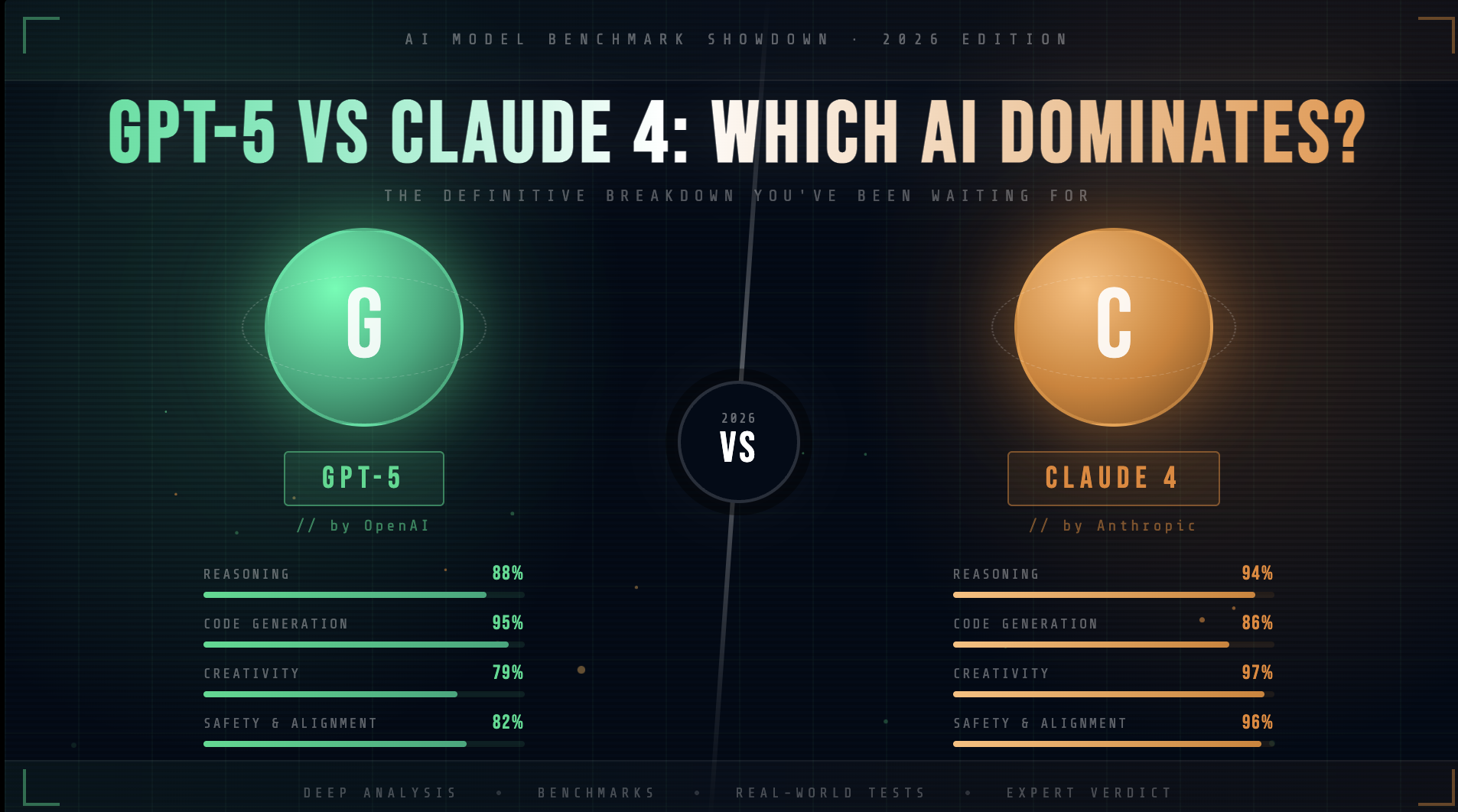
The AI race in 2026 is no longer just about chatbots. It is about autonomous agents, multimodal reasoning, coding copilots, enterprise automation, scientific discovery, and real-time decision-making. Two names dominate this frontier: OpenAI with GPT-5, and Anthropic with Claude 4.
Both models represent a major leap beyond the GPT-4 and Claude 3 era. They are faster, smarter, more autonomous, and increasingly capable of acting like digital coworkers instead of simple assistants. But the big question remains:
Which model actually leads in 2026?
The answer depends on what you care about most — coding, reasoning, enterprise safety, long-context analysis, creativity, or autonomous workflows.
The Evolution of the AI War
By 2026, the competition between OpenAI and Anthropic has evolved into a battle of philosophies.
- OpenAI focuses on general intelligence + agentic automation
- Anthropic focuses on reliable reasoning + safe enterprise AI
GPT-5 introduced a “system-of-models” architecture with dynamic routing between reasoning engines and lightweight inference systems. (Wikipedia)
Claude 4, especially Claude Opus 4.x, focused heavily on sustained reasoning, long-context processing, and coding reliability. Anthropic openly positioned Claude Opus 4 as “the world’s best coding model.” (Anthropic)
The result is that both companies are now building AI systems that increasingly resemble operating systems for knowledge work.
GPT-5: OpenAI’s Unified Intelligence Engine
GPT-5 is OpenAI’s most ambitious architecture to date. Instead of functioning as a single monolithic model, GPT-5 dynamically switches between different reasoning layers depending on task complexity. (Wikipedia)
Key strengths include:
1. Advanced Reasoning
GPT-5 dramatically improved logical reasoning, mathematical accuracy, and scientific analysis compared to GPT-4. Research evaluations showed state-of-the-art performance across medical reasoning, multimodal analysis, and structured problem solving. (arXiv)
For example, OpenAI reported:
- Major improvements in biomedical analysis
- Stronger chain-of-thought reasoning
- Better hallucination resistance
- Higher coding benchmark scores
GPT-5.5 later pushed this further with enhanced “thinking” capabilities for enterprise-grade analysis. (OpenAI)
2. Autonomous AI Agents
GPT-5 is heavily optimized for agentic workflows.
It can:
- Browse the web autonomously
- Operate software tools
- Use APIs dynamically
- Execute multi-step tasks
- Manage long-running workflows
This transformed ChatGPT from a conversational assistant into something closer to an AI operating environment.
OpenAI also introduced specialized variants like GPT-5.3-Codex and GPT-5.5-Cyber for advanced software engineering and cybersecurity workflows. (OpenAI Help Center)
3. Coding Dominance
GPT-5 became exceptionally strong in:
- Full-stack development
- Refactoring
- Multi-file code understanding
- Infrastructure automation
- Scientific programming
Several benchmark reports in 2026 showed GPT-5 leading in:
- SWE-bench
- AIME reasoning tasks
- OSWorld environment interaction benchmarks
(Runbear)
It also demonstrated remarkable adaptability in niche programming ecosystems through iterative compiler-guided reasoning. (arXiv)
4. Multimodal Intelligence
GPT-5 excels at combining:
- Text
- Images
- Charts
- Documents
- Structured datasets
In medical multimodal reasoning evaluations, GPT-5 reportedly exceeded human expert performance in several benchmark categories. (arXiv)
This matters because enterprise AI increasingly depends on interpreting mixed information streams, not just text prompts.
Claude 4: The Enterprise Reliability King
Claude 4 Official Announcement
Anthropic approached AI differently.
Instead of chasing pure benchmark supremacy, Claude 4 focused on:
- Stable reasoning
- Long-context understanding
- Safety calibration
- Enterprise trust
- Tool-assisted workflows
And that strategy worked extremely well.
Why Enterprises Love Claude 4
Claude became especially popular among:
- Enterprises
- Researchers
- Financial institutions
- Legal firms
- Cybersecurity teams
Its outputs are often perceived as:
- More cautious
- Better structured
- Less hallucination-prone
- Easier to trust in high-stakes environments
Anthropic invested heavily in constitutional AI and interpretability systems designed to reduce harmful or misleading outputs. (Anthropic)
1. Long Context Mastery
Claude’s long-context performance became one of its defining strengths.
Claude can process extremely large document sets with high consistency:
- Legal archives
- Research papers
- Massive codebases
- Financial filings
- Technical specifications
For enterprises dealing with thousands of pages of context, Claude often feels more stable and coherent over long interactions.
2. Exceptional Coding Reliability
Claude Opus 4.x became famous among developers for:
- Precise code explanations
- Better architectural consistency
- Strong debugging capability
- Long-session memory stability
Anthropic specifically claimed Claude Opus 4 was the “world’s best coding model.” (Anthropic)
Later releases like Claude Opus 4.7 further improved coding benchmark performance. (Anthropic)
Many engineers in 2026 prefer Claude for:
- Reviewing pull requests
- Understanding legacy systems
- Security auditing
- Refactoring enterprise software
3. AI Safety Leadership
Anthropic positioned itself as the AI safety leader.
The company introduced highly controlled research systems like “Mythos,” which reportedly discovered thousands of critical software vulnerabilities across operating systems and browsers. (Tom’s Hardware)
This showcased Claude’s extraordinary reasoning power — but also highlighted the growing risks of frontier AI systems.
Anthropic repeatedly emphasized controlled deployment and careful governance, even warning publicly about existential AI risks. (The Guardian)
GPT-5 vs Claude 4: Head-to-Head Comparison
| Feature | GPT-5 | Claude 4 |
|---|---|---|
| Core Philosophy | General intelligence + agents | Reliable reasoning + safety |
| Coding | Excellent autonomous coding | Exceptional structured coding |
| Long Context | Strong | Industry-leading |
| Creativity | Superior for ideation/content | More restrained but coherent |
| Enterprise Trust | High | Extremely high |
| Safety Alignment | Strong | Stronger emphasis |
| Agentic Workflows | Best-in-class | Improving rapidly |
| Multimodal Reasoning | Outstanding | Strong |
| Scientific Research | Leading | Strong |
| Hallucination Control | Improved significantly | Generally more conservative |
| Tool Usage | Highly autonomous | More deliberate |
| Writing Style | Dynamic and versatile | Structured and analytical |
Where GPT-5 Wins
GPT-5 dominates when tasks require:
- Autonomous execution
- Dynamic tool orchestration
- Advanced multimodal reasoning
- Creative generation
- Fast adaptation
- General-purpose intelligence
It feels more like:
“An AI operator.”
For startups, creators, automation builders, researchers, and technical teams building AI-first products, GPT-5 is often the more powerful platform.
Where Claude 4 Wins
Claude 4 dominates when tasks require:
- Reliability
- Massive document analysis
- Long-context coherence
- Enterprise safety
- Structured reasoning
- Conservative outputs
It feels more like:
“An AI analyst.”
Large enterprises, legal teams, finance companies, and security-sensitive organizations frequently prefer Claude because it behaves more predictably.
The Bigger Shift: AI Models Are Becoming AI Employees
The real story in 2026 is not just “which chatbot is smarter.”
The real shift is that models like GPT-5 and Claude 4 are evolving into:
- Autonomous software engineers
- Research assistants
- Security analysts
- Scientific collaborators
- Workflow orchestrators
Anthropic even predicted AI-assisted Nobel Prize-level discoveries within years. (The Guardian)
Meanwhile, OpenAI continues pushing toward fully agentic AI ecosystems capable of operating computers, tools, browsers, and enterprise workflows autonomously. (Wikipedia)
This is no longer a productivity tool market.
It is the early stage of an AI labor platform economy.
Final Verdict: Which AI Model Dominates in 2026?
There is no universal winner.
Choose GPT-5 if you want:
- Maximum capability
- AI agents
- Autonomous workflows
- Superior multimodal reasoning
- Fast-moving innovation
- Creative versatility
Choose Claude 4 if you want:
- Reliable enterprise AI
- Safer outputs
- Better long-context analysis
- Stable reasoning
- Deep codebase understanding
- Predictable behavior
In practical terms:
- GPT-5 leads the frontier of autonomous intelligence
- Claude 4 leads the frontier of reliable reasoning
And in 2026, most advanced organizations are no longer choosing only one.
They are using both.