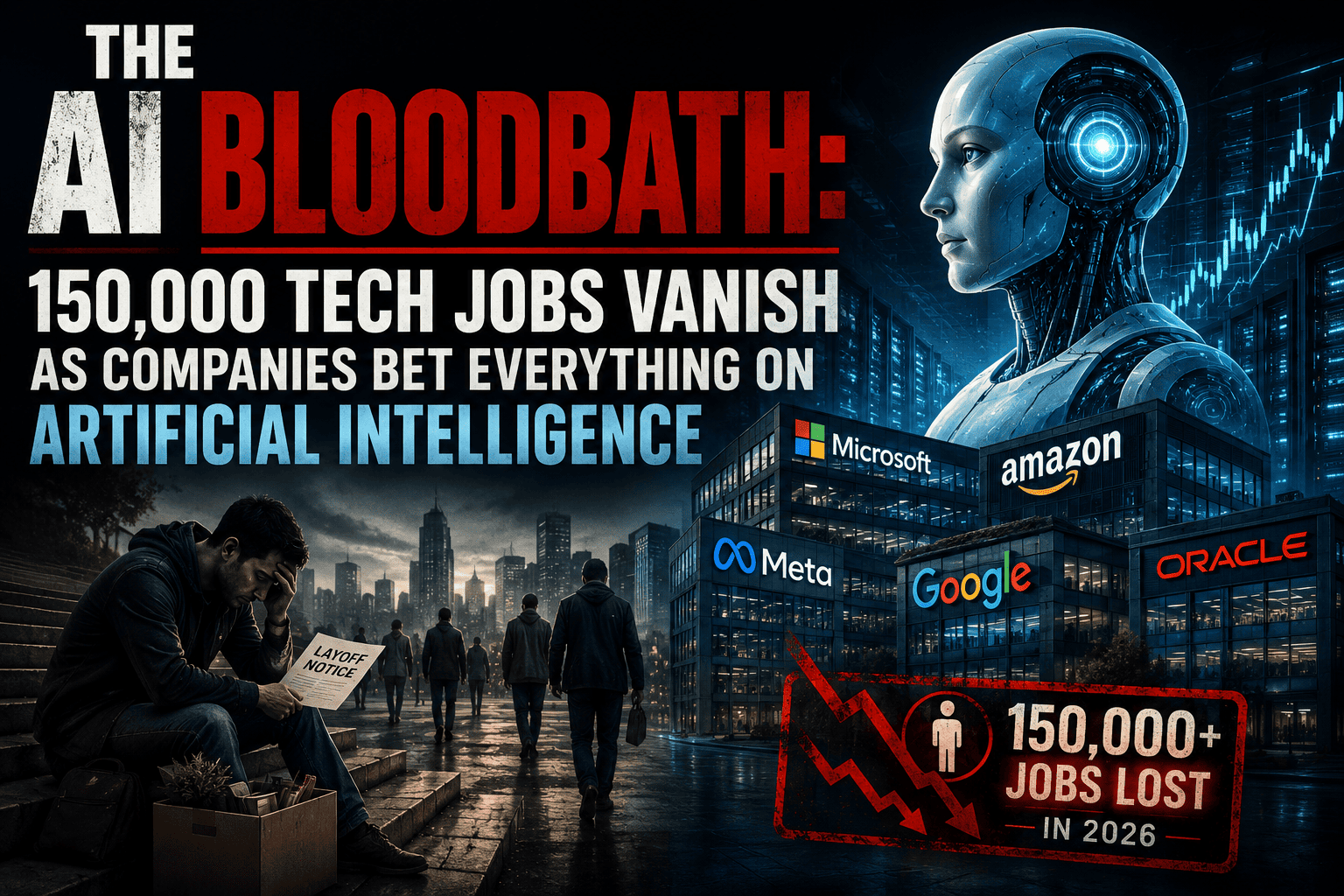
In 2026, the technology industry stopped pretending that artificial intelligence was just another innovation cycle.
This time, the machines were not merely helping employees. They were replacing entire layers of work.
By the middle of 2026, global tech layoffs had crossed 129,000 according to multiple layoff trackers, with some estimates already pushing beyond 150,000 when unreported contractor cuts, offshore restructuring, and silent hiring freezes were included. (TrueUp)
But the real story was not the layoffs themselves.
The real story was where the money went afterward.
While software engineers, recruiters, designers, QA testers, customer support agents, project managers, and even mid-level executives were losing jobs, the largest technology companies in the world were simultaneously committing hundreds of billions of dollars toward AI infrastructure, AI chips, data centers, and autonomous software systems. (The Times of India)
It felt less like a recession.
And more like a transfer of power.
Chapter 1: The Email Nobody Wanted to Receive
The first warning signs appeared quietly.
At 5:12 AM in Seattle, a Microsoft engineer woke up to an email titled:
“Organizational Realignment for the AI Era.”
In California, Meta employees opened internal dashboards only to discover revoked permissions.
At Amazon, calendar invites vanished.
At Oracle, entire teams disappeared overnight.
Inside Slack channels, the same message echoed repeatedly:
“Does anyone know what’s happening?”
Nobody did.
Or rather, leadership already knew.
The executives had spent the previous eighteen months in a race unlike anything Silicon Valley had seen since the birth of the internet.
OpenAI had changed the rules.
And now every major company was terrified of becoming irrelevant.
Chapter 2: The Great AI Arms Race
The AI boom of 2023 and 2024 had originally looked exciting.
By 2025, it became expensive.
By 2026, it became existential.
Alphabet, Microsoft, Meta, and Amazon were projected to collectively spend nearly $700 billion on AI-related infrastructure and compute expansion. (The Times of India)
Meta alone raised projected capital expenditure to as much as $135 billion in 2026, nearly doubling earlier spending levels. (The Verge)
Massive GPU clusters were being built across the United States, India, the UAE, and Europe.
Data centers began consuming electricity at levels comparable to small cities.
Companies started hiring:
- AI infrastructure engineers
- LLM optimization researchers
- prompt architects
- robotics experts
- AI safety teams
- synthetic data specialists
- inference optimization engineers
At the same time, they began eliminating:
- support teams
- middle management
- junior software developers
- manual QA teams
- content moderation layers
- traditional business analysts
- recruiters
- operations staff
The logic was brutally simple:
Why employ ten people when one person with AI tools could now do the work?
Chapter 3: “Efficiency”
The word “layoff” slowly disappeared from executive vocabulary.
Instead, companies used softer phrases:
- “efficiency”
- “organizational redesign”
- “strategic transformation”
- “AI-first transition”
- “resource optimization”
Business Insider found that “AI” had become one of the most common words appearing in layoff memos during 2026. (Business Insider)
Behind the language was a deeper shift.
AI was no longer treated as a tool.
It had become the new workforce multiplier.
Executives discovered something dangerous:
AI systems did not demand salaries, bonuses, healthcare, promotions, vacations, or stock refreshers.
A generative AI coding assistant could write boilerplate software in seconds.
Customer service bots handled thousands of simultaneous interactions.
AI video generators replaced creative production teams.
Autonomous analytics systems reduced dependence on data departments.
Recruiting platforms began filtering candidates automatically.
Suddenly, labor looked expensive.
Very expensive.
Chapter 4: The Junior Employee Crisis
The hardest hit group was not senior leadership.
It was young workers.
Fresh graduates.
Entry-level coders.
Associate analysts.
Junior designers.
People who traditionally learned by doing repetitive work.
A major 2026 executive survey revealed that 99% of CEOs expected AI-driven layoffs within two years. (Tom’s Hardware)
The same report found that companies were aggressively reducing junior positions because AI could already automate many early-career tasks. (Tom’s Hardware)
This created a terrifying paradox.
If AI handles beginner work, how do beginners gain experience to eventually become experts?
The traditional technology career ladder began collapsing.
In earlier years:
- juniors wrote documentation
- fixed bugs
- tested systems
- handled tickets
- performed repetitive coding
In 2026:
AI handled much of that instantly.
The result was a silent hiring freeze across many companies.
Not officially announced.
But deeply felt.
University graduates started competing for a shrinking number of human entry-level roles.
Some discovered that interview panels now expected candidates to already know how to work alongside AI agents.
Others found that companies wanted “AI-native employees” rather than traditional developers.
The industry had changed faster than education systems could adapt.
Chapter 5: Meta’s Shockwave
Then came Meta.
The company announced roughly 8,000 layoffs while simultaneously reallocating thousands of employees toward AI projects. (The Verge)
Internally, employees described the atmosphere as emotionally exhausting.
Some workers had survived multiple rounds of layoffs since 2022.
Others believed the cuts signaled a permanent restructuring rather than temporary cost control.
Mark Zuckerberg defended the move publicly, arguing that AI leadership required radical operational changes. (New York Post)
The message from leadership was unmistakable:
The future belonged to AI-first companies.
Even if thousands lost jobs getting there.
Chapter 6: Amazon, Microsoft, Oracle, Intel
Meta was not alone.
Amazon reportedly cut around 16,000 corporate roles globally as it expanded automation and AI systems. (Business Insider)
Oracle became one of the largest layoff stories of the year, with reports suggesting 20,000–30,000 reductions tied to restructuring and automation priorities. (The Economic Times)
Microsoft continued workforce reductions while aggressively embedding AI across Office, Azure, GitHub, and enterprise systems. (The Economic Times)
Intel, already under pressure from the semiconductor war and manufacturing competition, accelerated restructuring while chasing AI chip relevance. (INDmoney)
Salesforce, once famous for rapid hiring, shifted heavily toward autonomous AI agents capable of replacing large portions of customer operations. (Information Week)
Everywhere the same pattern emerged:
Cut labor.
Fund AI.
Increase productivity.
Repeat.
Chapter 7: The Rise of the “Super Employee”
Inside many corporations, something else quietly emerged.
The “10x engineer” narrative evolved into the “AI-amplified employee.”
One skilled worker using advanced AI systems could suddenly perform the work of entire teams.
Developers used AI coding copilots to generate thousands of lines of code.
Marketers used generative AI for campaigns.
Designers used image and video generation tools.
Analysts used AI research agents.
The workplace itself began changing shape.
A 2026 longitudinal study on AI coding assistants found developers were spending less time creating and more time supervising, verifying, and correcting AI-generated outputs. (arXiv)
The nature of work was transforming from production to orchestration.
Employees were becoming managers of machines.
Chapter 8: Silicon Valley’s Psychological Shift
The layoffs triggered something deeper than economic anxiety.
They shattered a cultural myth.
For decades, Big Tech jobs represented stability, prestige, and upward mobility.
Now even elite engineers felt vulnerable.
One of the strongest symbols of this shift came when startups openly began recruiting laid-off Big Tech employees, arguing that Silicon Valley’s aura of security had disappeared. (Business Insider)
The emotional damage spread quickly:
- burnout increased
- morale collapsed
- internal trust weakened
- survivor’s guilt intensified
Many employees stopped believing corporate promises about “family culture.”
Workers increasingly saw themselves as temporary assets in an AI optimization strategy.
Chapter 9: The Human Contradiction
Ironically, many executives admitted privately that AI still had limitations.
The same CEO survey showing expectations of layoffs also revealed low confidence in AI integration success. (Tom’s Hardware)
Only a minority of executives believed AI investments had fully delivered expected returns. (Tom’s Hardware)
This created a strange contradiction:
- companies were cutting humans aggressively
- while still being uncertain about AI’s long-term economic payoff
Why?
Because nobody wanted to be left behind.
The fear of missing the AI revolution became stronger than the fear of layoffs.
And in technology, fear drives spending faster than optimism.
Chapter 10: The Global Ripple Effect
The consequences spread beyond Silicon Valley.
India’s outsourcing industry began facing pressure as AI coding systems automated portions of IT services.
European SaaS companies started restructuring around smaller AI-native teams.
Customer support centers worldwide saw automation accelerate.
Even creative industries felt the shock.
AI video generation, AI music systems, AI advertising engines, and autonomous content platforms started reducing the need for large production teams.
The disruption moved across industries:
- banking
- retail
- logistics
- healthcare
- media
- education
- consulting
The layoffs were no longer a “tech problem.”
Technology had become the operating system of every industry.
And AI was rewriting that operating system in real time.
Chapter 11: The New Corporate Formula
By late 2026, Wall Street had largely rewarded companies for aggressive AI restructuring.
Investors loved:
- reduced payroll costs
- higher operating margins
- automation efficiency
- smaller teams with greater output
The corporate formula became clear:
Fewer humans + More AI + Massive compute spending = Market confidence
This incentivized even more layoffs.
Companies that failed to demonstrate AI transformation risked being punished by investors.
As a result, CEOs increasingly prioritized:
- AI-first roadmaps
- automation metrics
- autonomous workflows
- synthetic labor systems
The workforce became a variable cost to optimize.
Chapter 12: What Happens Next?
Economists now fear that 2026 may not represent a temporary layoff cycle.
Instead, it may mark the beginning of a permanent restructuring of white-collar work itself. (The Times of India)
Several critical questions remain unanswered:
1. Where do entry-level workers go?
If AI absorbs beginner tasks, future talent pipelines could collapse.
2. Will productivity gains create new industries?
Historically, automation destroyed some jobs but created others.
The uncertainty is whether AI moves faster than society can adapt.
3. Will governments intervene?
Discussions around AI taxation, universal basic income, and automation regulation are already growing globally. (Investors)
4. Could AI create an elite workforce economy?
A small number of highly skilled AI-native workers may eventually outperform massive traditional teams.
Final Chapter: The End of the Old Tech Era
The technology layoffs of 2026 were not just another downturn.
They were a signal.
A signal that the industry had crossed a psychological boundary.
For years, technology companies told the world that AI would “augment humans.”
In 2026, many workers discovered what augmentation sometimes means in practice:
One human.
Plus AI.
Instead of ten humans.
The industry is not collapsing.
In many ways, it is becoming more profitable than ever.
But the relationship between labor and technology is changing fundamentally.
The old Silicon Valley dream promised:
- more innovation
- more hiring
- more opportunity
The new AI era promises:
- extreme productivity
- smaller teams
- autonomous systems
- relentless efficiency
And somewhere between those two worlds sits the modern worker, staring at an email notification, wondering whether the next breakthrough in artificial intelligence will become a tool…
Or a replacement.