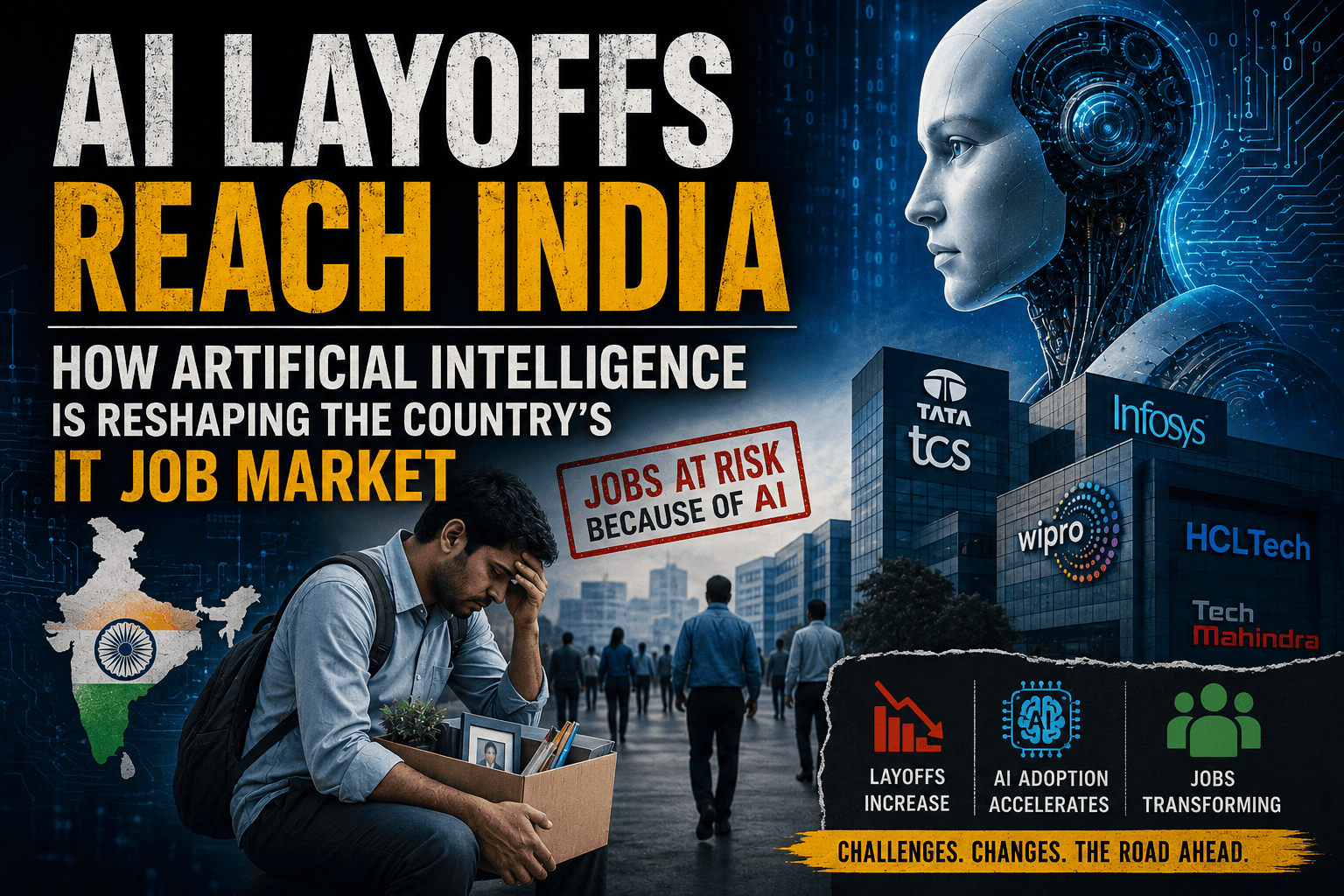
For nearly three decades, India’s IT industry represented one of the greatest economic success stories in modern history.
A middle-class revolution powered by software exports.
Millions of engineering graduates entered companies like TCS, Infosys, Wipro, HCLTech, and Tech Mahindra with one dream:
A stable corporate career.
The formula was simple.
More global clients meant more projects.
More projects meant more hiring.
More hiring meant more prosperity.
But in 2026, that formula began breaking apart.
Artificial intelligence changed the economics of India’s outsourcing engine — and for the first time in years, the country’s massive IT workforce started facing a future where technology growth no longer guaranteed job growth.
India’s IT Industry Has Entered a Structural Shift
Across FY26, India’s top IT companies collectively reduced thousands of jobs while simultaneously investing heavily in AI automation, cloud infrastructure, and productivity tools. Analysts increasingly describe the transition not as a temporary slowdown, but as a structural transformation of the Indian IT services model itself. (LinkedIn)
The old outsourcing model depended on scale.
Indian firms built global dominance by deploying large engineering teams for:
- application maintenance
- software testing
- customer support
- ERP management
- backend operations
- repetitive coding tasks
But generative AI systems can now automate many of those activities.
Tasks that once required dozens of junior engineers can increasingly be handled by AI copilots, autonomous testing tools, AI customer agents, and low-code automation systems.
This has fundamentally changed how companies think about hiring.
TCS Layoffs Became a Wake-Up Call
The biggest shock came from Tata Consultancy Services (TCS), India’s largest IT employer.
Reports indicated that TCS planned to cut over 12,000 jobs as part of restructuring tied to AI transformation and “skill mismatch” concerns. Industry experts warned that this could mark the beginning of a much larger disruption across India’s $283 billion outsourcing industry. (The Economic Times)
The layoffs were especially alarming because TCS has historically been viewed as one of India’s most stable employers.
For years, a TCS offer letter was seen as financial security for an entire family.
But AI changed the calculation.
Industry experts stated that people managers, testing teams, support operations, and mid-level delivery roles were becoming increasingly vulnerable as AI systems automated repetitive workflows. (Reuters)
The psychological impact across India’s tech workforce was immediate.
Employees who once worried about offshore competition now feared software itself.
Infosys, Wipro, HCLTech and Others Begin Restructuring
The shift was not limited to TCS.
Reports throughout 2025 and 2026 showed that Infosys, Wipro, HCLTech, Tech Mahindra, and several multinational firms operating in India had slowed hiring, reduced workforce size, or restructured teams around AI-led delivery models. (The New Indian Express)
Wipro reportedly reduced fresher hiring guidance significantly, while delayed onboarding became a growing issue for graduates waiting months for joining dates. (layofftrends.com)
Tech Mahindra also reported workforce reductions as part of operational restructuring. (layofftrends.com)
At the same time, companies were aggressively investing in:
- AI services
- machine learning
- cybersecurity
- cloud engineering
- autonomous workflows
- AI infrastructure
- data analytics
The hiring focus shifted from volume to specialization.
The industry no longer wanted thousands of generalists.
It wanted fewer AI-capable specialists.
India’s Fresh Graduates Face the Biggest Risk
The biggest concern in India is not senior layoffs alone.
It is the future of entry-level employment.
For years, India’s IT sector absorbed millions of engineering graduates through large-scale campus hiring.
Freshers traditionally started with:
- software testing
- support tickets
- debugging
- documentation
- maintenance work
- repetitive development tasks
But those are exactly the categories AI is automating fastest.
A 2026 executive survey found that companies worldwide increasingly expect AI-driven layoffs, especially among junior positions and standardized tasks. (Tom’s Hardware)
This has created growing anxiety among India’s youth.
The country produces nearly 1.5 million engineering graduates every year, but the industry’s demand is rapidly shifting toward advanced AI, cloud, and analytics skills. (Policy Circle)
The result is a dangerous mismatch:
- universities still teach traditional models
- companies now demand AI-native talent
Many graduates are discovering that having a degree alone is no longer enough.
AI Is Changing the Business Model of Indian IT
The Indian IT industry historically earned money through manpower scaling.
Clients paid for large delivery teams.
Revenue growth was closely tied to employee headcount growth.
But AI breaks that relationship.
Companies are now increasingly selling:
- outcomes
- automation
- productivity gains
- AI-driven efficiencies
Instead of billing for 100 engineers, firms may now deploy:
- 20 engineers
- AI coding assistants
- autonomous testing agents
- cloud automation systems
This dramatically improves efficiency — but reduces hiring demand.
Analysts say the industry is shifting from a “labor arbitrage” model toward an “AI-enabled services” model. (LinkedIn)
That transformation may permanently reduce the need for large workforces.
Global AI Tools Are Also Hitting Indian IT Stocks
The disruption became visible even in the stock market.
When Anthropic launched advanced workplace AI automation tools in early 2026, Indian IT stocks experienced a major selloff as investors feared that AI could reduce demand for traditional outsourcing services. (Reuters)
Infosys, TCS, Wipro, and HCLTech shares all declined sharply during the period.
The concern was simple:
If AI tools can directly automate coding, analysis, testing, legal workflows, and customer operations, global companies may need fewer outsourced workers.
This represents a direct threat to the staffing-heavy structure of India’s IT economy.
But the Story Is Not Entirely Negative
Despite the layoffs and restructuring, India’s tech industry is not collapsing.
In fact, new opportunities are emerging rapidly.
Global Capability Centres (GCCs) operated by companies like Walmart, JPMorgan, Goldman Sachs, Apple, and Shell are expanding aggressively across Bengaluru, Hyderabad, and Pune. (layofftrends.com)
These centers are hiring for:
- AI engineering
- cybersecurity
- advanced cloud operations
- product development
- enterprise AI integration
- data science
Industry experts estimate that GCCs may add between 300,000 to 400,000 new roles in the coming years. (layofftrends.com)
The nature of jobs is changing — not disappearing entirely.
The future workforce will likely be:
- smaller
- more specialized
- AI-assisted
- productivity-focused
The Human Reality Behind the Numbers
Behind every statistic is a personal story.
A mid-level manager in Bengaluru suddenly finds his 15 years of experience no longer enough.
A fresher in Pune waits endlessly for onboarding.
A testing engineer in Hyderabad realizes automation now performs tasks she mastered for years.
A software developer in Noida learns that AI can generate code faster than junior teams.
For many employees, the fear is not immediate unemployment.
It is long-term irrelevance.
And that may be even more terrifying.
India’s Next Big Challenge: Reskilling at Massive Scale
Experts increasingly believe India’s biggest challenge is no longer just job creation.
It is workforce transformation.
The country must rapidly adapt millions of workers for:
- AI-assisted development
- machine learning systems
- cloud-native architectures
- cybersecurity
- automation oversight
- human-AI collaboration
The IT industry is entering a phase where continuous learning may become mandatory for survival.
Those who adapt could thrive in the AI era.
Those who don’t may struggle to remain employable.
Final Thoughts
Artificial intelligence is not simply another software upgrade for India’s IT industry.
It is rewriting the economic foundation on which the sector was built.
The old promise of:
“More technology means more jobs”
is beginning to fade.
The new reality may look very different:
“More technology means fewer people doing more work.”
India now stands at a historic turning point.
The country that became the world’s outsourcing capital must now reinvent itself for an AI-first future.
And the race has already begun.