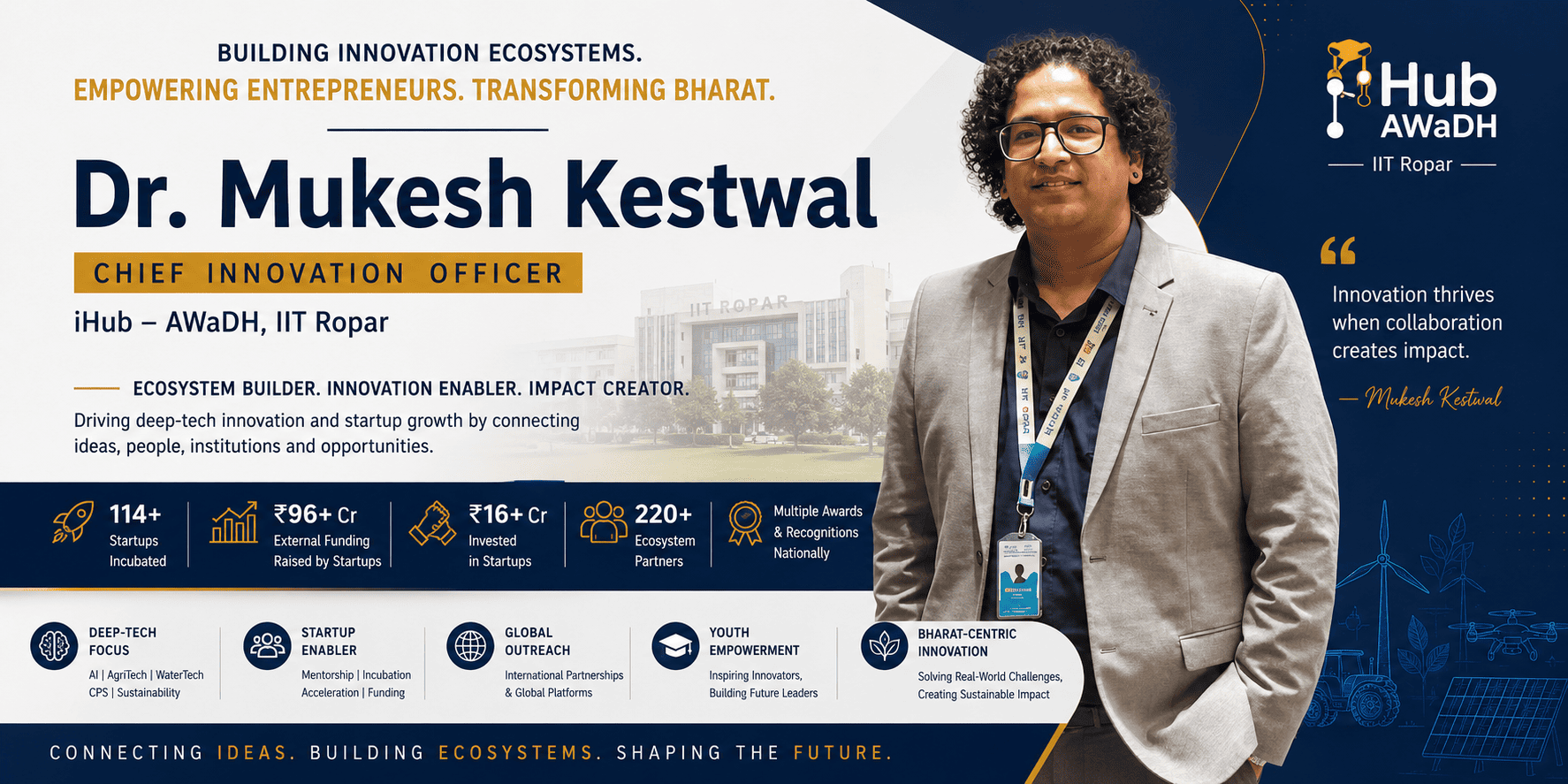
From building Bharat’s deep-tech innovation networks to driving international collaborations with Israel, Canada, Korea, and France, the iHub – AWaDH leader is helping shape India’s next-generation startup ecosystem.
India’s startup ecosystem is undergoing a historic transformation.
What began as a movement dominated by e-commerce and consumer internet startups is rapidly evolving into a deep-tech innovation revolution powered by Artificial Intelligence, Agriculture Technology, Cyber-Physical Systems, sustainability, robotics, and sovereign innovation infrastructure.
At the center of this transformation are not only founders and investors — but ecosystem builders who are creating the networks, collaborations, incubation systems, and innovation platforms required to support the next generation of Indian entrepreneurs.
Among the emerging names in this space is Dr Mukesh Kestwal, Chief Innovation Officer at iHub – AWaDH, IIT Ropar.
Over the last few years, Dr Kestwal has increasingly become associated with the expansion of India’s deep-tech startup ecosystem through:
- startup incubation
- international innovation partnerships
- ecosystem development
- founder mentorship
- global collaboration programs
- Bharat-centric innovation initiatives
His work reflects a larger shift happening across India:
the transition from startup growth to innovation nation-building.
Building More Than Startups — Building Ecosystems
Unlike traditional startup leadership focused solely on valuation growth or fundraising, Dr Mukesh Kestwal’s public work reflects an ecosystem-first approach.
At iHub – AWaDH, IIT Ropar, his role has focused on:
- connecting startups with global opportunities
- enabling institutional partnerships
- strengthening deep-tech incubation
- supporting founders with mentorship and funding access
- creating international innovation bridges
- expanding Bharat-focused innovation outreach
Industry observers increasingly believe that such ecosystem-oriented leadership is becoming essential for India’s long-term innovation competitiveness.
Because sustainable innovation is not built only through startups.
It is built through networks.
Scaling iHub – AWaDH into a National DeepTech Innovation Hub
Under the broader innovation ecosystem associated with iHub – AWaDH, IIT Ropar has emerged as one of India’s rapidly growing deep-tech incubation and startup acceleration centers.
Publicly available information and updated ecosystem figures indicate that the institution has now:
- incubated over 190 startups
- supported startup portfolios that have collectively raised over ₹125 crore
- directly invested more than ₹17 crore through iHub – AWaDH
The innovation hub focuses on:
- Artificial Intelligence
- Agriculture Technology
- Water Technology
- Sustainability
- Cyber-Physical Systems
- Drones and Robotics
- DeepTech commercialization
Experts say these numbers represent more than startup statistics.
They reflect the creation of a scalable innovation infrastructure capable of supporting Bharat’s next generation of technology companies.
Expanding India’s Innovation Diplomacy
One of the defining aspects of Dr Mukesh Kestwal’s recent work has been the expansion of international innovation collaborations.
As India positions itself as a global technology and AI powerhouse, innovation diplomacy is becoming increasingly important.
Dr Kestwal has actively contributed toward strengthening India’s startup and deep-tech partnerships with multiple countries and institutions.
Strengthening India–Israel Innovation Collaboration
Among the most notable international engagements was his visit to Israel as part of an Indian delegation facilitated through the Embassy of Israel in India.
The engagement went beyond ceremonial meetings and MoUs.
Following the visit, Dr Mukesh Kestwal played an active role in hosting the India AI and Global Accelerator Program in collaboration with:
- Embassy of Israel in India
- Reichman University, Israel
The initiative focused on:
- AI innovation
- startup acceleration
- deep-tech collaboration
- international ecosystem exchange
Observers note that this represented a practical innovation partnership model — focused not merely on agreements, but on real startup collaboration, ecosystem engagement, and cross-border innovation enablement.
Driving Collaborations with Canada, Korea, and France
Beyond Israel, Dr Mukesh Kestwal has also contributed toward expanding strategic international partnerships for India’s startup ecosystem.
His public work includes active involvement in:
- partnership development with the University of Saskatchewan, Canada
- collaboration initiatives with KOSME, Korea
- international ecosystem engagements supporting startup and innovation exchange
He is also currently supporting Bharat Innovate 2026, a flagship initiative under the Ministry of Education, Government of India.
As SPOC from IIT Ropar, he is contributing toward strengthening innovation and institutional collaboration with France as part of the initiative.
Such international engagements are increasingly becoming critical as India seeks to:
- expand deep-tech capabilities
- attract global collaboration
- support startup globalization
- build AI and innovation leadership
Taking Innovation Beyond Metro Cities
While much of India’s startup ecosystem historically concentrated around Bengaluru, Delhi NCR, and Mumbai, Dr Kestwal’s work has consistently reflected a Bharat-centric approach.
Programs associated with iHub – AWaDH increasingly focus on:
- Tier-2 and Tier-3 innovation ecosystems
- grassroots entrepreneurship
- AgriTech enablement
- student innovation
- youth entrepreneurship
- rural technology outreach
Initiatives such as:
- PRAGATI
- SAMRIDHI
- startup ideathons
- student innovation programs
- deep-tech acceleration initiatives
have helped bring innovation opportunities to students, founders, and researchers across India.
Industry experts believe such decentralized innovation models will be critical for India’s long-term economic and technological growth.
Connecting Academia, Startups, Government, and Industry
One of the recurring themes across Dr Mukesh Kestwal’s ecosystem work is collaboration.
India’s innovation ecosystem often struggles with fragmentation between:
- startups
- academia
- investors
- industry
- policymakers
His publicly visible work increasingly reflects efforts to bridge these silos.
Through:
- startup acceleration programs
- global innovation summits
- ecosystem partnerships
- founder mentorship
- institutional collaborations
the objective appears clear:
create interconnected innovation ecosystems instead of isolated startup activity.
This model aligns strongly with India’s growing focus on:
- AI sovereignty
- indigenous innovation
- deep-tech commercialization
- research-driven entrepreneurship
Recognition and Institutional Achievements
As iHub – AWaDH expanded its role within India’s innovation ecosystem, the institution also received multiple recognitions.
Public recognitions associated with the institution include:
- Best Incubator Award 2025
- BHARAT Incubator Award 2024
- Best Incubator for Significant Contribution in Startup & Innovation
- Innovation Program Leadership Award
- DSIR SIRO Recognition
These recognitions reflect the increasing visibility of India’s deep-tech incubation ecosystem at the national level.
A Vision Beyond Startup Valuations
What distinguishes many Bharat-focused innovation leaders today is a shift in priorities.
The objective is no longer only creating high-valuation startups.
It is increasingly about solving national-scale challenges through technology.
Publicly visible initiatives associated with Dr Mukesh Kestwal emphasize:
- agriculture transformation
- sustainability
- AI accessibility
- water innovation
- rural technology enablement
- digital inclusion
- deep-tech ecosystem building
This reflects a larger transformation underway within India’s innovation narrative:
from startup economy to innovation-driven nation building.
The Rise of Ecosystem Builders in India
India’s startup ecosystem is entering a new era where ecosystem leaders may become as important as startup founders themselves.
Because founders build companies.
But ecosystem builders create environments where thousands of founders can emerge.
Through:
- incubation infrastructure
- international collaborations
- founder enablement
- institutional partnerships
- global innovation bridges
leaders like Dr Mukesh Kestwal are contributing toward strengthening the foundation of Bharat’s deep-tech future.
As India moves deeper into the age of AI, deep-tech, and global innovation competition, such ecosystem-building leadership is expected to play an increasingly strategic role in shaping the country’s technological future.
And among the emerging contributors helping drive that transformation, Dr Mukesh Kestwal is steadily becoming one of the visible names shaping India’s innovation ecosystem from the ground up.