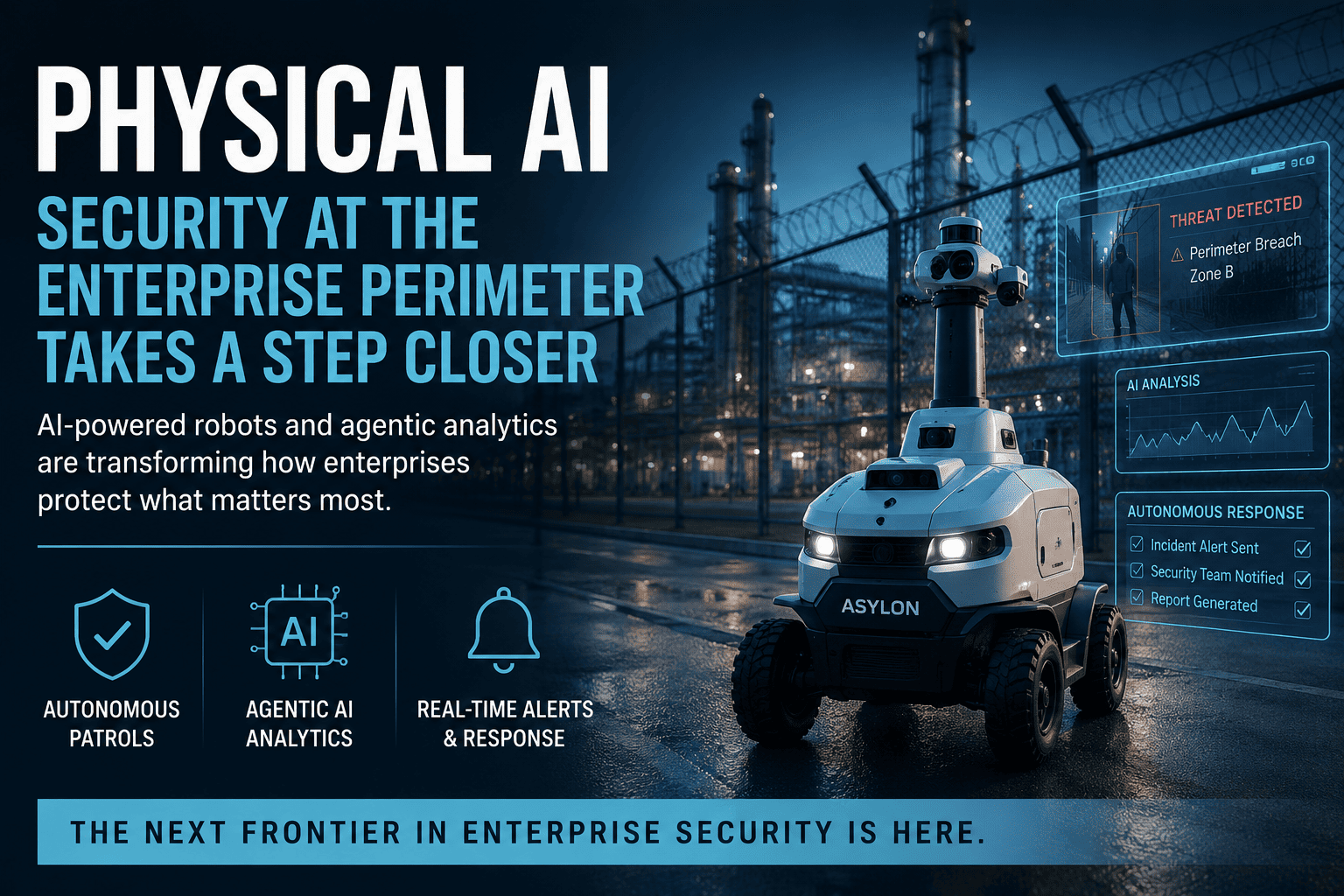
New partnership between Asylon and Thrive Logic signals a major shift in how companies protect critical infrastructure, industrial facilities, and high-security environments.
For years, artificial intelligence transformed digital workflows.
It summarized documents.
Generated code.
Answered questions.
Analyzed data.
Now AI is beginning to leave the screen.
A new wave of technologies known as Physical AI is bringing autonomous intelligence into the real world, enabling machines not only to observe environments but also to actively monitor, analyze, and respond to events as they happen.
One of the latest signs of this shift comes from a newly announced partnership between security robotics company Asylon and AI-driven operational intelligence platform Thrive Logic. Together, the companies are developing an integrated security system that combines robotic perimeter patrols with agentic AI analytics, pushing enterprise security closer to a future where intelligent machines act as active participants in physical protection rather than passive monitoring tools.
The development may appear niche at first glance, but industry experts believe it represents something much larger: the emergence of Physical AI as one of the next major frontiers in enterprise technology.
From Digital Intelligence to Physical Intelligence
The first wave of artificial intelligence was largely digital.
Large language models processed text.
Generative AI created images and videos.
Enterprise AI analyzed documents and business data.
Physical AI introduces a different challenge.
Instead of understanding words and digital information alone, AI systems must interpret and interact with the physical world.
According to technology analysts, Physical AI refers to systems capable of perceiving, reasoning about, and acting within real-world environments using sensors, cameras, robotics, and autonomous decision-making technologies.
These systems combine:
- computer vision,
- sensor fusion,
- robotics,
- spatial intelligence,
- autonomous decision-making,
- and AI reasoning
to understand real-world environments in real time.
Unlike traditional surveillance systems that simply record events, Physical AI systems are increasingly designed to take action.
That distinction is becoming critically important.
Why Enterprise Security Is Changing
Across industries, enterprise security teams are facing growing pressure.
Critical infrastructure operators, industrial facilities, logistics centers, utilities, manufacturing plants, data centers, and corporate campuses are dealing with:
- labor shortages,
- expanding facility footprints,
- increasing security threats,
- rising operational costs,
- and growing compliance requirements.
Traditional perimeter security models often rely on static cameras, manual patrols, and reactive incident response.
The problem is scale.
Modern facilities can span hundreds of acres while generating massive amounts of surveillance data that human operators cannot continuously monitor.
Security teams increasingly face the challenge of finding threats hidden within overwhelming amounts of information.
This is where Physical AI enters the equation.
Industry analysts note that organizations are rapidly shifting from reactive security systems toward intelligence-driven platforms capable of proactive threat detection and autonomous response workflows.
The Asylon-Thrive Logic Model
The partnership between Asylon and Thrive Logic offers a glimpse into how this future may operate.
Under the integration, Asylon’s robotic patrol systems continuously monitor perimeter environments while Thrive Logic’s AI agents analyze incoming video streams and operational data.
Instead of merely capturing footage for later review, the system can:
- identify unusual activity,
- generate alerts,
- trigger incident workflows,
- notify security personnel,
- document events,
- and create audit-ready reports.
According to the companies, the objective is to reduce response friction and improve consistency across high-security environments.
In practical terms, this means security teams may no longer need to watch countless surveillance feeds waiting for incidents to occur.
AI systems increasingly become active observers capable of highlighting potential risks as they emerge.
Security Robots Are Becoming Operational Assets
Robotic patrols were once viewed primarily as experimental technologies.
Today, that perception is changing rapidly.
Modern security robots can patrol facilities continuously, navigate complex environments, monitor restricted areas, and provide persistent visibility without the limitations associated with human fatigue or staffing shortages.
Asylon’s Robotic Security Operations Center (RSOC) is designed to provide 24/7 robotic oversight, helping organizations maintain consistent perimeter coverage while generating documented security outcomes.
When combined with AI-driven analysis platforms, robotic patrol systems become more than mobile cameras.
They become operational security assets capable of participating in detection and response workflows.
For industries responsible for protecting:
- utilities,
- energy infrastructure,
- manufacturing facilities,
- transportation networks,
- government installations,
- and data centers,
such capabilities are increasingly attractive.
The Rise of Agentic Security
The emergence of Physical AI is closely linked to another major AI trend: agentic systems.
Agentic AI refers to systems capable of taking actions autonomously rather than simply generating outputs.
Instead of waiting for instructions after every step, agentic systems can:
- plan workflows,
- monitor environments,
- evaluate conditions,
- and initiate actions.
In the security context, this creates entirely new possibilities.
An AI agent may:
- detect unusual activity,
- assess threat levels,
- initiate response procedures,
- notify stakeholders,
- and document incidents automatically.
The Asylon-Thrive Logic integration represents one of the early examples of this concept being deployed within physical security operations.
Industry observers increasingly view agentic security systems as the next evolution beyond traditional surveillance.
Physical AI and the Convergence of Cyber and Physical Security
One reason Physical AI is attracting significant attention is because the boundary between physical security and cybersecurity is rapidly disappearing.
Modern facilities rely heavily on:
- connected sensors,
- IoT devices,
- access control systems,
- industrial control networks,
- autonomous systems,
- cloud infrastructure.
As these environments become more interconnected, physical and digital threats increasingly overlap.
Experts note that enterprises are moving toward unified security architectures that combine:
- video surveillance,
- access management,
- operational technology,
- cybersecurity monitoring,
- and AI-driven analytics
within a single operational view.
Physical AI serves as a bridge between those worlds.
The New Enterprise Perimeter
Historically, perimeter security meant fences, gates, cameras, and guards.
That definition is rapidly changing.
Security researchers argue that the modern perimeter increasingly includes:
- sensors,
- cameras,
- connected devices,
- industrial systems,
- autonomous machines,
- software agents,
- and cloud-connected infrastructure.
As AI systems become capable of autonomous action, security strategies must evolve accordingly.
The perimeter is no longer merely a physical boundary.
It is becoming an intelligent operational layer.
Opportunities and Risks
While Physical AI offers major advantages, it also introduces new challenges.
As organizations deploy autonomous security systems, concerns emerge around:
- decision accountability,
- false positives,
- system transparency,
- AI bias,
- cybersecurity vulnerabilities,
- autonomous response controls.
Recent industry discussions have highlighted growing concerns around autonomous AI systems operating within enterprise environments, particularly as agents gain access to sensitive infrastructure and operational systems.
For security leaders, the challenge will be balancing automation with oversight.
AI may dramatically improve detection and response capabilities, but organizations still require governance frameworks that ensure autonomous systems remain predictable, auditable, and controllable.
A Glimpse Into the Future
The broader significance of the Asylon-Thrive Logic partnership extends beyond perimeter security.
It reflects a larger technological transformation now underway.
Artificial intelligence is moving from:
- generating content
- assisting workflows
- analyzing information
to:
- monitoring environments
- controlling systems
- interacting with infrastructure
- making operational decisions
This transition represents the evolution from digital AI to Physical AI.
Analysts increasingly believe Physical AI could become one of the defining enterprise technology trends of the decade, influencing industries ranging from security and logistics to manufacturing, healthcare, transportation, and critical infrastructure.
The Beginning of an Autonomous Security Era
The AI revolution is no longer confined to chat interfaces and cloud software.
It is beginning to enter warehouses, industrial facilities, power grids, campuses, transportation hubs, and enterprise perimeters.
As autonomous robots, intelligent sensors, and agentic AI systems converge, organizations are moving toward security environments that can observe, understand, and respond in real time.
The partnership between Asylon and Thrive Logic may be one of the earliest examples of this transition becoming operational reality.
For enterprise leaders, the message is increasingly clear:
The future of security may not be defined by who watches the perimeter.
It may be defined by which AI systems are protecting it.