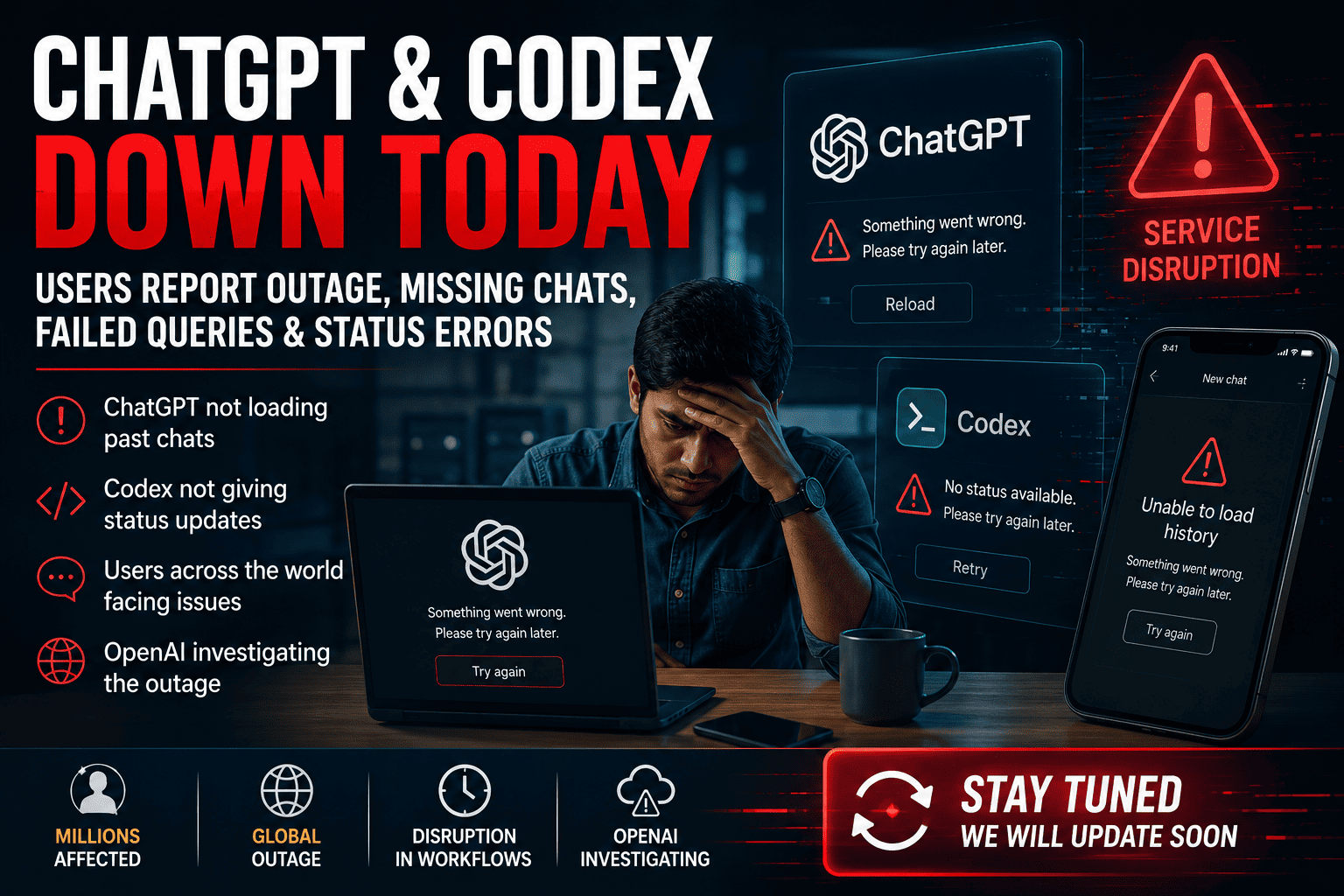
OpenAI faces another major service disruption as developers, students, businesses, and enterprises struggle with inaccessible AI tools increasingly embedded into daily work.
A major outage affecting OpenAI’s flagship platforms, ChatGPT and Codex, triggered widespread disruption across the world on Friday, highlighting just how deeply artificial intelligence tools have become integrated into modern digital workflows.
Users across multiple countries, including India, reported being unable to access ChatGPT, load previous conversations, retrieve chat history, or use Codex-powered coding features. Social media platforms quickly filled with complaints as professionals, students, developers, and businesses found themselves unexpectedly cut off from services many now rely on daily. (The Economic Times)
For many users, the outage began with unusual behavior inside ChatGPT.
Some reported blank conversation windows.
Others encountered repeated error messages.
Several users said past chats disappeared entirely from their conversation history, while developers using Codex reported stalled tasks and missing status updates. (The Economic Times)
The disruption rapidly became one of the most discussed technology incidents of the day, reflecting the growing dependence on generative AI systems not merely as productivity tools but as critical infrastructure for knowledge work.
When AI Becomes Part of Daily Operations
Just a few years ago, an outage affecting an AI chatbot would have been viewed as a temporary inconvenience.
Today, the consequences are far broader.
ChatGPT is now used by:
- software developers,
- researchers,
- students,
- content creators,
- startups,
- enterprises,
- customer support teams,
- and government organizations.
Meanwhile, Codex has evolved into a major coding assistant used for software development, debugging, automation, and workflow execution.
As reports of service failures spread, users described interruptions to:
- coding projects,
- business reports,
- academic work,
- software deployments,
- and customer-facing operations. (The Economic Times)
The incident serves as another reminder that generative AI has moved beyond experimentation and become an operational dependency for millions.
What Users Experienced
According to reports from users and outage trackers, the issues manifested in several ways.
Many users attempting to open ChatGPT encountered:
- loading failures,
- conversation errors,
- network error messages,
- slow responses,
- missing chat history,
- or completely blank interfaces. (The Economic Times)
Developers using Codex reported similar difficulties.
Some users stated that coding sessions stopped responding, while others said Codex failed to return status updates during active workflows. (The Economic Times)
For businesses that increasingly integrate OpenAI services into internal operations, even short interruptions can affect productivity across multiple departments.
OpenAI Status Systems Confirm Service Issues
OpenAI’s service status records showed incidents affecting ChatGPT, Codex, and API-related infrastructure during the outage period.
Status updates referenced users being unable to load ChatGPT, Codex, and API services, while multiple service components experienced degraded performance. (OpenAI Status)
Historical records reveal that OpenAI has experienced a growing number of service interruptions throughout 2026, including:
- elevated conversation errors,
- login failures,
- API disruptions,
- Codex responsiveness issues,
- workspace access problems,
- file upload failures,
- and degraded performance events. (OpenAI Status)
While most incidents have been resolved relatively quickly, the frequency of disruptions highlights the operational complexity involved in running large-scale AI infrastructure serving hundreds of millions of users globally.
The Infrastructure Challenge Behind AI at Scale
The outage arrives at a time when AI adoption is accelerating at unprecedented speed.
Every major OpenAI release attracts new users, increased workloads, and more demanding use cases.
Unlike traditional web applications, modern AI systems require enormous computational resources.
Every query sent to ChatGPT triggers:
- inference workloads,
- model routing,
- memory management,
- infrastructure orchestration,
- GPU allocation,
- and distributed processing systems.
When millions of users interact simultaneously, even minor infrastructure issues can cascade into large-scale service degradation.
Industry experts note that maintaining availability for frontier AI systems is becoming one of the most difficult engineering challenges in technology.
The challenge becomes even greater as AI evolves from simple chat interactions toward long-running agent workflows capable of:
- executing tasks,
- writing code,
- conducting research,
- and interacting with external tools.
Codex Has Become a Critical Tool for Developers
One reason the outage attracted particular attention was the disruption of Codex.
OpenAI has invested heavily in expanding Codex capabilities throughout 2026.
Recent updates introduced:
- richer contextual understanding,
- longer task execution,
- browser integration,
- enhanced coding workflows,
- and remote development capabilities. (OpenAI Help Center)
The platform has seen rapid adoption among software developers seeking AI-assisted coding support.
Industry reports indicate Codex usage has expanded significantly following the release of newer coding-focused models and development tools. (TechRadar)
As AI increasingly becomes embedded within software development workflows, interruptions can affect not only productivity but also deployment timelines and engineering operations.
The Growing Risk of AI Dependency
The outage has reignited a broader discussion across the technology industry:
What happens when businesses become dependent on AI systems that remain externally operated?
Organizations increasingly rely on AI for:
- customer support,
- software development,
- research,
- documentation,
- analytics,
- and workflow automation.
Yet many of these capabilities are concentrated within a small number of AI providers.
The incident illustrates a growing operational risk.
When AI becomes part of critical business infrastructure, service outages can have cascading consequences across organizations that lack fallback systems.
Some experts argue that enterprises may increasingly adopt:
- multi-model strategies,
- hybrid AI deployments,
- open-source alternatives,
- and on-premise AI infrastructure
to reduce dependence on a single provider.
A Reminder of How Fast AI Has Changed Work
Perhaps the most revealing aspect of the outage was the public reaction.
Across social media, users expressed frustration not merely because a website stopped working, but because an essential part of their workflow suddenly disappeared.
Just three years ago, many organizations had never used generative AI.
Today, countless professionals begin their day with ChatGPT open alongside email, documentation tools, development environments, and productivity software.
The outage demonstrated how quickly AI has transitioned from a novelty into an everyday work platform.
The Road Ahead
As of the latest updates, OpenAI has continued monitoring service recovery efforts while restoring affected systems. Several previous outages throughout the year have eventually been resolved, though the company has not yet publicly detailed the precise cause behind the latest disruption. (OpenAI Status)
For users, the incident serves as a reminder to maintain backups, diversify workflows, and avoid complete dependence on a single AI platform.
For OpenAI, it underscores an even larger challenge.
The company is no longer simply operating a chatbot.
It is increasingly running a layer of digital infrastructure that millions of people rely upon for work, education, software development, research, and business operations.
As artificial intelligence becomes more deeply embedded into everyday life, reliability may become just as important as intelligence itself.
And each outage serves as a reminder that building the future of AI is not only about creating smarter models — it is also about ensuring they remain available when the world depends on them.