For decades, countries measured their influence through military strength, economic power, natural resources, or technological innovation. In the 21st century, a new form of influence is emerging: the ability to build digital systems that empower billions of people.
India may have quietly become the global leader in this new category.
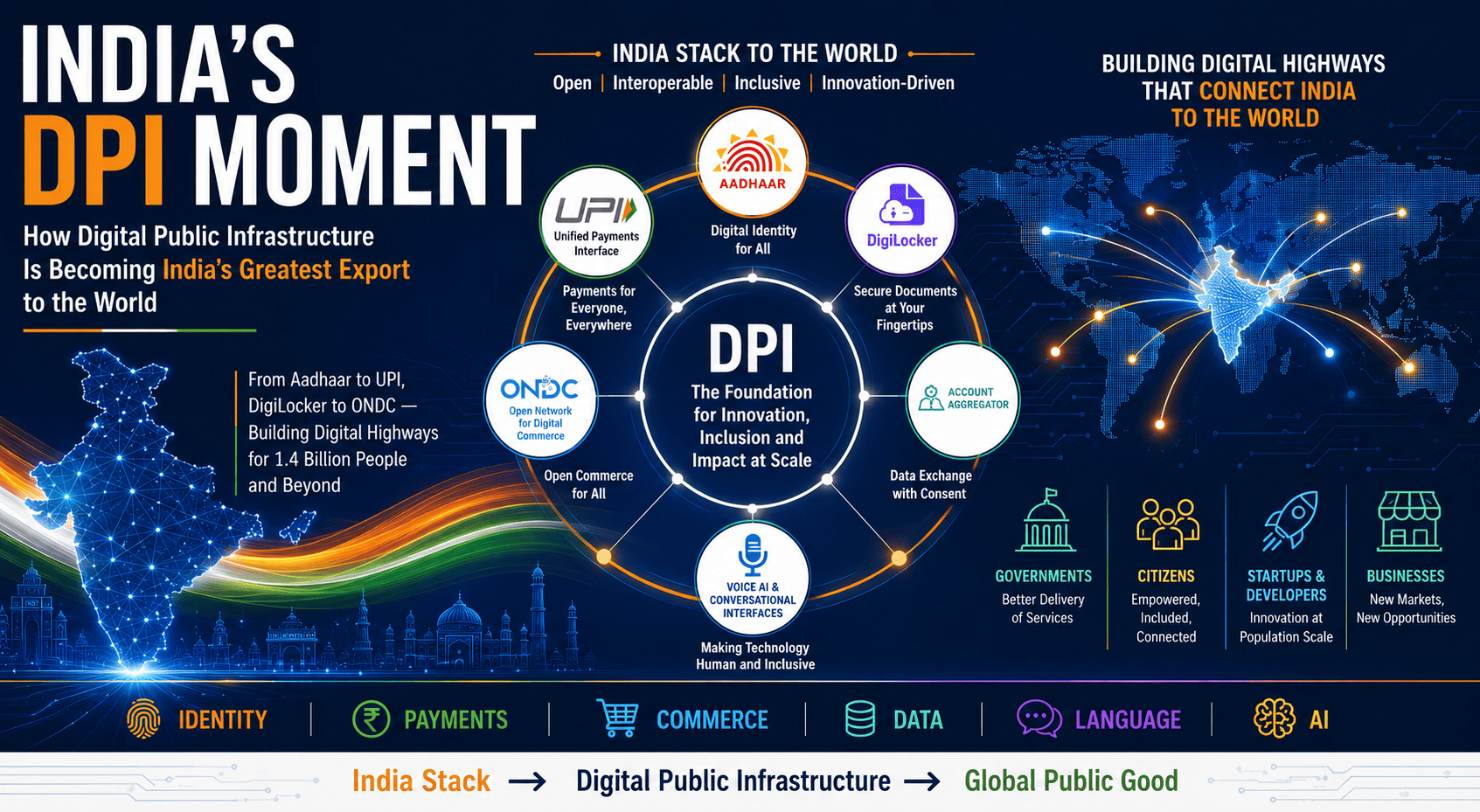
What began as a domestic effort to solve problems of identity, financial inclusion, and public service delivery has evolved into one of the most ambitious digital transformation stories in modern history. The world now recognizes this framework as Digital Public Infrastructure (DPI)—a set of interoperable digital systems that allow governments, businesses, and citizens to interact seamlessly at population scale.
From Aadhaar and UPI to DigiLocker, CoWIN, ONDC, and Account Aggregator, India has built not just applications but foundational digital rails that enable innovation across sectors. These platforms are increasingly being viewed as public goods for the digital age.
The significance of this achievement extends far beyond India’s borders.
From Population Scale Challenges to Population Scale Solutions
India’s digital transformation did not emerge from abundance. It emerged from necessity.
A nation of over 1.4 billion people faced challenges that traditional systems struggled to solve efficiently. Delivering welfare benefits, verifying identities, expanding financial inclusion, and enabling access to public services required solutions that could operate at unprecedented scale.
The answer was not a single platform but a layered approach.
Digital identity through Aadhaar established trust. UPI transformed payments. DigiLocker enabled secure document exchange. CoWIN demonstrated how digital infrastructure could support one of the world’s largest vaccination drives. ONDC is now attempting to do for digital commerce what UPI did for payments—creating open networks instead of closed platforms.
Each system became stronger because it was designed as infrastructure rather than a standalone product.
The Rise of the DPI Stack
Unlike many technology ecosystems dominated by proprietary platforms, India’s DPI philosophy is built around openness, interoperability, and public access.
The model creates digital highways upon which private innovation can flourish.
Thousands of startups, fintech companies, banks, educational institutions, healthcare providers, and government agencies have built services atop these digital rails. Innovation no longer requires rebuilding identity verification, payment systems, or trust frameworks from scratch.
This dramatically lowers the cost of innovation while increasing accessibility for citizens.
The result is a rare alignment of public policy and market-driven growth.
India’s New Soft Power
Historically, countries exported products.
Today, India is exporting frameworks.
Governments across Asia, Africa, Latin America, and the Middle East are studying India’s digital infrastructure model. Several countries are exploring collaborations around identity systems, payment networks, digital governance frameworks, and citizen service platforms.
This represents a new dimension of India’s global influence.
Unlike traditional exports, DPI creates long-term institutional partnerships. Countries adopting elements of India’s digital architecture are not simply purchasing technology; they are embracing a governance model that combines scale, inclusion, and affordability.
India’s digital public infrastructure is increasingly becoming a cornerstone of its foreign policy engagement, particularly with developing nations seeking to leapfrog legacy systems.
The Next Frontier: Language and AI
While payments and identity formed the first generation of India’s DPI journey, the next chapter is likely to be driven by artificial intelligence and language technologies.
The true test of digital inclusion is not whether services are available online, but whether they are accessible to every citizen regardless of language, literacy, geography, or technical expertise.
This is where initiatives such as Bhashini are becoming increasingly important.
Just as UPI democratized digital payments, language infrastructure has the potential to democratize access to knowledge, governance, education, healthcare, and commerce. AI-powered translation, speech recognition, and speech-to-speech communication can make digital services available in every Indian language and dialect.
The future of DPI may not be typed—it may be spoken.
Voice-based interfaces, multilingual AI systems, and conversational government services could become the next foundational layer of India’s digital transformation.
From India Stack to Global Stack
The world is entering an era where digital infrastructure will shape economic competitiveness as much as physical infrastructure once did.
Countries that successfully build digital highways for identity, payments, data exchange, commerce, and communication will be better positioned to deliver services, foster innovation, and drive inclusive growth.
India’s achievement lies not merely in building technology but in proving that population-scale digital systems can be inclusive, affordable, and interoperable.
What began as a solution to India’s unique challenges has evolved into a model that many nations now seek to emulate.
This is India’s DPI moment.
Not because the world is discovering Indian technology.
But because the world is beginning to recognize that digital public infrastructure may become as essential to national development in the 21st century as roads, railways, and electricity were in the 20th.
And in that future, India is not following the global playbook.
It is helping write it.