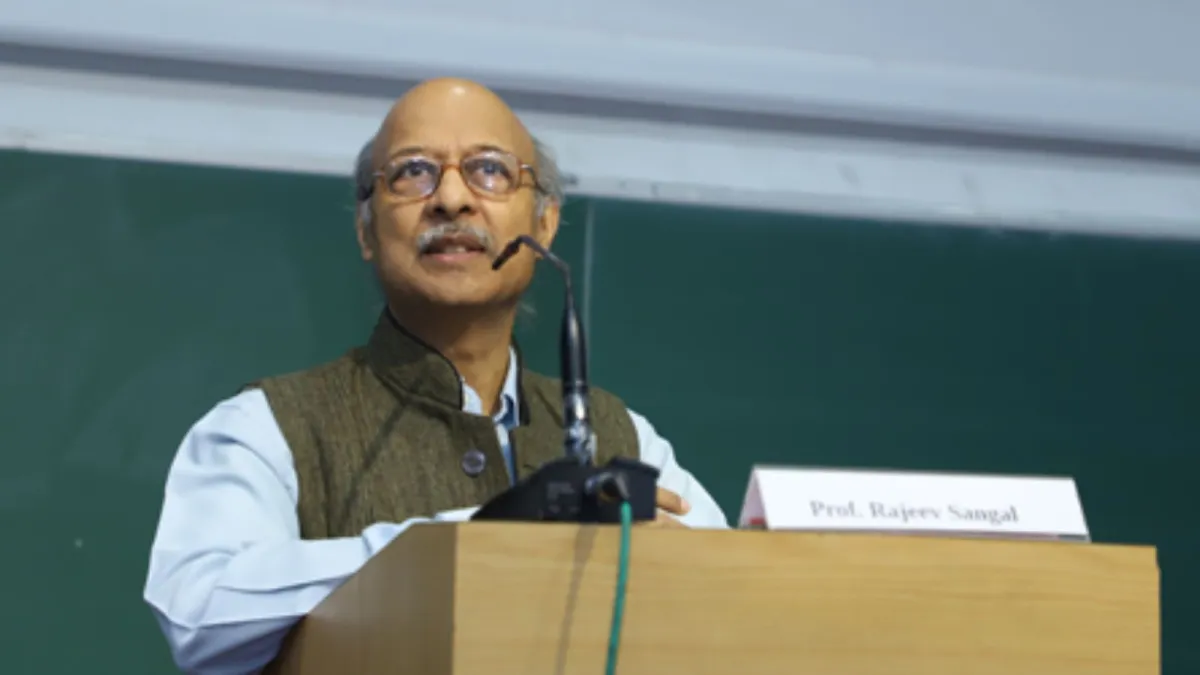
“Some people build products. Some build institutions. A rare few build national missions that redefine a country’s technological future.”
When the story of Artificial Intelligence in India is written, it will undoubtedly mention breakthroughs in Large Language Models, speech recognition, and multilingual AI. Yet, behind one of India’s most transformative AI initiatives—Mission BHASHINI (National Language Translation Mission)—stands a visionary whose contribution extends far beyond technology. Professor Rajeev Sangal is not merely a computer scientist or academician; he is the principal architect who transformed decades of Indian language research into a national AI mission aimed at democratizing digital access for over a billion people. (IIIT Hyderabad Blogs)
A Pioneer Long Before AI Became Mainstream
Long before generative AI captured the world’s imagination, Prof. Rajeev Sangal had dedicated his career to one of India’s most challenging technological problems—enabling computers to understand, process, and translate Indian languages.
After earning his B.Tech. in Electrical Engineering from IIT Kanpur, followed by an M.S. and Ph.D. in Computer and Information Science from the University of Pennsylvania, he returned to India instead of pursuing opportunities abroad. Beginning his academic career at IIT Kanpur in 1982, he devoted over four decades to research in Artificial Intelligence, Natural Language Processing (NLP), Machine Translation, and Computational Linguistics. (Indian National Academy of Engineering)
His research on Computational Paninian Grammar, inspired by the linguistic principles of the ancient Indian grammarian Panini, became one of the foundational frameworks for computational processing of Indian languages. At a time when most global NLP research focused on English and a handful of European languages, Prof. Sangal believed that India’s linguistic diversity demanded its own scientific and technological approach. (Indian National Academy of Engineering)
Building Institutions That Outlast Individuals
Prof. Sangal’s legacy is not confined to research papers or algorithms. He has consistently demonstrated the ability to build institutions capable of nurturing generations of innovators.
As the first full-time Director of IIIT Hyderabad, he helped establish it as one of India’s premier research universities in Artificial Intelligence, Machine Learning, Robotics, Computer Vision, and Language Technologies. Under his leadership, the institute emerged as a global centre for Natural Language Processing research and fostered collaborations across academia, industry, and government. Later, as Director of IIT (BHU) Varanasi, he continued to strengthen research ecosystems and academic leadership. (Indian National Academy of Engineering)
These experiences would prove invaluable when India embarked on one of its most ambitious AI initiatives.
Conceiving Mission BHASHINI
The origins of Mission BHASHINI date back to 2018, well before the advent of ChatGPT and the global generative AI boom.
Under the Prime Minister’s Science, Technology and Innovation Advisory Council (PM-STIAC), Prof. K. VijayRaghavan requested Prof. Sangal to prepare a technology roadmap for addressing India’s language translation challenges. What began as an initiative focused on translating scientific and technical content soon evolved into a far more ambitious vision—a national AI mission capable of breaking language barriers across governance, education, healthcare, justice, agriculture, and citizen services. (IIIT Hyderabad Blogs)
Prof. Sangal envisioned a platform where every Indian, irrespective of language, could interact naturally with digital systems. His objective was not merely translation, but the creation of a multilingual digital public infrastructure powered by indigenous AI.
The Founding Architect
As the Founding Chairman of the Executive Committee of Mission BHASHINI (2021–2026), Prof. Sangal guided the mission from concept to implementation. His leadership went beyond defining technical architecture—he shaped its organizational structure, collaborative model, research priorities, and long-term vision. (IIIT Hyderabad Blogs)
Rather than concentrating development within a single institution, he designed a distributed research ecosystem involving approximately 70 research groups across 30 academic institutions, organized into multiple consortia. This collaborative framework enabled India to mobilize expertise in speech recognition, speech synthesis, machine translation, optical character recognition, transliteration, and language datasets across numerous Indian languages. (IIIT Hyderabad Blogs)
The mission thus became not only a technology programme but also a national capacity-building initiative.
Beyond Technology: Building an AI Ecosystem
One of Prof. Sangal’s most significant contributions lies in his understanding that AI leadership cannot be achieved through software alone.
Mission BHASHINI emphasized:
- Development of high-quality multilingual datasets.
- Creation of foundational AI models for Indian languages.
- Open APIs enabling government and industry integration.
- Academic collaboration at national scale.
- Capacity building for AI researchers and engineers.
- Real-world deployment across public digital services.
Prof. Sangal has argued that perhaps BHASHINI’s greatest achievement is not merely its technology, but the human capital it has created—training hundreds of researchers while strengthening India’s long-term AI ecosystem. (IIIT Hyderabad Blogs)
A Vision Ahead of Its Time
When BHASHINI was conceived, the world had yet to witness the explosive growth of generative AI.
The mission’s focus on speech-to-speech translation, multilingual language models, and conversational AI anticipated many of the challenges that would later become central to global AI development. After ChatGPT’s emergence, BHASHINI’s early investments in Indian language resources positioned India to accelerate work on indigenous multilingual AI systems. (The Indian Express)
Today, the mission supports hundreds of AI models, serves government platforms, and contributes to language technologies that power digital services across sectors. (The Indian Express)
Language as National Infrastructure
Unlike many AI initiatives focused primarily on commercial applications, Prof. Sangal viewed language technology as essential public infrastructure.
India’s linguistic diversity, often perceived as a challenge, became the foundation of his vision. Whether a farmer seeking agricultural advice, a patient consulting healthcare services, a student accessing educational content, or a citizen interacting with government portals, language should never become a barrier to participation in the digital economy.
This philosophy aligns closely with India’s broader Digital Public Infrastructure movement, where AI is treated not merely as a commercial product but as an enabler of inclusive governance and public service delivery.
Leadership Rooted in Values
Colleagues frequently describe Prof. Sangal as an institution builder who combines technical excellence with an emphasis on ethics and education. Beyond AI research, he has championed Universal Human Values in engineering education, arguing that technological progress must remain grounded in societal purpose. (Indian National Academy of Engineering)
This perspective is reflected in BHASHINI itself. Rather than pursuing AI for prestige alone, the mission seeks to make technology accessible to citizens in their own languages, ensuring that innovation serves inclusion.
The Lasting Legacy
Technological missions often become associated with platforms, software, or products. Yet their true impact lies in the ecosystems they create.
Prof. Rajeev Sangal’s enduring legacy is not simply BHASHINI as a platform. It is the research culture, institutional collaboration, multilingual AI ecosystem, and human talent that the mission has cultivated across India.
He demonstrated that India need not imitate global AI leaders; it could chart its own course by addressing uniquely Indian challenges with indigenous innovation.
The history of technology often celebrates the final product while overlooking those who designed its foundations. Prof. Rajeev Sangal belongs to that rare class of visionaries whose greatest achievements are embedded within institutions rather than individual accolades.
As the architect of Mission BHASHINI, he transformed decades of research in computational linguistics into a national mission that has reshaped India’s approach to language technology and artificial intelligence. His work reminds us that true nation-building in technology is not measured solely by algorithms or infrastructure, but by the number of people empowered through them.
In the years to come, millions of Indians may use AI-driven language services without knowing the name of the person who first imagined such a future. Yet every conversation made possible across languages, every government service accessed in a citizen’s mother tongue, and every barrier removed by multilingual AI will stand as a testament to Prof. Rajeev Sangal’s vision.
Some architects design buildings. Others design institutions. Prof. Rajeev Sangal designed a mission that gave India a multilingual voice in the age of artificial intelligence.