“Every examination should test a student’s knowledge—not the strength of a criminal network.”
For years, India’s competitive examinations have represented hope. For a student in a remote village, an entrance test could open the doors to an IIT. For a graduate preparing for years, a government recruitment examination could change the economic future of an entire family.
But every time a question paper is leaked, that hope is shaken.
Behind every leaked examination paper are countless untold stories—a student who sacrificed festivals to study, parents who invested their life savings in coaching, and young aspirants who believed that merit alone would determine their future. When organised criminal networks manipulate examinations, they don’t merely break a law; they undermine the trust that forms the foundation of a nation’s education and recruitment system.
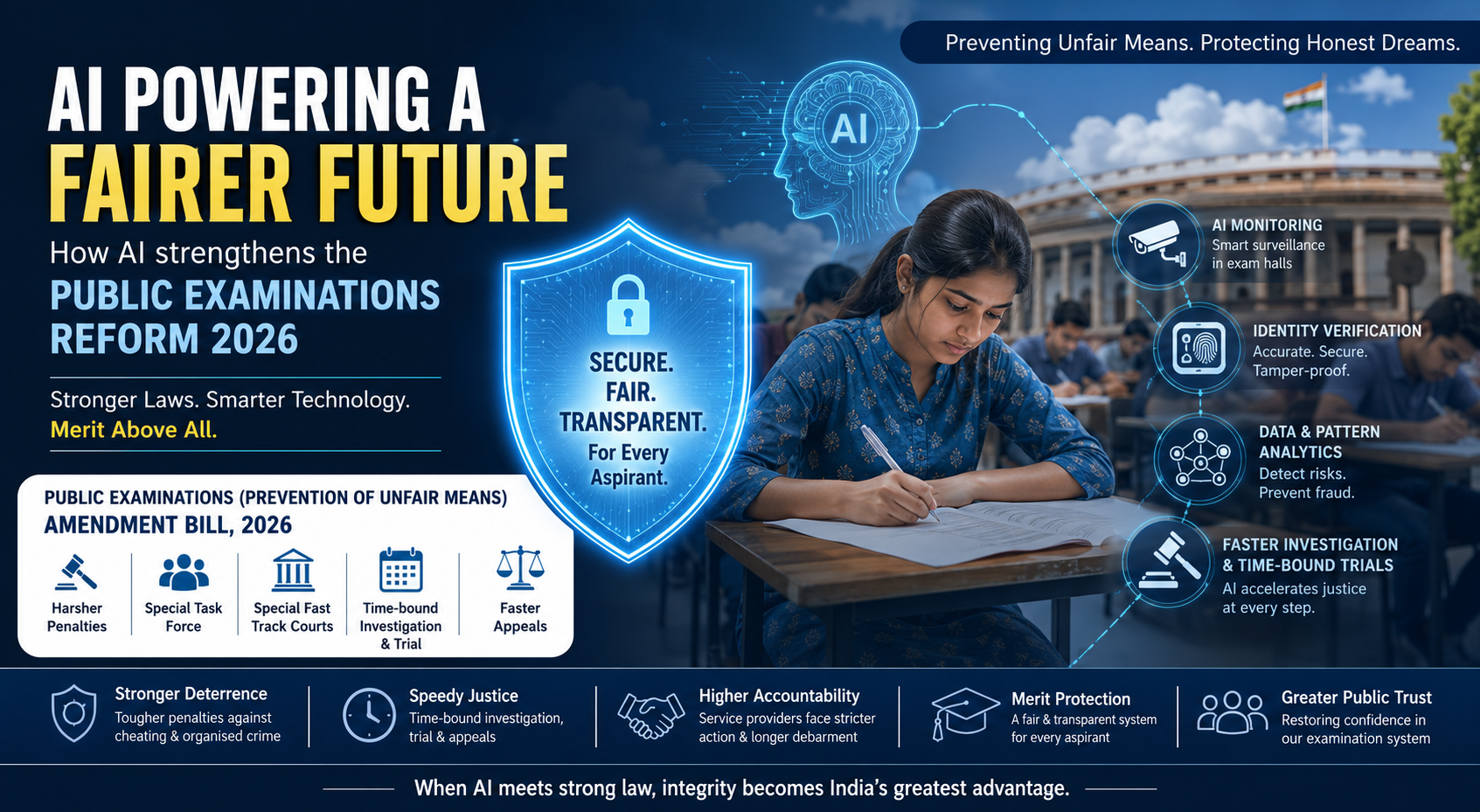
Recognising this growing challenge, Parliament has introduced the Public Examinations (Prevention of Unfair Means) Amendment Bill, 2026. The legislation strengthens penalties, mandates faster investigations, creates Special Fast Track Courts, and targets organised examination fraud with unprecedented seriousness.
Yet, an important question remains.
Can laws alone defeat technology-enabled crime?
The answer is increasingly becoming Artificial Intelligence.
The Criminals Have Changed. So Must the System.
A decade ago, examination malpractice often involved handwritten notes or impersonation by an individual candidate.
Today, the landscape is entirely different.
Question papers are transmitted within seconds through encrypted messaging platforms. Digital devices have become smaller and harder to detect. Fake identities can be generated using advanced image-editing tools, and organised syndicates operate across multiple states, using sophisticated communication channels and financial networks.
By the time investigators begin collecting evidence, the damage has often already been done.
This is where Artificial Intelligence changes the story.
Rather than waiting for a crime to occur, AI has the ability to detect patterns, identify risks, and alert authorities before a breach escalates into a nationwide scandal.
Imagine the Journey of One Examination
Months before the examination is conducted, thousands of candidates begin registering online.
Traditionally, officials manually verify applications. AI, however, can analyse millions of records within minutes.
It can detect duplicate registrations, suspicious identity documents, multiple applications using similar photographs, or unusual registration patterns emerging from a particular region.
Before anyone enters the examination hall, AI has already begun protecting the system.
The Question Paper Becomes Intelligent
The question paper is perhaps the most sensitive asset in the entire examination process.
Instead of relying solely on human supervision, AI can continuously monitor who accesses confidential files, when they are accessed, where they are downloaded, and whether any unusual activity occurs.
If someone attempts to retrieve the paper at an unusual hour or from an unauthorised location, the system can immediately raise an alert.
The objective is simple: prevent leaks rather than investigate them later.
Inside the Examination Hall
On examination day, thousands of invigilators oversee candidates across the country.
Imagine giving each of them an intelligent digital assistant.
AI-powered computer vision systems can observe examination halls in real time, identifying suspicious behaviour such as repeated communication between candidates, attempts to use concealed electronic devices, impersonation, or unusual movement patterns.
The technology does not replace the invigilator. Instead, it quietly highlights situations that require attention, allowing human supervisors to make the final decision.
When a Crime Happens, Speed Becomes Critical
The Amendment Bill requires investigations to be completed within two months.
Meeting this timeline would be extremely difficult if investigators had to manually analyse thousands of mobile phones, financial records, digital messages, CCTV footage, and electronic documents.
AI can dramatically accelerate this process.
It can organise digital evidence, identify links between suspects, reconstruct communication timelines, detect recurring phone numbers, trace financial transactions, and reveal connections that might otherwise remain hidden.
Instead of spending weeks searching for clues, investigators can focus on building stronger cases.
Seeing the Entire Criminal Network
Perhaps the greatest strength of AI lies in its ability to connect seemingly unrelated pieces of information.
A mobile number recovered in Rajasthan may also appear in investigations in Uttar Pradesh.
A payment made through one digital wallet could be linked to multiple examination centres.
A service provider operating in one state may repeatedly appear in suspicious activities elsewhere.
While these connections may not be obvious to human investigators reviewing isolated files, AI can visualise them as interconnected criminal networks.
The result is a shift from arresting individual offenders to dismantling entire organised syndicates.
Justice Should Not Wait
The Amendment Bill also mandates Special Fast Track Courts and seeks to complete trials within three months.
Here too, AI can become a valuable assistant.
Court proceedings can be transcribed automatically. Documents can be translated instantly into multiple Indian languages. Judges and prosecutors can search thousands of pages of evidence within seconds. Chronologies, witness statements, and digital records can be organised intelligently, reducing administrative burdens while allowing the judiciary to focus on legal reasoning.
AI does not deliver judgments. It enables faster access to information, helping courts manage increasingly complex digital evidence.
Learning Before the Next Crime Happens
Perhaps the most exciting capability of Artificial Intelligence is not investigation—but prediction.
By studying historical examination data, AI can identify recurring patterns.
It may reveal that certain examination centres consistently report unusual activity. It may identify service providers with repeated compliance issues or flag anomalies in candidate attendance, scoring patterns, or logistics.
These insights allow authorities to strengthen monitoring before the next examination is held, reducing the likelihood of malpractice.
In this sense, AI transforms the examination system from one that reacts to fraud into one that anticipates and prevents it.
Law and Technology Must Work Together
The Public Examinations (Prevention of Unfair Means) Amendment Bill, 2026 provides the legal framework. It increases punishments, creates Special Task Forces, establishes Fast Track Courts, and introduces strict timelines for investigations and trials.
Artificial Intelligence complements these reforms by making them operationally effective.
Together, they create a comprehensive ecosystem where:
- Strong laws deter offenders.
- AI identifies threats early.
- Investigators solve cases faster.
- Courts dispose of cases more efficiently.
- Honest candidates receive the protection they deserve.
The Real Winner
At the heart of this reform is not technology or legislation.
It is the student who studies late into the night believing that effort will be rewarded.
It is the parent who sacrifices personal comforts to support a child’s education.
It is the belief that public examinations should remain a fair gateway to opportunity.
Artificial Intelligence will never replace honesty, determination, or merit. But when combined with a robust legal framework such as the Public Examinations (Prevention of Unfair Means) Amendment Bill, 2026, it can become a silent guardian—working behind the scenes to ensure that the future of millions is decided not by paper leaks or organised fraud, but by knowledge, integrity, and hard work.
In the years ahead, the true success of this reform will not be measured only by the number of convictions. It will be measured by something far more meaningful: the confidence of every student walking into an examination hall, knowing that the system is designed to protect fairness at every step.