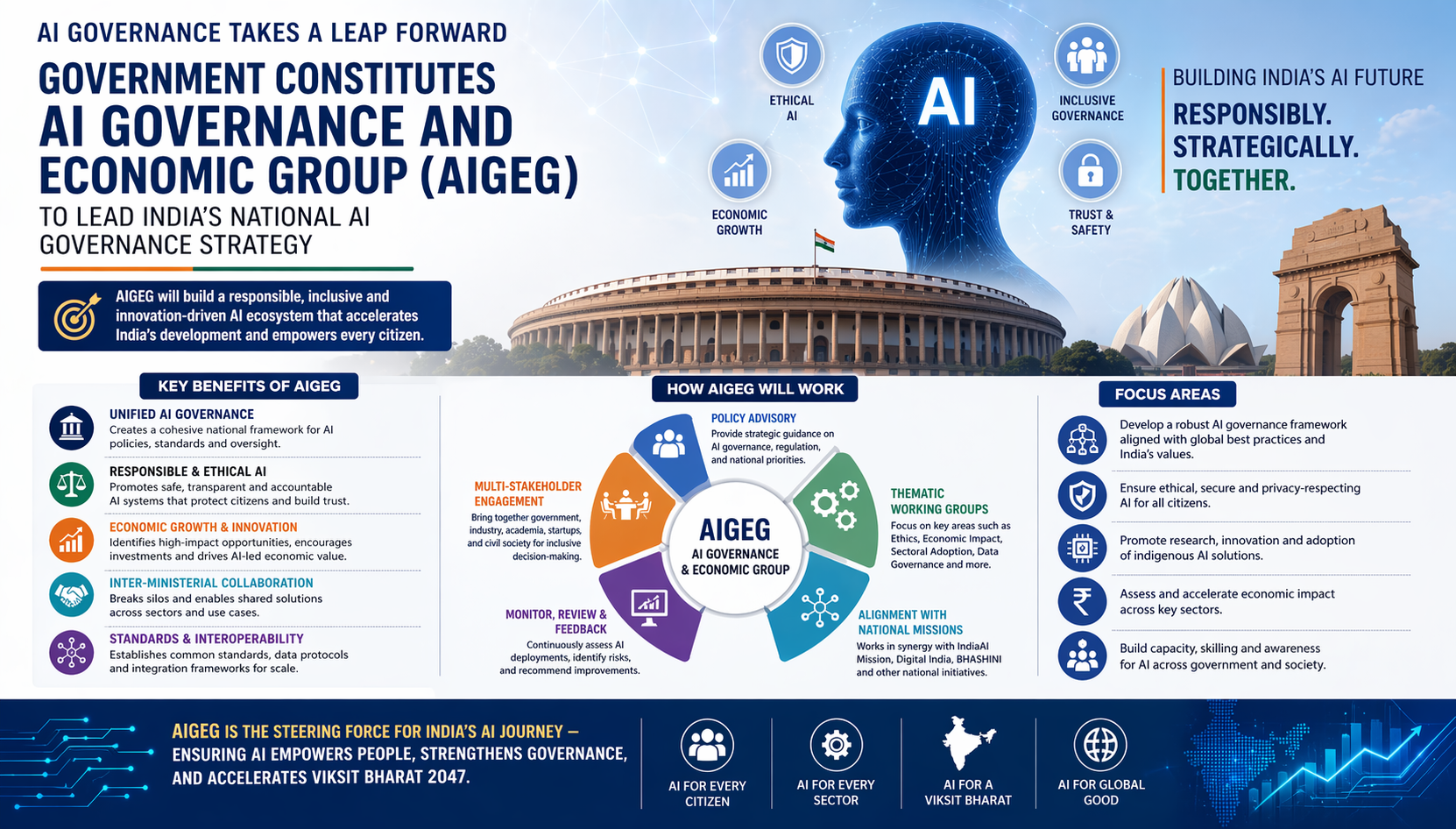
India’s AI journey is entering a decisive phase with the constitution of the AI Governance and Economic Group (AIGEG)—a strategic body aimed at guiding the nation’s approach toward responsible, scalable, and economically impactful adoption of Artificial Intelligence. This move signals a clear shift from isolated AI deployments to a coordinated national governance framework, placing India firmly on the path toward GovTech 2.0.
As AI begins to permeate ministries, public services, and digital infrastructure, the need for a centralized mechanism to ensure alignment, oversight, and direction becomes critical. AIGEG is envisioned as that anchor—bridging policy, technology, economics, and governance into a unified strategy.
Why AIGEG Matters: Moving from Adoption to Governance
Until now, India’s AI ecosystem has largely focused on enablement—building infrastructure, datasets, and pilot use cases. However, as deployments scale across ministries, challenges around ethics, interoperability, economic impact, and regulatory clarity begin to emerge.
AIGEG addresses this transition by shifting the focus from “Can we deploy AI?” to “How should AI be governed at scale?”
It introduces:
- A structured approach to AI regulation and oversight
- Alignment of AI initiatives with national priorities and economic goals
- A mechanism to ensure responsible and ethical AI deployment
This marks the evolution from AI experimentation to AI institutionalization.
Core Benefits of AIGEG
1. Unified National AI Governance Framework
AIGEG will bring together fragmented AI efforts under a single, coherent governance model. This ensures that ministries are not working in silos but are aligned with a common national vision.
2. Strengthening Responsible AI
With increasing concerns around bias, privacy, and misuse, AIGEG will define ethical guidelines, compliance standards, and accountability mechanisms, ensuring that AI systems remain trustworthy and citizen-centric.
3. Driving Economic Value from AI
Beyond governance, AIGEG will focus on the economic dimension of AI, identifying sectors where AI can:
- Boost productivity
- Create jobs
- Enable innovation ecosystems
It positions AI not just as a governance tool, but as a driver of economic growth.
4. Enabling Inter-Ministerial Coordination
AI use cases often cut across sectors—health, justice, agriculture, education. AIGEG will facilitate cross-ministry collaboration, ensuring interoperability and shared learning.
5. Standardization and Interoperability
The group will help define:
- Common standards
- Data-sharing protocols
- Integration frameworks
This ensures that AI systems across ministries can work together seamlessly, especially within Digital Public Infrastructure (DPI).
How AIGEG Will Work: Operating Model
AIGEG is expected to function as a strategic advisory and coordination body, rather than a purely regulatory authority. Its working style will likely include:
1. Policy Advisory Role
- Recommending AI governance frameworks
- Advising on regulatory approaches
- Aligning with global best practices
2. Multi-Stakeholder Engagement
The group will bring together:
- Government ministries
- Industry leaders
- Academic experts
- AI practitioners
This ensures balanced and inclusive decision-making.
3. Thematic Working Groups
AIGEG may operate through specialized sub-groups focusing on:
- Ethical AI
- Economic impact
- Sectoral AI adoption
- Data governance
4. Continuous Monitoring & Feedback
- Reviewing ongoing AI deployments
- Identifying risks and bottlenecks
- Recommending course corrections
5. Integration with National Missions
AIGEG will work closely with initiatives like:
- IndiaAI Mission
- Digital India
- BHASHINI
Ensuring that governance frameworks are embedded into execution layers.
AIGEG and the Future of GovTech 2.0
The creation of AIGEG is not just an administrative step—it is a strategic milestone. It reflects a deeper understanding that AI is no longer just a technology initiative but a governance priority.
In the GovTech 2.0 era:
- Ministries will deploy AI at scale
- Citizens will interact with intelligent systems
- Governance will become predictive and data-driven
AIGEG ensures that this transformation happens:
- Responsibly
- Strategically
- Inclusively
From AI Adoption to AI Leadership
With AIGEG, India is taking a leadership position in defining how nations can govern AI at scale. It represents a shift from technology adoption to governance leadership, where the focus is not just on building AI systems, but on shaping how they impact society and the economy.
The message is clear:
India is not just building AI—it is building the framework to govern it for public good.