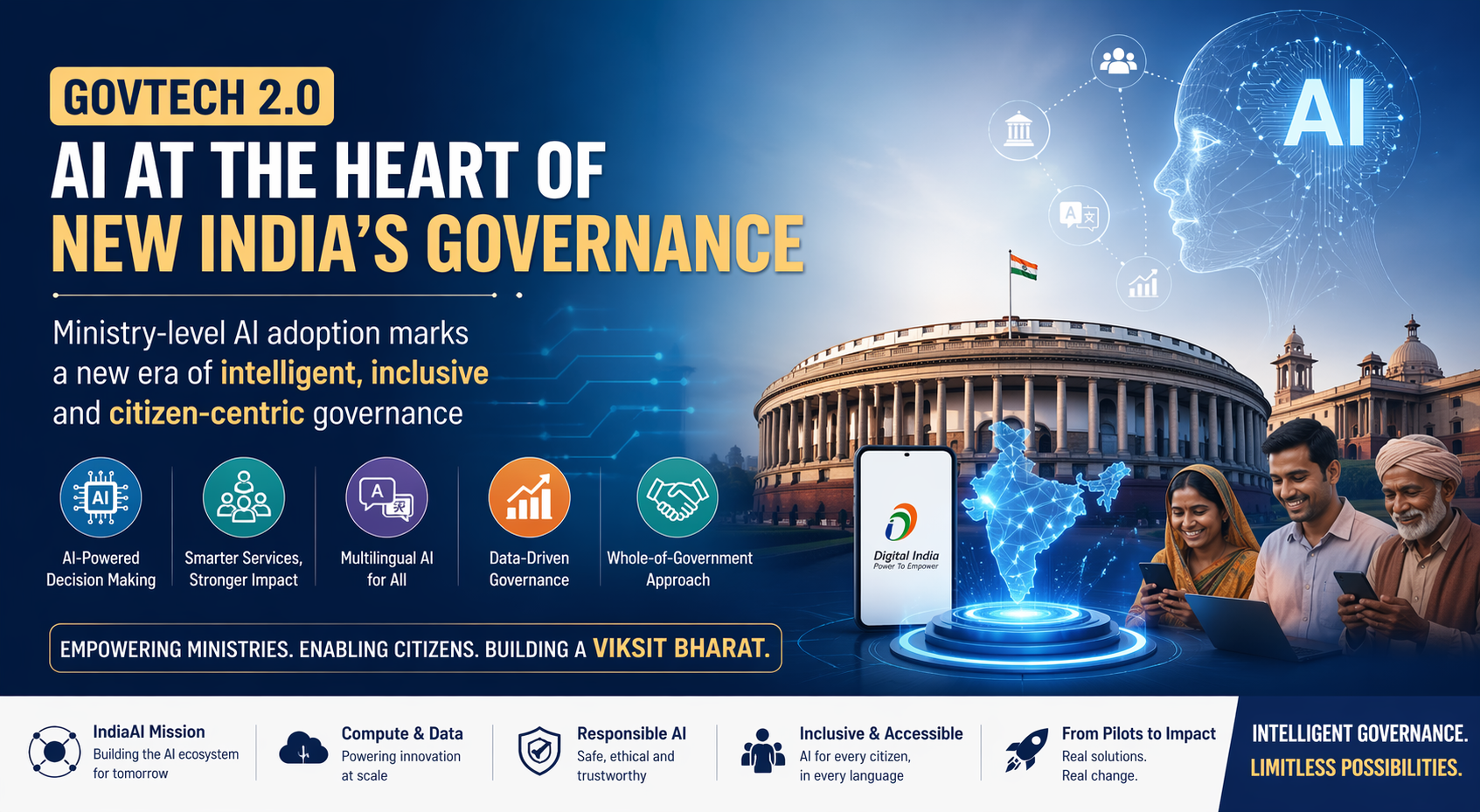
India is quietly but decisively entering a new phase of digital governance—GovTech 2.0, where Artificial Intelligence is no longer experimental but deeply embedded into the functioning of ministries, departments, and public service delivery systems. The recent developments highlighted through government initiatives and deployments signal a clear shift: AI is no longer a future ambition—it is becoming the operational backbone of governance.
At the heart of this transformation lies a fundamental change in approach. Earlier, digital governance focused on digitization—moving processes online. Today, the focus has evolved toward intelligent governance, where AI systems are actively interpreting data, enabling decision-making, and improving citizen interaction at scale. This transition is being driven by a combination of policy, infrastructure, and real-world deployments across ministries.
From Policy to Practice: AI Moves into Ministries
India’s AI journey is no longer limited to strategy documents—it is being actively implemented across sectors. Government initiatives such as the IndiaAI Mission, backed by a ₹10,000+ crore investment, are building the foundational ecosystem required for large-scale AI adoption, including compute infrastructure, datasets, and innovation platforms. (Press Information Bureau)
More importantly, ministries are no longer passive beneficiaries of technology—they are becoming active adopters and deployers of AI systems. This marks a structural shift in governance, where each ministry is beginning to integrate AI into its operational workflows, citizen interfaces, and data systems.
AI as a Governance Layer, Not Just a Tool
One of the most significant insights emerging from recent developments is that AI is evolving into a horizontal layer across governance, much like digital infrastructure did a decade ago. AI is now being used to:
- Enhance data classification and accessibility
- Improve decision-support systems
- Automize citizen service delivery
- Enable multilingual and inclusive interfaces
This shift indicates that AI is not being treated as a standalone solution, but as an enabling layer embedded within Digital Public Infrastructure (DPI). (Press Information Bureau)
The Rise of Multilingual, Inclusive AI Systems
A defining characteristic of India’s GovTech 2.0 journey is its focus on inclusion. Unlike global AI deployments that often cater to limited linguistic or demographic groups, India’s approach emphasizes accessibility for all.
Platforms such as BHASHINI and multilingual AI assistants are breaking language barriers by enabling voice and language-based access to government services. This is particularly transformative in a country as linguistically diverse as India, where language has historically been a barrier to accessing public services. (Press Information Bureau)
The emergence of AI-powered assistants in ministries—such as those deployed for citizen services—demonstrates how AI is directly improving last-mile governance.
Whole-of-Government Approach: The Core of GovTech 2.0
India’s AI transformation is not fragmented—it follows a “whole-of-government” approach, where multiple ministries, regulators, and institutions collaborate to drive adoption.
The governance framework emphasizes:
- Shared infrastructure (compute, datasets)
- Cross-ministerial collaboration
- Sector-specific AI deployments
- Responsible and ethical AI usage
This coordinated approach ensures that AI adoption is scalable, interoperable, and aligned with national priorities, rather than isolated pilots. (Press Information Bureau)
From Pilots to Production: The Real Turning Point
What truly defines GovTech 2.0 is the transition from pilot projects to production-grade deployments. AI systems are no longer being tested in isolation—they are being:
- Integrated into live government platforms
- Used by real citizens
- Evaluated based on impact, not just innovation
This shift reflects maturity. It indicates that the government is moving beyond experimentation toward institutionalizing AI in governance workflows.
AI for Public Good: India’s Distinct Mode
Unlike purely commercial AI ecosystems, India’s model is built around AI as a public good. The focus is on:
- Improving service delivery
- Enhancing transparency
- Enabling data-driven governance
- Ensuring equitable access
AI is being positioned not as a replacement for governance, but as a multiplier of state capacity, enabling governments to serve citizens better, faster, and more inclusively.
Conclusion: The Dawn of GovTech 2.0
India’s ministry-level adoption of AI marks the beginning of a new governance paradigm. GovTech 2.0 is not just about digitization—it is about intelligence, scale, and inclusion.
As AI becomes embedded across ministries, platforms, and public services, governance itself is being redefined—from reactive administration to proactive, intelligent, and citizen-centric systems.
The message is clear: The future of governance in India will not just be digital—it will be intelligent.