Introduction
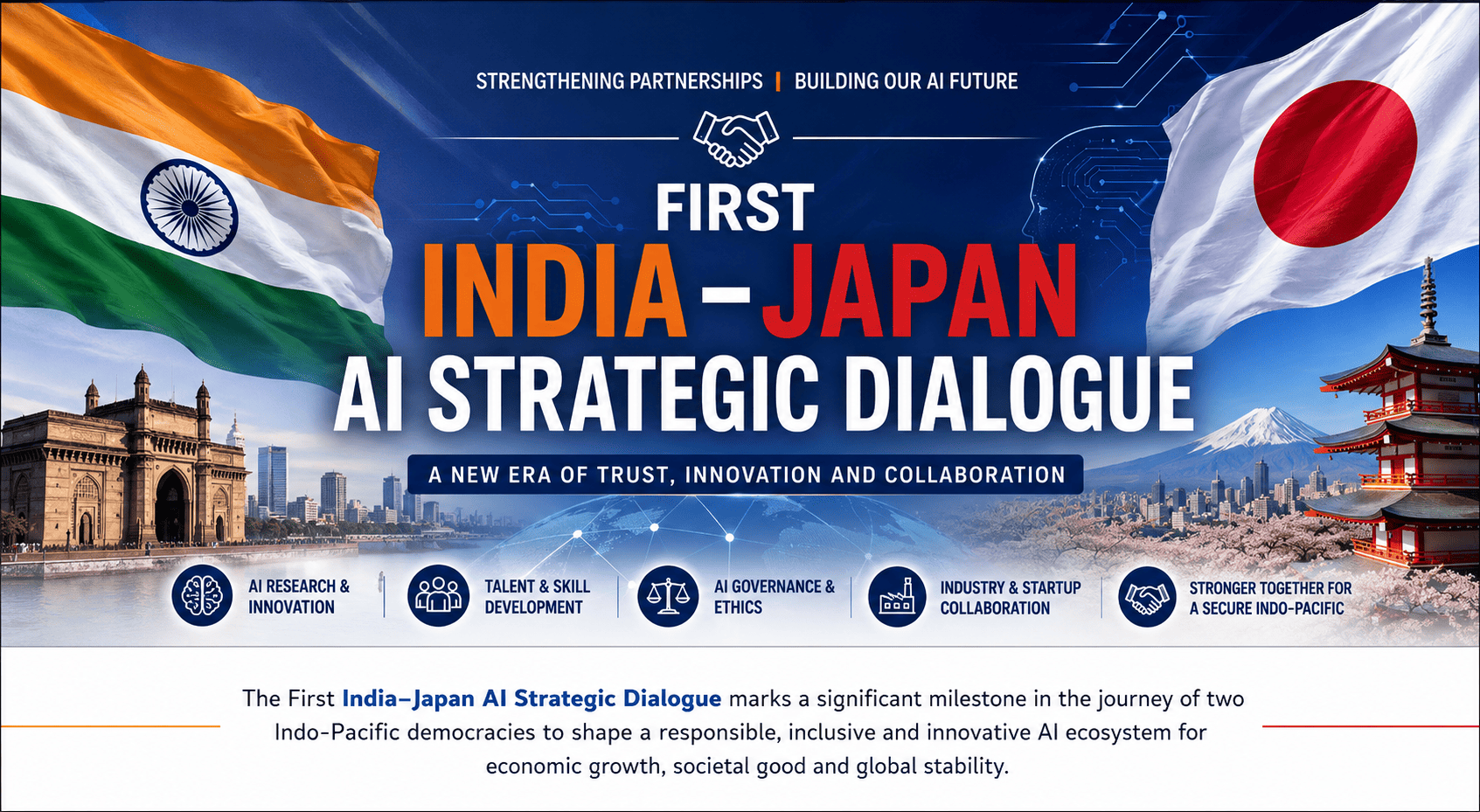
Artificial Intelligence has rapidly evolved from a technological innovation to a strategic national capability. Nations across the world are increasingly recognizing AI as a key driver of economic growth, digital transformation, national security, and global competitiveness. Against this backdrop, India and Japan took a significant step forward by convening the First India–Japan AI Strategic Dialogue on 21–22 April 2026 in Mumbai and Bengaluru, marking the beginning of a structured bilateral framework for cooperation in Artificial Intelligence.
The dialogue represents more than a diplomatic engagement. It reflects the shared vision of two major Indo-Pacific democracies to shape the future of AI through collaboration, innovation, trust, and responsible governance.
A New Chapter in India–Japan Technology Cooperation
The AI Strategic Dialogue emerged from the broader Japan–India AI Cooperation Initiative (JAI), which was announced as part of the growing strategic partnership between the two countries. The initiative aims to translate high-level political commitments into concrete cooperation in AI research, talent development, industrial innovation, governance frameworks, and emerging technologies.
The inaugural dialogue was co-chaired by senior officials from the Ministries of Foreign Affairs of both countries and brought together representatives from government agencies, research institutions, industry leaders, and AI innovators. Discussions focused on developing practical mechanisms for cooperation across the entire AI ecosystem.
Why This Dialogue Matters
The significance of the dialogue extends beyond bilateral relations.
AI is increasingly becoming a critical determinant of economic competitiveness and geopolitical influence. Countries that successfully build AI ecosystems, secure computing infrastructure, talent pipelines, and governance frameworks are likely to lead the next phase of global technological transformation.
For India, AI presents an opportunity to leverage its vast digital public infrastructure, software talent, and innovation ecosystem to drive inclusive growth. For Japan, AI offers solutions to challenges such as demographic shifts, productivity enhancement, advanced manufacturing, and societal resilience.
By working together, both nations can combine their complementary strengths:
- India’s scale, talent pool, and digital innovation capabilities.
- Japan’s expertise in advanced manufacturing, robotics, precision engineering, and industrial technology.
- Shared democratic values and commitment to trusted technology.
- A common interest in promoting a stable and secure Indo-Pacific digital ecosystem.
Key Areas of Collaboration
One of the most important outcomes of the dialogue was the agreement to deepen cooperation across the entire AI value chain. Discussions covered several strategic areas.
AI Research and Innovation
Both countries emphasized strengthening joint research initiatives between universities, innovation hubs, startups, and industrial research laboratories. Collaborative research can accelerate breakthroughs in areas such as generative AI, robotics, healthcare AI, smart manufacturing, and sustainable development.
Talent Mobility and Skill Development
A major focus area was the mobility of AI professionals and researchers. Enhanced exchanges between academic institutions, research organizations, and industry can help build a globally competitive AI workforce while addressing skill shortages in emerging technology sectors.
AI Governance and Policy
As AI systems become increasingly powerful, governance frameworks are becoming as important as technological capabilities. Both countries exchanged perspectives on AI regulation, ethical deployment, transparency, accountability, and international standards development. The dialogue highlighted the need for AI systems that are safe, secure, and trustworthy.
Industry Collaboration
The dialogue included interactions with private-sector companies from both countries, creating opportunities for partnerships in AI product development, enterprise solutions, infrastructure deployment, and innovation commercialization. Such collaborations can accelerate AI adoption across industries including manufacturing, healthcare, finance, education, and logistics.
Strategic Importance for the Indo-Pacific
The First India–Japan AI Strategic Dialogue also carries broader geopolitical significance.
The Indo-Pacific region is becoming a focal point for emerging technology competition. As countries seek to secure critical supply chains, digital infrastructure, semiconductors, and advanced computing capabilities, AI is increasingly viewed as a strategic technology.
India and Japan share a long-standing commitment to a free, open, inclusive, and rules-based Indo-Pacific. Cooperation in AI strengthens this vision by promoting trusted technology ecosystems that are transparent, secure, and aligned with democratic values.
The dialogue therefore contributes not only to bilateral technology cooperation but also to shaping the future architecture of digital governance in the region.
Opportunities for India
For India, the dialogue opens several strategic opportunities.
India’s AI ambitions are expanding rapidly through initiatives focused on compute infrastructure, digital public goods, language technologies, research ecosystems, and startup innovation. Collaboration with Japan can provide access to advanced industrial expertise, research partnerships, investment opportunities, and international market linkages.
The partnership also complements India’s broader objective of becoming a global hub for responsible and inclusive AI development.
Opportunities for Japan
Japan stands to benefit from India’s growing AI talent pool, software capabilities, startup ecosystem, and large-scale digital transformation initiatives.
Collaboration with India can help Japanese organizations accelerate AI innovation, expand research partnerships, and access one of the world’s largest technology ecosystems. It also strengthens Japan’s engagement with a key Global South partner at a time when international cooperation in emerging technologies is becoming increasingly important.
Challenges Ahead
While the dialogue marks an important milestone, several challenges remain.
Both countries will need to ensure that strategic discussions translate into measurable outcomes. This includes establishing joint research programmes, facilitating talent exchanges, supporting startup collaboration, creating interoperable governance frameworks, and promoting responsible AI deployment.
Success will depend on sustained engagement between governments, academia, industry, and civil society.
The First India–Japan AI Strategic Dialogue marks a significant milestone in the evolution of technology diplomacy between two of Asia’s leading democracies. More importantly, it signals a shared commitment to shaping the future of Artificial Intelligence through collaboration rather than competition.
As AI increasingly influences economic growth, national security, industrial innovation, and public service delivery, partnerships such as this will play a crucial role in determining how emerging technologies are developed and governed.
The dialogue is not merely about advancing AI capabilities. It is about building a trusted, secure, and inclusive AI ecosystem that can contribute to innovation, prosperity, and stability across the Indo-Pacific and beyond.