The artificial intelligence race is no longer limited to large language models.
A new battleground has emerged in speech technologies, where countries and companies are competing to build systems capable of understanding, generating, cloning, and translating human speech across hundreds of languages.
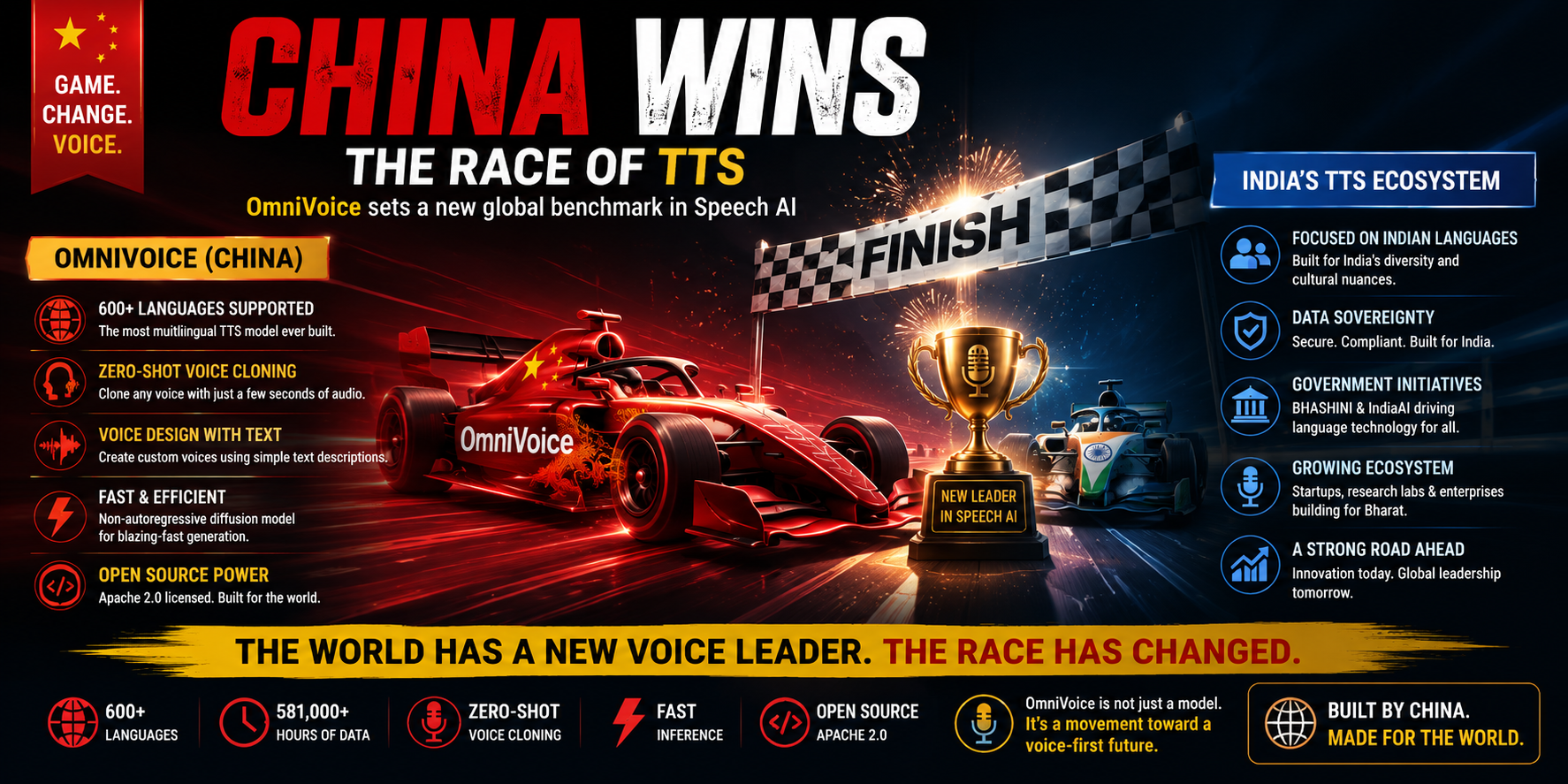
In this rapidly evolving landscape, a Chinese-origin open-source model called OmniVoice has attracted significant attention. Developed by the k2-fsa research community and backed by researchers associated with China’s speech AI ecosystem, OmniVoice claims support for over 600 languages, making it one of the most linguistically expansive text-to-speech (TTS) systems ever released.
The model arrives at a critical moment when India is aggressively expanding its own speech technology ecosystem through initiatives such as BHASHINI, indigenous startups, and multilingual AI programs.
The question is no longer whether AI can speak.
The question is whose voice it will speak with.
What is OmniVoice?
OmniVoice is a massively multilingual zero-shot text-to-speech model built on a diffusion language model architecture. Unlike conventional TTS systems that often require language-specific models or extensive voice recordings, OmniVoice can generate speech in more than 600 languages while supporting voice cloning from only a few seconds of reference audio.
The model’s most notable capabilities include:
- Support for 600+ languages
- Zero-shot voice cloning
- Voice design using text descriptions
- Fast non-autoregressive inference
- Emotional and expressive speech generation
- Cross-lingual speech synthesis
- Open-source availability under Apache 2.0 licensing
Unlike traditional TTS systems that focus primarily on English and a handful of major languages, OmniVoice was trained on an enormous multilingual dataset reportedly exceeding 581,000 hours of speech data collected from open-source sources.
The result is a single model capable of generating speech for languages ranging from English and Mandarin to many low-resource languages.
Why OmniVoice Matters
For years, voice AI development followed a fragmented approach.
A company might have:
- One model for English
- Another for Mandarin
- Separate models for Hindi
- Additional models for regional languages
OmniVoice attempts to unify all these capabilities into a single foundation model. This significantly reduces deployment complexity and opens the possibility of creating truly multilingual voice applications.
Imagine:
- One API
- One model
- Hundreds of languages
This architecture aligns with the broader industry shift toward foundation models that serve multiple use cases simultaneously.
India’s TTS Landscape
India’s speech technology ecosystem has evolved rapidly over the last few years.
Several organizations are actively building indigenous speech solutions:
BHASHINI
India’s Digital Public Infrastructure for language technologies has supported the development of speech datasets, ASR systems, translation engines, and TTS capabilities across Indian languages. The initiative has enabled the creation of over 100 voices across 22 scheduled Indian languages while focusing heavily on linguistic accuracy, inclusivity, and regional representation.
Sarvam AI
Sarvam AI has emerged as one of India’s most ambitious AI companies and offers speech models such as Bulbul V3 and Saaras V3, specifically optimized for Indian users and multilingual Indian deployments. Sarvam’s speech stack focuses on production-grade deployment for Indian languages and voice-first applications.
Other Indian Efforts
India’s ecosystem also includes:
- Academic research groups
- Startup-led speech initiatives
- State government deployments
- Enterprise voice platforms
- Open-source language technology communities
Together, these efforts are helping create an indigenous speech AI stack optimized for Indian conditions.
OmniVoice vs Indian TTS Models
Language Coverage
Winner: OmniVoice
OmniVoice claims support for more than 600 languages, making it one of the largest multilingual speech models available today.
Most Indian TTS systems focus primarily on:
- Hindi
- Tamil
- Telugu
- Bengali
- Marathi
- Gujarati
- Punjabi
- Other Indian languages
This narrower focus is intentional and reflects India’s need for depth rather than global breadth.
Indian Language Quality
Winner: Indian Models
While OmniVoice supports many languages, support does not necessarily imply excellence.
Indian speech technologies are trained specifically for:
- Indian phonetics
- Code-mixed speech
- Regional accents
- Native pronunciation
- Government service delivery
Models developed under BHASHINI and startups like Sarvam are likely to outperform generic multilingual systems in many Indian-language scenarios because they are optimized for local linguistic realities.
Voice Cloning
Winner: OmniVoice
OmniVoice demonstrates strong zero-shot voice cloning capabilities and can reproduce a speaker’s voice using only a short audio sample. It also supports cross-lingual voice transfer, allowing a voice captured in one language to speak another language. This capability could be transformative for content creation, dubbing, and accessibility applications.
Government and Enterprise Readiness
Winner: India
For government deployments, factors such as:
- Data sovereignty
- Security
- Regulatory compliance
- Local hosting
often outweigh benchmark performance.
Indian-developed speech systems have a strategic advantage because they can be deployed within India’s governance and compliance frameworks.
The Strategic Question: Sovereign Speech AI
The emergence of OmniVoice raises a broader strategic question.
Should nations depend on external AI models for critical speech infrastructure?
Voice technologies are increasingly being used in:
- Citizen services
- Healthcare
- Education
- Judiciary systems
- Parliamentary workflows
- Emergency response systems
These are not merely consumer applications.
They are becoming components of national digital infrastructure.
For India, the long-term goal may not simply be adopting the best global speech model.
It may be building the best speech models for Indian users.
Where OmniVoice Could Disrupt India
Despite India’s progress, OmniVoice introduces several capabilities that could accelerate innovation:
Cross-Lingual Voice Cloning
A speaker records 10 seconds of Hindi speech.
The system generates:
- Tamil speech
- Telugu speech
- Bengali speech
- English speech
while preserving the original speaker’s identity.
AI Content Creation
Media organizations could generate multilingual voiceovers instantly.
Real-Time Translation
Speech-to-speech systems become easier to build when one model supports hundreds of languages.
Accessibility
Visually impaired users could receive highly natural speech output across multiple languages.
Final Verdict
OmniVoice is not simply another TTS model.
It represents the emergence of foundation-scale speech AI.
In terms of language coverage, voice cloning, and open-source accessibility, OmniVoice currently stands among the most ambitious speech generation systems available.
However, India’s TTS ecosystem has a different objective.
Rather than serving hundreds of languages globally, Indian initiatives are focused on delivering highly accurate, culturally aware, and production-ready speech experiences for Indian citizens.
The competition therefore is not necessarily OmniVoice versus India.
The future may involve combining both approaches:
- Global foundation speech models for scale.
- Indian speech models for localization and governance.
- Sovereign AI infrastructure for strategic independence.
As AI increasingly becomes voice-first, the race to define how billions of people interact with technology may ultimately be won not by the model that speaks the most languages—but by the model that understands its users best.