Balancing Innovation, Justice, and Constitutional Values
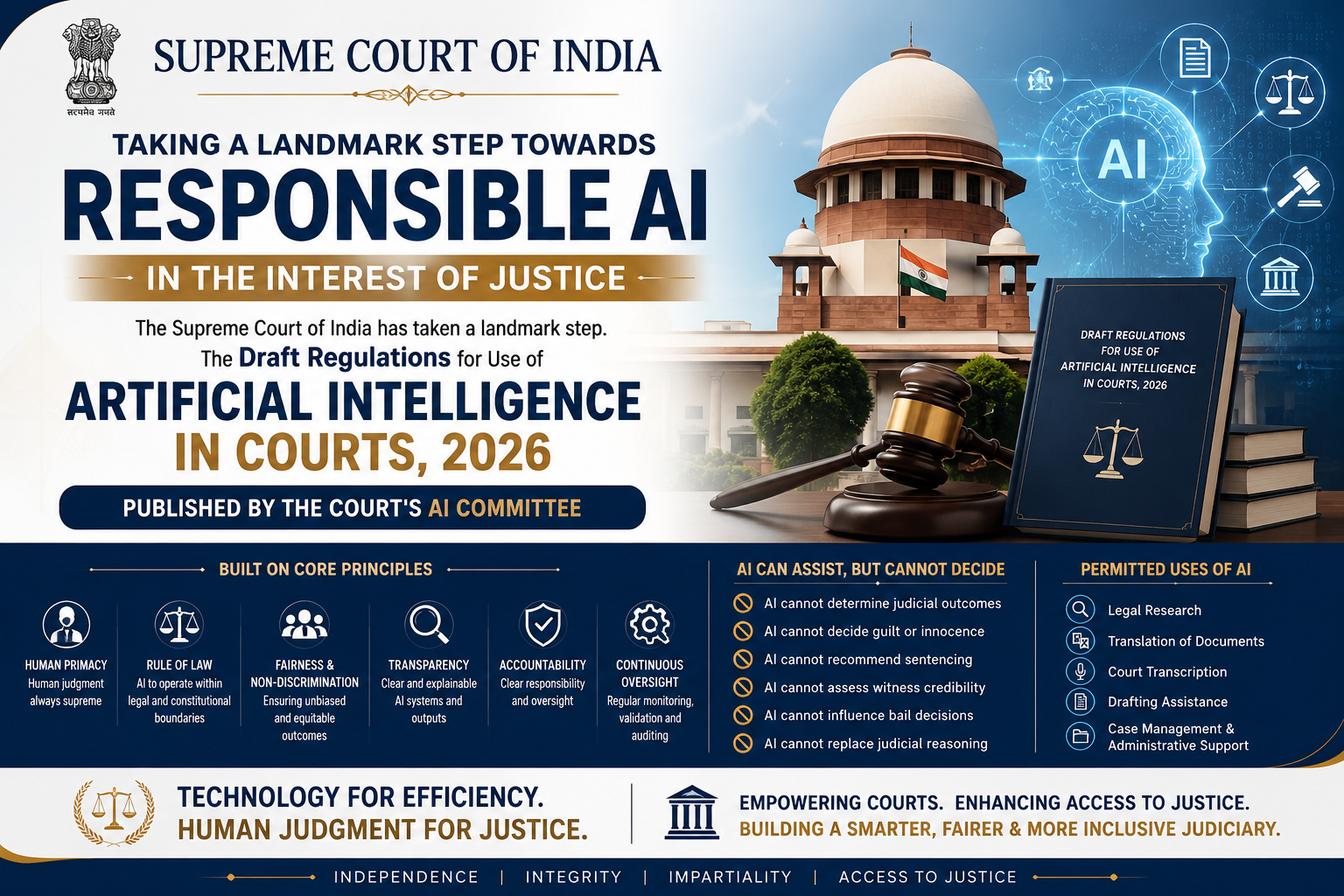
In a significant development that could shape the future of judicial technology not only in India but globally, the Supreme Court of India has released the Draft Regulations for Use of Artificial Intelligence in Courts, 2026. Prepared under the guidance of the Supreme Court’s AI Committee, the proposed framework marks India’s first comprehensive attempt to regulate the use of Artificial Intelligence across judicial institutions while preserving the sanctity of human judgment and constitutional principles.
At a time when courts worldwide are grappling with both the opportunities and risks of Generative AI, the Indian judiciary has chosen a measured path—embracing technological innovation while drawing clear boundaries around judicial decision-making. The regulations seek to ensure that AI remains an assistive tool rather than a substitute for judges, thereby protecting the independence and integrity of the justice delivery system.
Why These Regulations Matter
Artificial Intelligence is rapidly transforming industries across the globe. Legal systems are no exception. AI-powered tools are increasingly being used for legal research, document analysis, translation, transcription, case management, and predictive analytics.
However, recent incidents involving lawyers and legal professionals citing non-existent judgments generated by AI systems have raised serious concerns regarding accuracy, accountability, and the potential misuse of such technologies in judicial proceedings. The Supreme Court itself had previously expressed concern about fabricated AI-generated legal citations finding their way into court filings.
Recognizing both the transformative potential and inherent risks of AI, the Supreme Court’s AI Committee has proposed a governance framework that prioritizes constitutional values, judicial independence, transparency, fairness, and accountability.
Human Judgment Remains Supreme
The most significant principle underpinning the draft regulations is Human Primacy and Judicial Independence.
The proposed framework unequivocally states that AI systems must remain subordinate to human authority and can never replace judges in exercising judicial functions. AI-generated outputs may assist judicial officers, but final decisions must always rest with human judges.
Under the draft regulations:
- AI cannot determine judicial outcomes.
- AI cannot decide guilt or innocence.
- AI cannot recommend sentencing.
- AI cannot assess witness credibility.
- AI cannot influence bail decisions.
- AI cannot replace judicial reasoning or interpretation of law.
This approach reflects a fundamental recognition that justice is not merely a computational exercise but a human process involving ethics, empathy, constitutional interpretation, and contextual understanding.
Permitted Uses of AI in Courts
While prohibiting AI from exercising judicial authority, the draft regulations actively encourage the use of AI in administrative and support functions where technology can improve efficiency and access to justice.
The proposed framework allows AI systems to assist in:
Legal Research
AI tools may help judges, researchers, and legal professionals quickly identify relevant judgments, statutes, and precedents.
Translation Services
India’s multilingual judicial ecosystem can significantly benefit from AI-assisted translation of judgments, pleadings, and legal documents into various Indian languages.
Court Transcription
Real-time transcription of court proceedings can improve transparency and reduce manual documentation burdens.
Drafting Assistance
AI can assist in preparing administrative documents, summaries, and non-adjudicatory drafts while remaining subject to human verification.
Case Management
Automation of scheduling, document organization, workflow management, and record maintenance can enhance judicial efficiency and reduce delays.
These applications demonstrate that the Court views AI as an enabler of productivity rather than a replacement for judicial expertise.
Core Principles of the Framework
The draft regulations are built upon several foundational principles that mirror emerging global standards for trustworthy AI governance. These include:
Human Primacy
Human judges remain the ultimate decision-makers.
Rule of Law
AI systems must operate within constitutional and legal boundaries.
Fairness and Non-Discrimination
AI deployments must not create or amplify bias against individuals or groups.
Transparency
Users should understand how AI-generated outputs are produced and utilized.
Accountability
Clear responsibility must exist for decisions influenced by AI-assisted processes.
Continuous Oversight
AI systems require ongoing monitoring, validation, and auditing to ensure reliability and compliance.
These principles place India among jurisdictions attempting to establish responsible AI governance before widespread judicial deployment occurs.
Addressing Global Concerns Around AI
The regulations arrive at a crucial moment in the global AI landscape.
Across multiple jurisdictions, concerns have emerged regarding:
- Hallucinated legal citations.
- Algorithmic bias.
- Lack of explainability.
- Privacy risks.
- Automated decision-making.
- Over-reliance on machine-generated recommendations.
Unlike some experimental deployments seen internationally, the Indian judiciary’s proposed framework explicitly rejects “black box” decision-making systems and places transparency at the center of AI adoption.
This is particularly important because judicial systems rely heavily on public trust. Any perception that machines are replacing human judges could undermine confidence in the justice delivery process.
A Model for Judicial AI Governance
Legal experts view the draft regulations as one of the most comprehensive attempts by a major judiciary to establish governance norms before large-scale AI adoption becomes entrenched. Rather than reacting to technological disruptions after they occur, the Supreme Court is proactively defining acceptable and unacceptable uses of AI within the justice ecosystem.
The framework covers:
- Supreme Court of India
- High Courts
- District and Subordinate Courts
- Tribunals
- Statutory Adjudicatory Bodies
This broad applicability ensures consistency in AI governance across India’s judicial architecture.
Implications for India’s Digital Justice Future
India’s judiciary is already among the world’s largest users of digital court infrastructure through the e-Courts Mission Mode Project. The introduction of structured AI regulations could accelerate the next phase of judicial modernization by enabling responsible adoption of advanced technologies while safeguarding constitutional values.
The framework also creates opportunities for Indian AI startups, legal technology companies, research institutions, and academic bodies to develop compliant AI solutions tailored for the justice sector.
Areas such as multilingual translation, intelligent legal search, court transcription, document analytics, and case-flow optimization could witness significant innovation under a regulated environment.
The Road Ahead
The publication of the Draft Regulations for Use of Artificial Intelligence in Courts, 2026 is more than a regulatory exercise—it is a statement about the future of justice in the digital age.
The Supreme Court’s approach recognizes that technology can strengthen judicial institutions when deployed responsibly, but it can never replace the human wisdom, constitutional morality, and ethical reasoning that define the administration of justice.
As courts worldwide explore the integration of Artificial Intelligence, India’s judiciary has offered a compelling model: one where innovation serves justice, but justice remains firmly in human hands.
If adopted in its present spirit, these regulations may well become a global benchmark for responsible AI governance in judicial systems and reinforce India’s position as a leader in building trustworthy and human-centric AI frameworks.