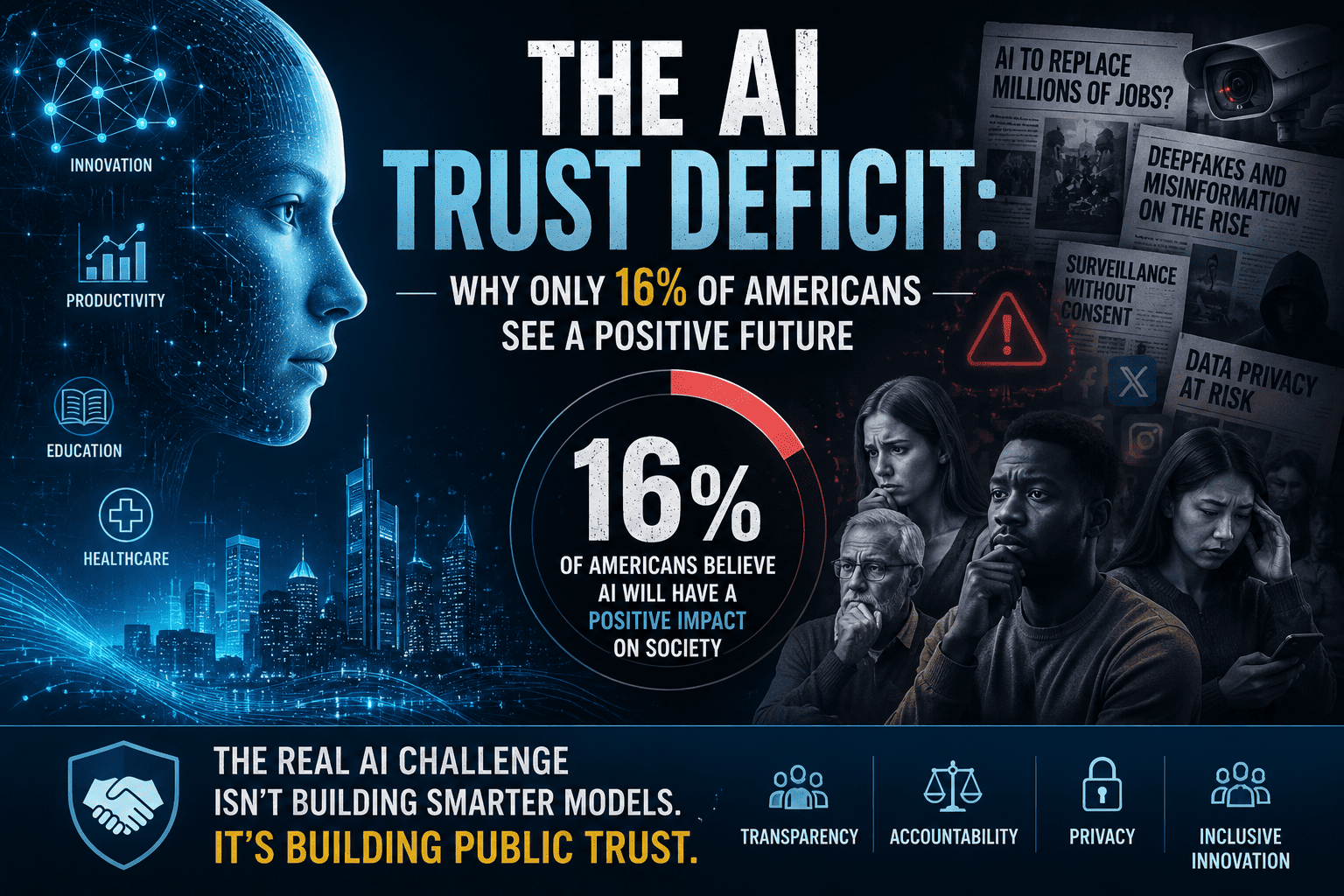
Artificial Intelligence may be advancing at breakneck speed, but public confidence appears to be moving in the opposite direction.
A recent study revealed a striking statistic: only 16 percent of Americans believe AI will have a positive impact on society. At a time when technology companies are investing hundreds of billions of dollars into AI infrastructure, models are becoming increasingly capable, and governments are drafting national AI strategies, the finding raises an uncomfortable question.
Why are people becoming more skeptical of a technology that its creators claim will transform humanity for the better?
The answer lies not in the technology itself, but in the growing gap between how AI is being developed and how ordinary people perceive its impact on their lives.
For many citizens, AI no longer feels like a futuristic innovation. It feels immediate, disruptive, and increasingly unavoidable.
Every week brings new headlines about jobs being automated, AI-generated misinformation, deepfakes, surveillance concerns, and powerful models capable of performing tasks that were once considered uniquely human. While researchers and technology executives often speak about productivity gains and economic growth, the public is encountering AI through a very different lens.
A customer service representative hears about AI replacing call center operations.
A graphic designer watches AI generate artwork in seconds.
A journalist sees AI writing articles.
A software engineer reads predictions about autonomous coding agents.
In each case, AI is perceived not as an opportunity but as a competitor.
This perception challenge may be one of the biggest obstacles facing the AI industry today.
Historically, transformative technologies have generated both excitement and fear. The Industrial Revolution displaced traditional forms of labor. Computers were once viewed as job destroyers. The internet itself was criticized for creating social and economic disruption.
However, AI differs from previous technological shifts because it directly targets cognitive tasks rather than physical labor alone. For the first time, highly educated professionals are confronting the possibility that some aspects of their work may be automated.
As a result, anxiety around AI is spreading far beyond manufacturing and routine operations.
Another reason for declining optimism is the concentration of AI power.
A significant portion of the world’s most advanced AI systems are controlled by a small number of technology companies. Decisions affecting billions of people are increasingly being made by organizations that many citizens neither understand nor trust. Questions around transparency, accountability, and governance remain largely unresolved.
Who decides what an AI system can say?
Who is responsible when it causes harm?
Who owns the data used to train it?
Who benefits from the enormous wealth it may create?
These questions have become central to public perception.
Recent controversies surrounding frontier AI models have only amplified these concerns. Governments are beginning to treat advanced AI systems as strategic assets, introducing restrictions, export controls, and regulatory frameworks. What was once considered software is increasingly being viewed as critical infrastructure.
To the average citizen, this sends a powerful signal: if governments are worried, perhaps they should be too.
Yet there is another side to this story.
While public sentiment in some countries appears increasingly skeptical, many emerging economies continue to view AI through a more optimistic lens. In countries such as India, AI is often associated with opportunity rather than displacement.
The reason is simple.
In developing economies, AI is not merely a productivity tool. It is a potential solution to longstanding structural challenges.
It can help bridge language barriers through multilingual translation systems. It can improve access to healthcare through diagnostic assistance. It can enhance education through personalized learning. It can support governance through digital public services.
For millions of people who have never had access to high-quality services, AI represents inclusion rather than disruption.
This difference in perception may explain why the global conversation around AI is becoming increasingly fragmented.
In parts of the developed world, the debate centers on regulation, safety, and labor displacement.
In many developing nations, the discussion focuses on accessibility, growth, and digital empowerment.
Neither perspective is entirely right or wrong.
Both reflect the realities experienced by different societies.
The challenge for the AI industry is that technological progress alone cannot guarantee public trust.
More powerful models will not automatically make people feel safer.
Larger context windows will not address concerns about misinformation.
Faster inference speeds will not solve questions about accountability.
Trust must be earned.
That requires transparency, responsible deployment, clear governance frameworks, and demonstrable societal benefits.
The statistic that only 16 percent of Americans believe AI will positively impact society should not be interpreted as a rejection of artificial intelligence.
Rather, it is a warning.
It suggests that public confidence is lagging far behind technological capability.
The companies building AI often measure success through benchmarks, model performance, and investment rounds. Society measures success differently.
People want to know whether their jobs will remain secure.
Parents want to know whether their children will be protected.
Citizens want to know whether the technology will serve them rather than replace them.
Until those questions are answered convincingly, skepticism is likely to persist.
The future of AI will not be determined solely by engineers, researchers, or investors.
It will also be determined by whether society believes the technology is being built in its interest.
And right now, according to the latest survey, that confidence remains surprisingly low.
Perhaps the most important challenge facing the AI industry is no longer making AI smarter.
It is making people trust it.