The recent controversy surrounding Telegram in India has triggered a much larger debate than a temporary platform restriction.
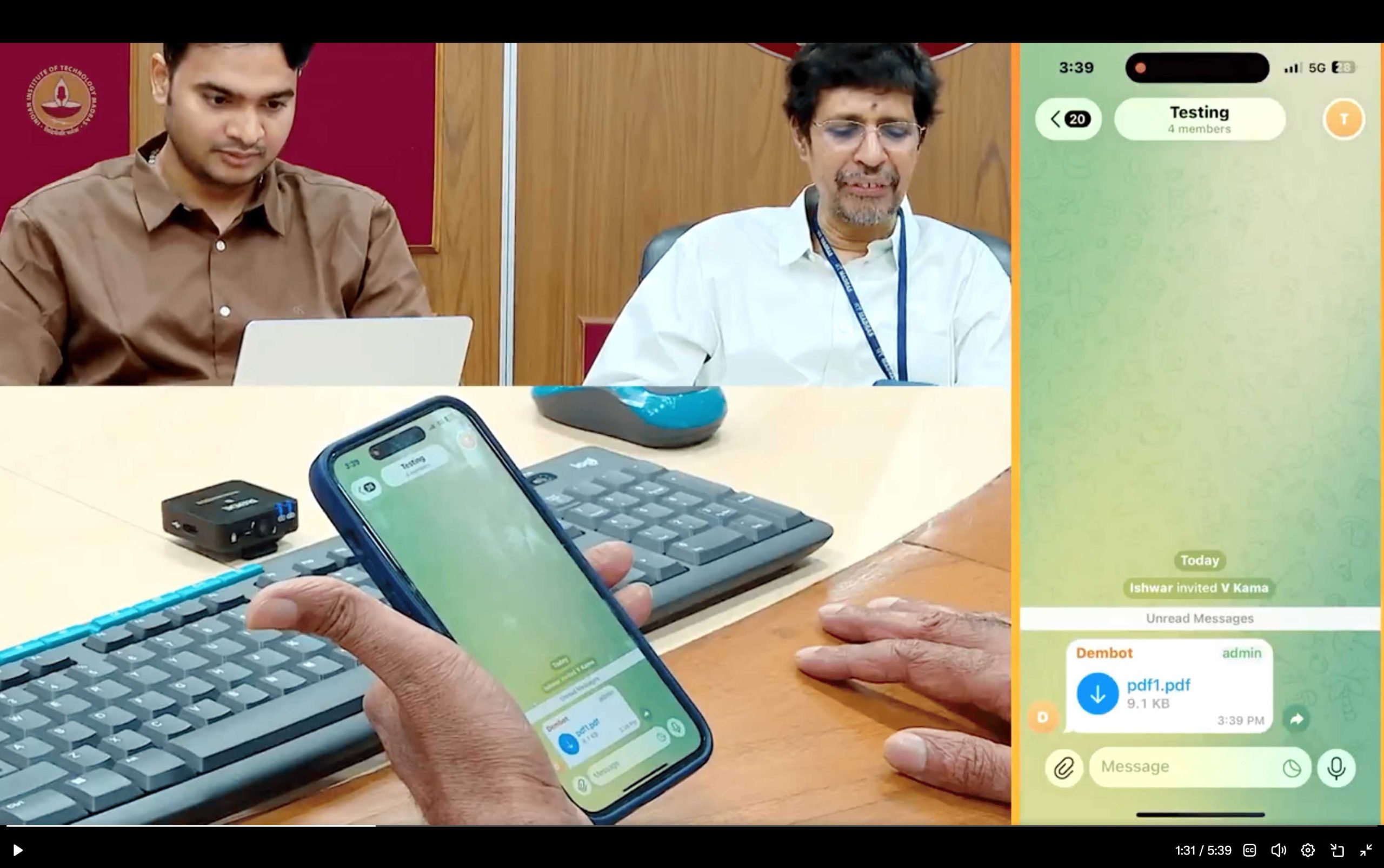
At the center of that debate is an observation made by IIT Madras Director and National Security Advisory Board member V. Kamakoti, who argued that Telegram possesses a critical vulnerability that can be exploited to spread misinformation, manipulate evidence, and create the illusion of authenticity. His comments came amid the government’s decision to temporarily restrict Telegram services ahead of the NEET-UG re-examination after allegations that exam papers and misleading content were being circulated through Telegram channels.
The issue highlighted by Kamakoti is not a traditional cybersecurity vulnerability involving hacking, malware, or encryption failures.
Instead, it relates to a feature deeply embedded within Telegram’s design philosophy.
According to Kamakoti, Telegram allows users to edit messages and even attached files while retaining the original timestamp. In practical terms, a message posted days earlier can later be modified to contain entirely different content, while appearing as though it had existed in that form from the beginning.
This capability became particularly relevant during the NEET controversy.
Authorities alleged that certain channels could potentially claim they had posted examination papers before an examination occurred, when in reality the content may have been edited later. Such functionality makes it significantly harder to distinguish genuine leaks from fabricated claims, creating confusion among students, investigators, and the public.
To many technology experts, this debate reveals an important distinction between security and trust.
Telegram has long marketed itself as a privacy-focused platform. Its encryption protocols have undergone scrutiny, and there is no evidence that the issue raised by Kamakoti represents a cryptographic weakness. However, a platform can be technically secure while still enabling behaviors that undermine information integrity.
This distinction matters because the modern internet is increasingly shaped not only by cybersecurity risks but by information risks.
A decade ago, security discussions focused on protecting systems from unauthorized access.
Today, governments and institutions are equally concerned with preventing manipulation, misinformation, impersonation, fraud, and coordinated influence operations.
Telegram’s architecture makes these challenges particularly complex.
Unlike many messaging applications, Telegram combines private messaging with massive public channels, bots, file-sharing capabilities, anonymous participation, and large-scale content distribution networks. These features have helped Telegram become one of the most influential communication platforms in the world. They have also made it attractive for activities ranging from political campaigns and activist movements to piracy networks and fraud operations. Research published in 2026 found that large-scale piracy ecosystems on Telegram were specifically designed to evade takedowns through interconnected channels, bots, and redirection mechanisms.
The concerns raised by Kamakoti therefore extend beyond a single examination.
They touch on a broader question facing digital societies.
How should platforms balance flexibility and user convenience against the need for verifiable information?
The ability to edit messages can be useful. Users correct mistakes, update information, and refine communications. Yet when edits are not sufficiently transparent, the same feature can create opportunities for manipulation.
This challenge is not unique to Telegram.
Social media platforms worldwide have struggled with similar issues involving edited content, synthetic media, manipulated screenshots, and AI-generated misinformation.
Telegram’s case simply highlights the problem in a particularly visible manner.
Critics of Telegram point out that the platform has faced recurring concerns over misuse. Studies have documented the presence of piracy networks, scam channels, fake communities, impersonation campaigns, and coordinated information operations. Researchers have also noted that Telegram’s structure can make moderation and enforcement more difficult than on traditional social networks.
At the same time, defenders of Telegram argue that restricting an entire platform because of misuse by a minority of users sets a dangerous precedent. Telegram itself challenged the Indian government’s temporary restrictions, arguing that millions of legitimate users should not be penalized because of the actions of a few bad actors. Founder Pavel Durov publicly criticized the move and maintained that platform bans rarely address the root causes of misuse.
The truth likely lies somewhere in between.
Digital platforms have become critical infrastructure for communication, education, commerce, and governance. With that influence comes responsibility. Features that can be exploited to create confusion or undermine trust inevitably attract scrutiny from governments and regulators.
What makes Kamakoti’s intervention significant is that it shifts the discussion away from platform popularity and toward platform design.
The debate is no longer simply whether Telegram should be allowed or restricted.
The more important question is whether digital platforms should incorporate stronger mechanisms for transparency and auditability.
Should users be able to see complete edit histories?
Should edited attachments receive visible indicators?
Should platforms preserve immutable records for sensitive communications?
These are questions that extend far beyond Telegram.
As artificial intelligence, synthetic content, and digital communications continue to converge, the integrity of information may become as important as its confidentiality.
The Telegram controversy demonstrates that the future of platform security will not be determined solely by encryption algorithms and firewalls.
It will also be determined by whether people can trust what they see.
And that is precisely the concern V. Kamakoti has brought into the national conversation.