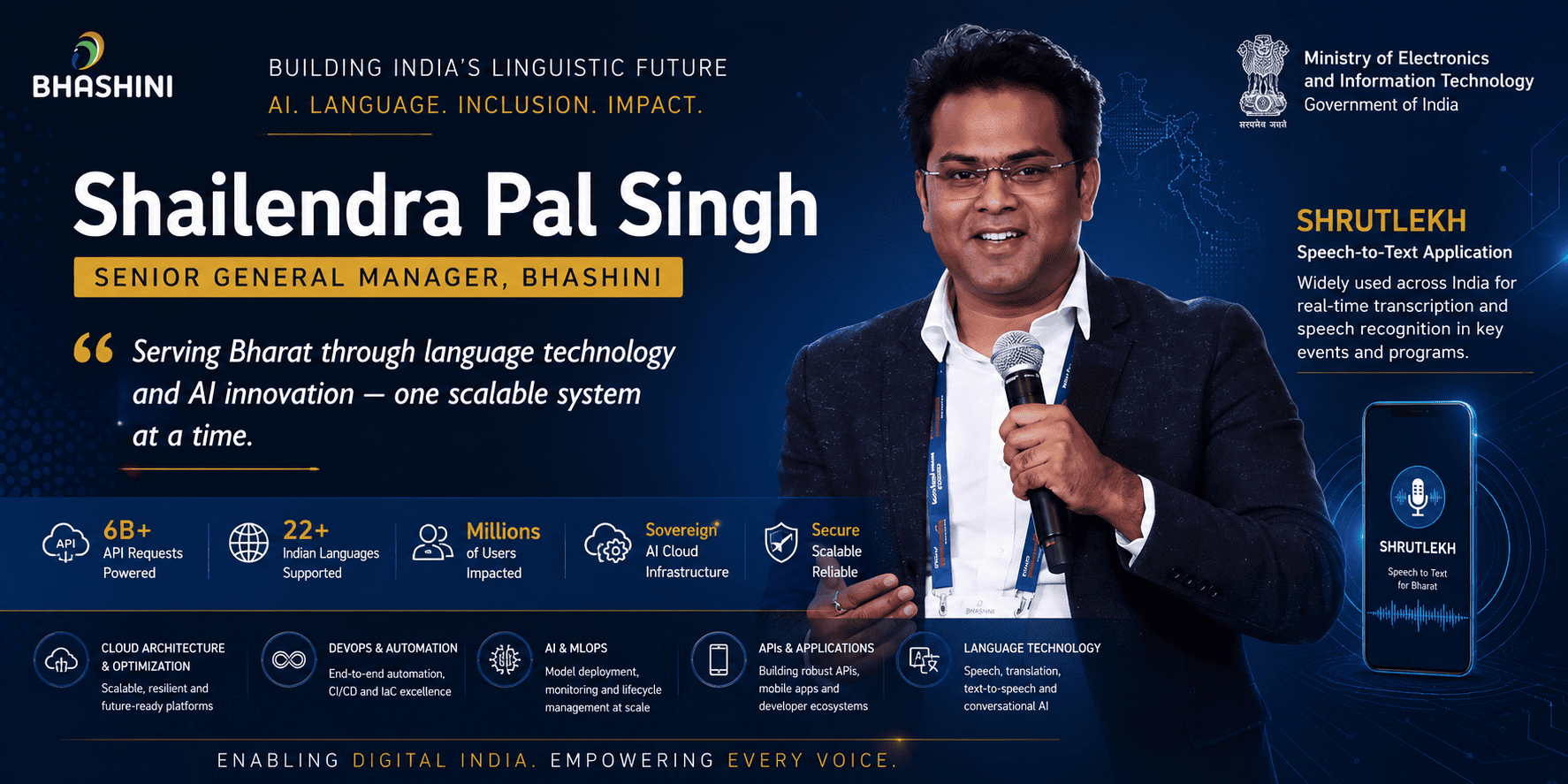
From managing global enterprise systems to developing speech technologies used across India, the BHASHINI leader is helping bridge the country’s linguistic divide through AI.
As India accelerates toward becoming a global leader in artificial intelligence and digital public infrastructure, one challenge remains uniquely Indian: language.
With hundreds of languages and dialects spoken across the country, ensuring that technology remains accessible to every citizen requires far more than computing power. It demands a new generation of language technologies capable of understanding, translating, and interacting in India’s linguistic diversity at national scale.
At the center of this mission is BHASHINI, the Government of India’s ambitious language AI platform, and among the technology leaders helping drive its growth is Shailendra Pal Singh, Senior General Manager at BHASHINI.
While platforms often receive public recognition, the engineers and architects behind them largely remain invisible. Yet the success of a national-scale digital infrastructure initiative depends heavily on those responsible for ensuring that millions of users can access services reliably, securely, and in their preferred language.
For Shailendra Pal Singh, the mission extends beyond software development. It is about enabling digital inclusion for an entire nation.
With more than eighteen years of experience spanning enterprise infrastructure, cloud computing, DevOps, automation, and AI systems, Singh’s career reflects the evolution of modern technology itself. Long before artificial intelligence became a global phenomenon, he was working on large-scale enterprise deployments, infrastructure modernization, and automation frameworks that powered complex digital ecosystems.
Industry sources indicate that before joining BHASHINI, he managed over 7,000 workloads across 136 countries, gaining extensive experience in operating technology systems at international scale. This background proved invaluable as India began building sovereign digital infrastructure capable of serving millions of users across multiple languages and government platforms.
Today, Singh plays a critical role in the technical operations of BHASHINI, an initiative under the Ministry of Electronics and Information Technology (MeitY) designed to make digital services accessible in every Indian language.
The platform powers a growing ecosystem of language technologies, including speech-to-text, text-to-speech, multilingual translation, conversational AI, and real-time language processing services. At its core lies the National Hub for Language Technology (NHLT), which handles billions of requests while supporting applications across governance, judiciary systems, education, and public service delivery.
Experts note that managing such a platform requires far more than cloud infrastructure. It demands precision engineering, resilient architectures, scalable AI deployment pipelines, and near-perfect operational reliability. Every second of downtime impacts accessibility, and every delay affects user experience across multiple public-facing systems.
One of Singh’s most significant contributions has been the development of Shrutlekh, a speech-to-text platform that has become widely used for real-time transcription and language accessibility across India.
Shrutlekh enables speech recognition and live transcription in Indian languages, allowing spoken content to be converted instantly into readable text. The technology has reportedly been used during government events, conferences, public programs, and multilingual communication initiatives where accessibility and real-time language processing are essential.
In a country where language barriers often limit participation in digital services, tools like Shrutlekh are increasingly viewed as critical enablers of inclusion. By converting speech into text instantly, the platform helps make information more accessible to diverse audiences and improves communication across linguistic boundaries.
Singh’s interest in voice technologies predates the current AI boom. As early as 2016, he was working on conversational systems, voice interfaces, Amazon Alexa integrations, and natural language processing solutions. That early exposure to voice-first computing has become increasingly relevant as AI shifts toward more natural human-computer interactions.
Colleagues describe his approach as deeply rooted in automation and operational efficiency. Throughout his career, he has focused on building systems that reduce manual intervention, improve scalability, and increase reliability. From infrastructure provisioning and deployment orchestration to AI model management and platform monitoring, automation remains a recurring theme in his work.
Within BHASHINI, this philosophy translates into resilient infrastructure, scalable APIs, efficient AI deployment pipelines, and operational systems capable of supporting national-scale workloads.
The significance of such work extends beyond technology itself. BHASHINI represents one of India’s most important efforts to create sovereign AI infrastructure that serves the country’s linguistic and cultural diversity. The platform supports a broader vision of digital inclusion, ensuring that language does not become a barrier to accessing government services, education, healthcare, or digital opportunities.
As India expands the use of AI across public infrastructure, language technology is expected to play an increasingly strategic role. The ability to communicate naturally in local languages could determine how effectively millions of citizens participate in the digital economy.
In that context, leaders like Shailendra Pal Singh are helping build more than software platforms. They are creating the technological foundations that allow artificial intelligence to serve a nation as diverse as India.
While BHASHINI continues to gain attention as a flagship AI initiative, its success ultimately depends on the engineers, architects, and innovators working behind the scenes. Through his leadership, contributions to language technology, and development of widely adopted solutions like Shrutlekh, Shailendra Pal Singh is quietly helping shape the future of multilingual digital India.
As the country moves toward an AI-powered future, his work serves as a reminder that transformative technology is often built not by those seeking the spotlight, but by those committed to solving real-world problems at scale.