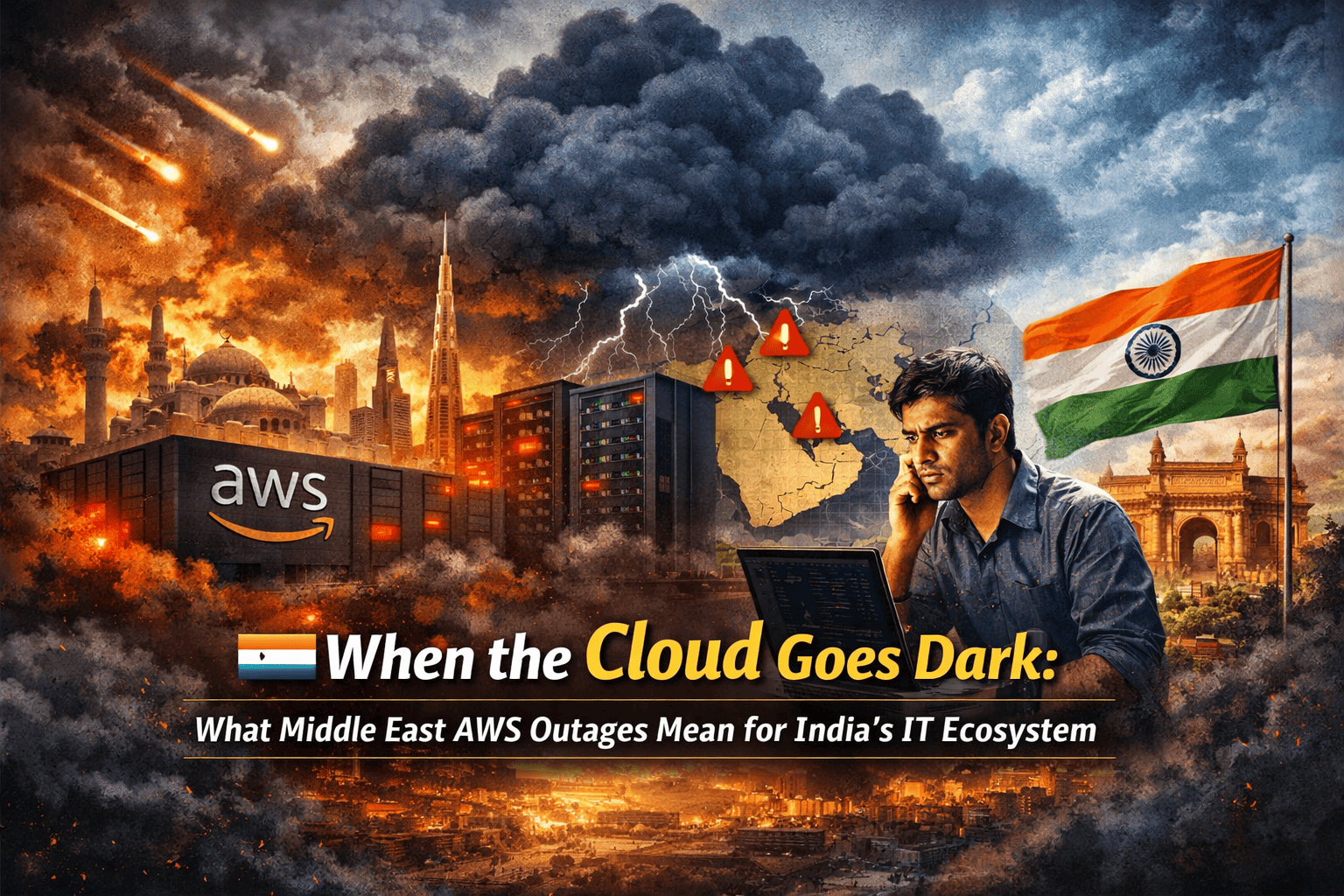
In today’s digital age, most of the apps, websites, and services people use daily do not run on physical computers nearby but on remote servers known as the “cloud.” One of the world’s largest providers of such services is Amazon Web Services, which powers everything from small startups to large enterprises.
When the Cloud Goes Dark
Recent disruptions in AWS cloud regions located in Bahrain and Dubai, following weeks of geopolitical tensions involving Iran, have brought attention to how deeply interconnected global digital infrastructure has become—and how events far from India can directly affect its technology ecosystem.
For many Indian companies, especially in sectors like fintech, e-commerce, logistics, and software services, cloud infrastructure is not limited to domestic servers.
India’s Invisible Dependence
Due to reasons such as cost efficiency, faster connectivity, and load balancing, several firms rely on data centers in the Middle East. This means that even if an application is designed, developed, and used in India, parts of its backend operations may be running in Bahrain or Dubai. When these regions experience a “hard down,” or complete outage, the consequences can be immediate and widespread.
From App Failures to Financial Losses
Users may suddenly find that their apps stop working, websites fail to load, or digital payments do not go through. For businesses, such disruptions translate into real-time financial losses, interrupted services, and damage to customer trust. A short outage can impact thousands of transactions, delay deliveries, and bring internal operations to a halt. Systems that depend on real-time data—such as logistics tracking, financial dashboards, or customer support platforms—can become temporarily unusable, creating a cascading effect across industries.
Data Safe, But Out of Reach
Importantly, such outages do not usually result in permanent data loss, but they can make data inaccessible for the duration of the disruption. Even temporary inaccessibility can create serious challenges, particularly for sectors that depend on continuous availability, such as banking, healthcare, and public services.
A Wake-Up Call for India’s Digital Backbone
For India, this incident highlights a structural vulnerability: the growing dependence on external cloud infrastructure without adequate redundancy or backup systems. At the same time, it serves as a wake-up call and an opportunity. There is likely to be increased focus on strengthening domestic cloud infrastructure, including greater use of data centers within India and policies that support data sovereignty.
The Shift Towards Resilient Systems
Companies may begin to adopt multi-cloud strategies, distributing their systems across multiple providers and regions to avoid a single point of failure. This approach ensures that even if one region or provider faces issues, services can continue with minimal disruption.
Technology Meets Geopolitics
The situation also underlines a broader reality that technology is no longer isolated from geopolitics. Conflicts and tensions in one part of the world can have ripple effects across global digital systems, affecting economies and users thousands of kilometers away.
A Lesson for the Next Generation
For students and young professionals observing these developments, the lesson is clear: building technology is not just about writing code but about understanding systems, dependencies, and risks at a global scale. As digital infrastructure becomes as critical as physical infrastructure, the ability to design robust, resilient, and distributed systems will define the next phase of India’s technological growth.