By IndicOps Research
Artificial Intelligence has rapidly evolved from being a transformative commercial technology to becoming one of the most critical pillars of national security. Around the world, governments are investing heavily in AI to strengthen defence capabilities, protect critical infrastructure, secure cyberspace, and enhance strategic decision-making. In the coming decades, the strength of a nation may no longer be measured solely by the size of its military or the sophistication of its weapons, but by its ability to harness intelligent systems that can analyze, predict, and respond faster than ever before.
The battlefield of the future extends far beyond land, sea, and air. It now encompasses cyberspace, satellite networks, financial systems, digital public infrastructure, communication networks, and information ecosystems. In this rapidly evolving landscape, AI has emerged as a force multiplier, enabling armed forces and governments to process vast volumes of information, detect threats in real time, and support critical decisions with unprecedented speed and precision.
The world’s leading powers have already recognized this shift. The United States has integrated AI into military planning through initiatives focused on autonomous systems, predictive maintenance, intelligence fusion, and battlefield decision support. China continues to invest aggressively in intelligent warfare, autonomous platforms, military-civil fusion, and large-scale AI infrastructure, viewing artificial intelligence as a strategic asset for long-term geopolitical influence. Israel has become a global benchmark for operational AI, deploying intelligent systems for missile defence, cyber operations, reconnaissance, and intelligence analysis. Across Europe, governments are increasingly adopting AI to strengthen border security, maritime surveillance, cyber resilience, and emergency response while balancing innovation with ethical governance.
This global race demonstrates an important reality: artificial intelligence is no longer optional for national security—it is becoming foundational.
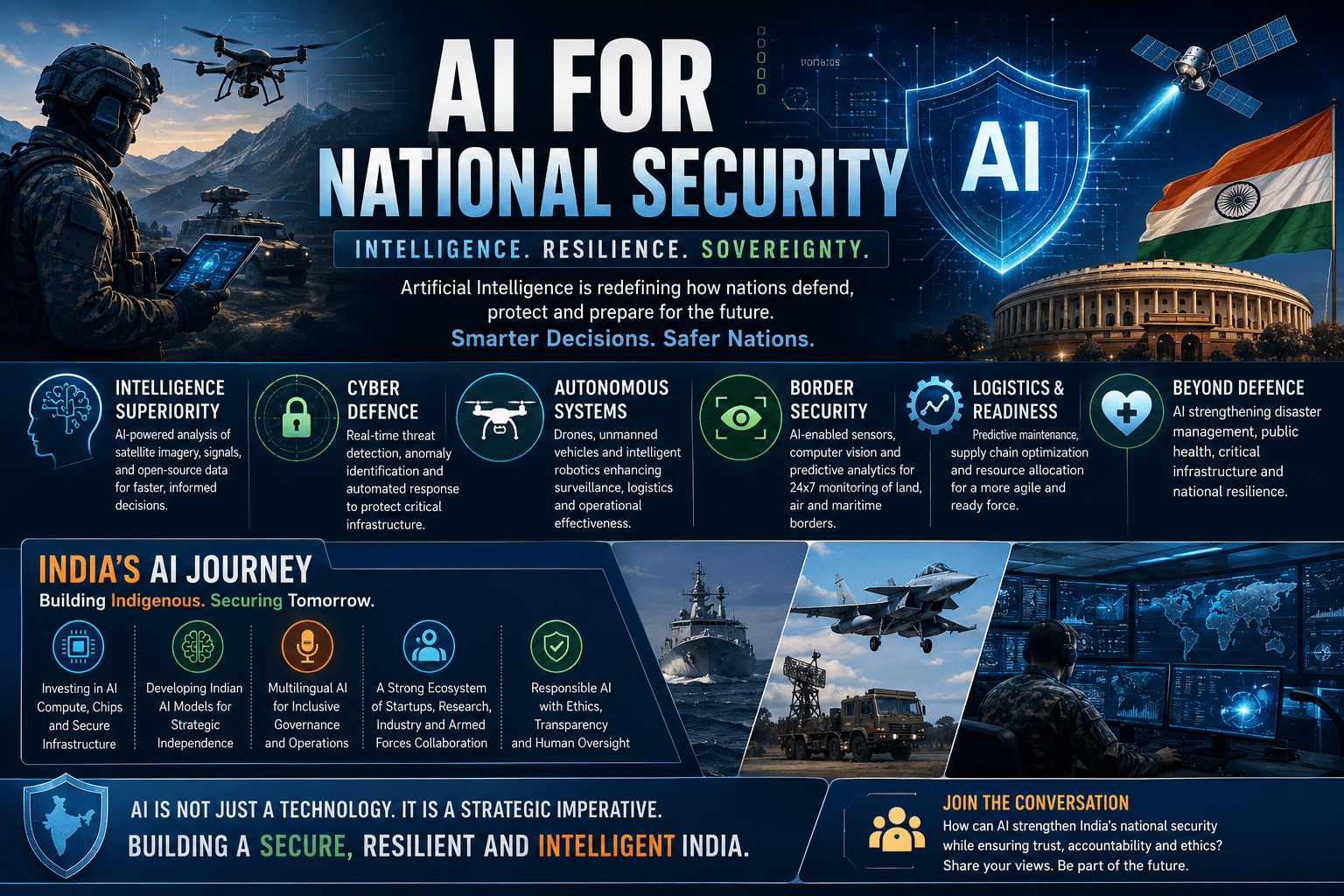
Unlike conventional technologies, AI enables nations to make sense of enormous volumes of information generated every second. Satellite imagery, drone footage, sensor networks, cyber logs, intelligence reports, social media, and open-source information collectively produce data at a scale impossible for humans to analyze alone. AI systems can rapidly identify patterns, detect anomalies, prioritize threats, and provide actionable insights to commanders and policymakers. Rather than replacing human expertise, these systems enhance human judgment by reducing the time required to transform data into informed decisions.
Cybersecurity represents another domain where AI is redefining national defence. Modern cyberattacks are increasingly automated, sophisticated, and persistent. Traditional security systems often struggle to respond quickly enough. AI-powered cybersecurity platforms can continuously monitor network activity, detect unusual behavior, identify previously unseen malware, and automate incident response, allowing organizations to contain threats before they escalate. As nations digitize governance and critical infrastructure, intelligent cyber defence will become as essential as physical border security.
Artificial Intelligence is also transforming border management and surveillance. Intelligent computer vision systems integrated with drones, satellites, thermal cameras, and ground sensors can detect suspicious movement, recognize objects, classify vehicles, and monitor remote regions continuously. These technologies significantly improve situational awareness while allowing security personnel to focus on high-priority events rather than routine monitoring.
Perhaps one of the most significant shifts is the emergence of autonomous and semi-autonomous systems. Modern defence organizations are investing in intelligent aerial vehicles, unmanned ground systems, maritime drones, robotic logistics platforms, and AI-assisted reconnaissance. These technologies reduce operational risks to personnel while extending surveillance capabilities into environments that are hazardous or difficult to access.
However, national security extends far beyond military operations. AI is increasingly becoming an indispensable tool for disaster management, public health preparedness, emergency response, and the protection of critical infrastructure. Intelligent forecasting models help predict floods, cyclones, and wildfires, enabling authorities to allocate resources more effectively and save lives. AI also plays a growing role in securing power grids, telecommunications, transportation systems, and financial networks, all of which form the backbone of a nation’s resilience.
For India, the importance of AI in national security is particularly significant. As one of the world’s fastest-growing digital economies, India manages vast volumes of data across government services, financial systems, communication networks, and digital public infrastructure. Protecting these assets requires advanced technologies capable of responding to complex and evolving threats.
Recognizing this reality, India has steadily increased its focus on building indigenous AI capabilities. National initiatives are supporting investments in AI computing infrastructure, GPU availability, research ecosystems, semiconductor development, startup innovation, and domestic foundation models. The emphasis is clear: strategic technologies should increasingly be developed within the country, reducing dependence on external ecosystems while strengthening technological self-reliance.
One of India’s unique strengths lies in multilingual artificial intelligence. Unlike many countries, India’s linguistic diversity presents both a challenge and an opportunity. AI systems capable of understanding and communicating across Indian languages can significantly improve emergency communication, intelligence sharing, citizen engagement, and public service delivery. Technologies for speech recognition, machine translation, document intelligence, and multilingual conversational AI are not merely tools for convenience—they are strategic capabilities that improve inclusivity and operational effectiveness across a nation of extraordinary diversity.
India’s vibrant startup ecosystem is also contributing to this transformation. Across the country, entrepreneurs and researchers are developing AI solutions in computer vision, robotics, cybersecurity, drone technologies, edge computing, language AI, and autonomous systems. Collaboration between government, academia, industry, and startups is creating an innovation ecosystem capable of addressing both civilian and strategic challenges.
Yet, as AI becomes increasingly embedded in national security, responsible governance becomes equally important. Intelligent systems influence decisions that can affect public safety, privacy, and even international stability. Ensuring transparency, accountability, reliability, and meaningful human oversight is therefore essential. AI should enhance human judgment—not replace it. Ethical frameworks, rigorous testing, secure deployment practices, and robust governance mechanisms will determine whether AI remains a force for stability and trust.
Looking ahead, the future of national security will likely be defined by intelligent command centres, autonomous surveillance systems, AI-assisted cyber defence, multilingual intelligence platforms, edge AI deployments, and secure sovereign computing infrastructure. Nations that invest today in trusted AI ecosystems, indigenous research, skilled talent, and resilient digital infrastructure will be better prepared to address the complex challenges of tomorrow.
India has both the talent and the technological foundation to become a global leader in secure and responsible AI. The country’s progress in digital public infrastructure, multilingual technologies, startup innovation, and strategic computing demonstrates that the journey has already begun. The next phase will require sustained collaboration, long-term investment, and a commitment to building AI that is not only powerful but also trustworthy and aligned with democratic values.
Artificial Intelligence is not simply another technological revolution—it is becoming a strategic national capability. The countries that master it responsibly will shape the future of defence, governance, economic resilience, and global influence.
As India advances towards becoming an AI-powered nation, the focus must remain on developing technologies that protect national interests, empower institutions, and strengthen the security of every citizen. In this new era, intelligence will increasingly complement traditional military strength, making AI one of the defining pillars of national security in the twenty-first century.
Call to Action
The conversation around AI and national security cannot remain confined to defence establishments or technology companies. Researchers, policymakers, startups, academia, and industry must work together to build secure, ethical, and indigenous AI solutions that address India’s strategic needs. The future of national security will depend not only on advanced algorithms but also on responsible innovation and collaborative ecosystems.
What role do you think AI should play in strengthening India’s national security while ensuring transparency, accountability, and ethical governance? Share your thoughts and join the conversation on building a secure AI future for India.