India’s AI Momentum Continues: The Biggest AI Developments Shaping the Nation
By IndicOps Research
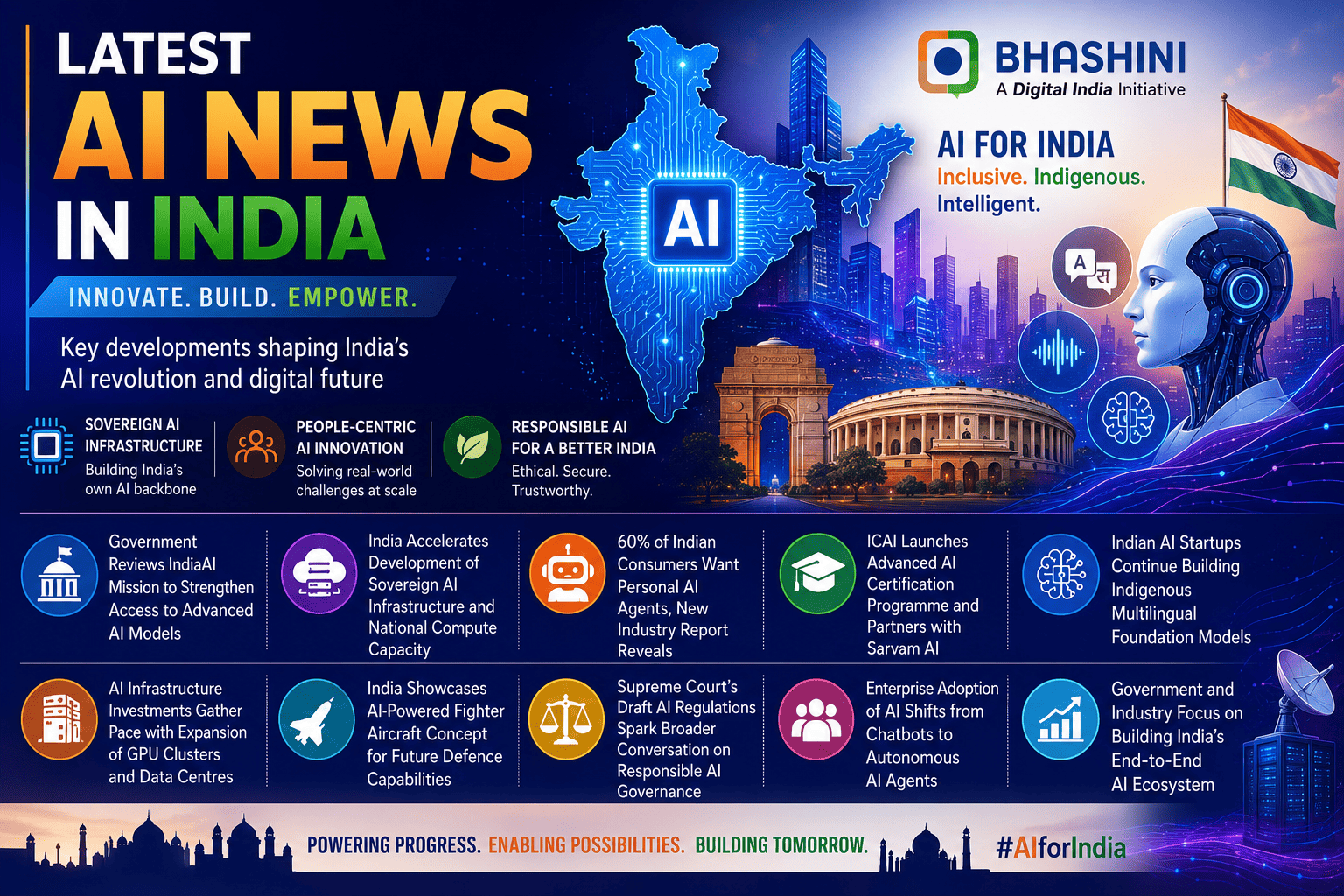
Artificial Intelligence in India is entering a new phase—one that extends beyond experimentation into large-scale deployment, sovereign AI infrastructure, and enterprise adoption. Over the past few weeks, several developments have highlighted India’s ambition to become a global AI leader, spanning government policy, enterprise investments, AI infrastructure, education, and defense.
Here are some of the most significant AI developments currently shaping India’s ecosystem.
IndiaAI Mission Under Strategic Review
One of the most important developments is the Government of India’s ongoing review of the IndiaAI Mission.
The review comes amid growing concerns over access to frontier AI models, global export restrictions, and India’s dependence on overseas AI providers. Policymakers are reassessing priorities to strengthen sovereign AI capabilities, computing infrastructure, and domestic innovation. This reflects a broader recognition that AI is becoming a strategic technology with implications for economic competitiveness and national security.
The review is expected to influence future investments in compute infrastructure, indigenous model development, and research collaborations.
AI Becoming a National Infrastructure Priority
India’s AI strategy is increasingly focused on building a complete AI ecosystem rather than isolated applications.
Recent initiatives continue to emphasize:
- Expansion of GPU infrastructure.
- National AI compute resources.
- Indigenous AI models.
- AI datasets and digital public infrastructure.
- Open innovation ecosystems for startups and researchers.
This “full-stack AI” approach aims to reduce dependence on foreign platforms while accelerating AI adoption across government and industry.
Consumer Demand for AI Agents Is Rising
A recent industry report indicates that India now leads the Asia-Pacific region in consumer enthusiasm for AI.
According to the findings, around 60% of Indian consumers express interest in using or creating personal AI agents capable of performing complex tasks on their behalf. This signals a shift from chatbot interactions toward agentic AI systems that can automate workflows, assist with decision-making, and personalize digital experiences.
For businesses, this means future applications will increasingly revolve around autonomous AI assistants rather than traditional conversational interfaces.
AI Education Expands Across Professional Sectors
Artificial intelligence is rapidly becoming part of professional education in India.
Recently, the Institute of Chartered Accountants of India (ICAI) launched an advanced AI certification program while also signing an MoU with Sarvam AI to promote AI-driven innovation within the accounting profession. This reflects a growing trend of integrating AI into domains such as finance, auditing, taxation, and governance.
The development demonstrates that AI literacy is no longer limited to software engineers—it is becoming essential across professional disciplines.
Indigenous AI Models Continue to Mature
India’s AI ecosystem continues to strengthen its indigenous model landscape.
Recent developments include continued momentum around Indian foundation models designed for multilingual reasoning, speech technologies, and enterprise applications. Open-source releases from Indian AI companies are expanding the availability of models optimized for Indian languages and local use cases, supporting the country’s vision of language-inclusive AI innovation.
These efforts are particularly significant for sectors such as governance, education, healthcare, and digital public services.
AI Infrastructure Investments Accelerate
India’s AI ambitions are supported by significant investments in infrastructure.
Industry reports indicate continued expansion of data centres, GPU clusters, and AI-ready cloud infrastructure, creating new opportunities for enterprises, startups, and system integrators. Rather than focusing solely on AI applications, organizations are increasingly investing in the foundational infrastructure required to train, deploy, and serve AI models at scale.
AI Finds New Applications in Defence
Artificial intelligence is also making inroads into India’s defence sector.
One recent example is the unveiling of an indigenous AI-piloted fighter aircraft concept designed around autonomous mission execution and advanced decision-making. While still under development, the initiative highlights India’s growing interest in AI-enabled defence technologies and autonomous systems.
Such developments reinforce the expanding role of AI in national security and strategic innovation.
Responsible AI and Governance Gain Momentum
Responsible AI continues to receive significant attention.
The Supreme Court’s draft regulations on the use of Artificial Intelligence in courts have sparked broader discussions on transparency, accountability, and ethical deployment of AI within public institutions. Although focused on the judiciary, these principles are expected to influence AI governance across multiple sectors.
India’s policy landscape increasingly recognizes that trustworthy AI is as important as technological advancement.
What These Developments Mean
Several clear trends are emerging:
- India is shifting from AI experimentation to production-scale deployment.
- Sovereign AI infrastructure is becoming a strategic national priority.
- Indigenous AI models are gaining greater attention.
- AI adoption is expanding beyond technology companies into finance, governance, education, and defence.
- Enterprises are preparing for the era of AI agents rather than standalone chatbots.
- Responsible AI governance is becoming an integral part of India’s digital transformation.
Looking Ahead
India’s AI journey is entering a defining phase. The next few years are likely to be shaped by investments in compute infrastructure, multilingual AI, sovereign foundation models, enterprise automation, and AI-driven public services.
For startups, researchers, developers, and policymakers, the opportunity is no longer simply to adopt artificial intelligence—it is to help build India’s own AI ecosystem that is scalable, inclusive, secure, and globally competitive.
As AI becomes deeply embedded in governance, industry, and everyday life, India’s focus on indigenous innovation and responsible deployment positions the country to play an increasingly influential role in the global AI landscape.