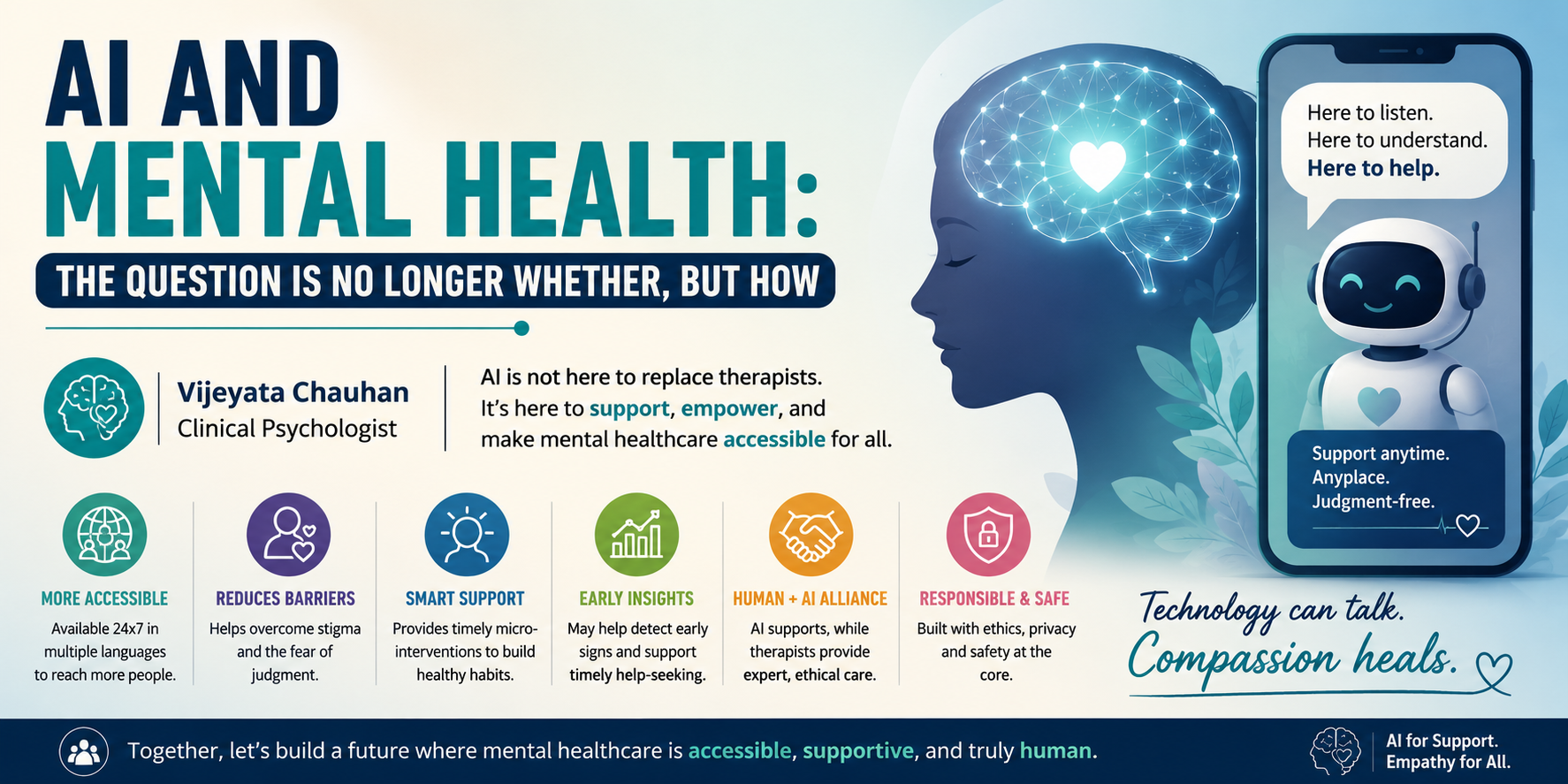
Author: Vijeyata Chauhan, Clinical Psychologist
For years, the conversation around artificial intelligence (AI) in mental health revolved around a single question: Can AI play any role in psychological care?
Today, that question has largely changed.
Recent research suggests that the debate is no longer about whether AI has a place in mental health, but about how it should be integrated responsibly. Researchers are now focusing on questions of ethics, governance, safety, and collaboration between AI and mental health professionals rather than asking if AI should exist in this space at all.
FROM MEDITATION APPS TO CONVERSATIONAL COMPANIONS
A few years ago, digital mental health mostly meant meditation apps, mood trackers, relaxation exercises, or self-help platforms.
The arrival of Generative AI has significantly changed this landscape.
Unlike traditional mental health apps, modern AI systems can hold conversations, remember previous discussions, encourage self-reflection, and provide continuous support over time. This shift has transformed AI from a passive tool into an active conversational companion.
AN ACCESSIBILITY REVOLUTION
One of AI’s greatest strengths is accessibility.
Mental health services remain out of reach for millions of people worldwide because there simply are not enough psychologists and psychiatrists to meet the growing demand. At the same time, smartphones and internet access have become increasingly common.
AI can potentially bridge part of this gap. It can communicate in multiple languages, remain available 24 hours a day, and provide immediate responses whenever someone seeks support.
Because of these advantages, some researchers have even described AI as the “first point of psychological contact.” Rather than replacing a therapist, AI may become the first place people turn to before seeking professional care.
REDUCING THE BARRIER OF SHAME
One of the most fascinating findings emerging from qualitative research is that many people report sharing deeply personal experiences with AI that they had never shared with another person.
Why does this happen?
Researchers believe it may be because people experience AI as non-judgmental. This does not necessarily mean that AI possesses empathy or genuine understanding. Instead, people often experience a perceived emotional safety, a feeling that they can express themselves without fear of criticism, embarrassment, or stigma.
This perception alone may lower one of the biggest barriers to seeking psychological help: shame.
SMALL INTERVENTIONS CAN MAKE A BIG DIFFERENCE
AI may also be particularly useful for what researchers call micro-interventions.
Instead of waiting for a weekly therapy session, AI can encourage small but meaningful actions throughout the day, such as practicing a minute of mindful breathing, taking a short walk, checking in with one’s emotions, or maintaining healthy sleep habits.
These brief, timely interventions may improve adherence to healthy routines and help people stay engaged in their mental health journey between professional appointments.
CAN AI DETECT MENTAL ILLNESS EARLIER?
Another rapidly growing area of research is the possibility of early detection.
Some recent systematic reviews suggest that AI may eventually help identify early warning signs of mental health conditions, even before they become clinically obvious. Researchers are exploring whether AI can detect subtle patterns in typing behaviour, pauses during speech, facial expressions, language use, sleep activity, or even social media posts.
Such systems may one day assist in identifying individuals who are at risk for depression, suicidal thoughts, bipolar episodes, or relapse in psychotic disorders.
However, this research is still largely experimental. These technologies show promise but are not yet reliable enough to replace clinical assessment, and much more evidence is needed before they can be used routinely.
AI SHOULD NOT REPLACE THERAPISTS
Perhaps the strongest message emerging across recent reviews is that AI should augment, not replace mental health professionals.
Therapy is much more than delivering information or asking questions. It involves clinical judgment, ethical decision-making, understanding human relationships, cultural sensitivity, and responding to complex emotional situations, areas where trained psychologists remain indispensable.
The future is therefore unlikely to be a competition between humans and AI. Instead, many researchers envision a human-AI alliance, where AI supports therapists by increasing accessibility, monitoring progress, providing psychoeducation, and encouraging healthy habits, while clinicians continue to provide diagnosis, formulation, psychotherapy, and ethical care.
WHAT DO PEOPLE ACTUALLY EXPERIENCE?
Interestingly, some studies published in recent years have found that users often describe AI as calm, patient, and emotionally available.
This observation should be interpreted carefully.
It does not mean that AI genuinely feels empathy or emotions. Rather, it suggests that people often experience AI as emotionally responsive and psychologically supportive during conversations. This distinction is important because the user’s experience can influence engagement and help-seeking, even if the AI itself does not possess consciousness or emotions.
THE ROAD AHEAD
Research on AI in mental health has expanded dramatically over the past three to four years, and the field is evolving at remarkable speed.
While many questions remain about safety, ethics, privacy, regulation, and clinical effectiveness, one thing is becoming increasingly clear: AI is likely to become an important part of future mental healthcare.
The challenge is no longer deciding whether AI belongs in mental health. The real challenge is learning how to integrate it responsibly, ensuring that technology enhances human care without ever losing sight of the human being behind every conversation.
Vijeyata Chauhan
Clinical Psychologist
If you’d like, I can also convert this into an editable Word document while preserving the original formatting and headings.