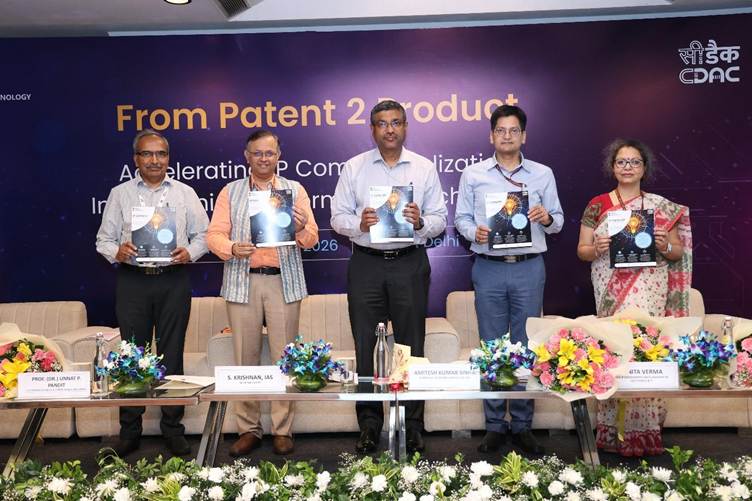
India’s innovation ecosystem is rapidly evolving from being service-driven to becoming research and IP-driven. In this transition, Intellectual Property (IP) commercialization is emerging as one of the most critical pillars for transforming research into real economic value. The recently concluded one-day IPR conference on “From Patent to Product: Accelerating IP Commercialization in Electronics & IT”, organized by the Ministry of Electronics and Information Technology at India Habitat Centre on May 12, 2026, highlighted precisely this national priority. During the conference, the Secretary of MeitY formally launched the IP Catalyst Initiative — a major step toward building a comprehensive digital ecosystem for innovation commercialization in India.
The session brought together several distinguished leaders and experts from India’s technology, healthcare, research, and innovation ecosystem. Insightful discussions were held with Neha Jain from NASSCOM, Taruna Gupta from Tata Consultancy Services, Dr. Sandip representing Indian Council of Medical Research, Sanjay Wandhekar from Centre for Development of Advanced Computing Pune, and Dr. Sangita Garg from IHFC. Their perspectives reinforced the growing consensus that India must move beyond patent creation toward large-scale commercialization, technology transfer, and market deployment.
For decades, India has generated exceptional talent, research papers, and innovative ideas. However, a large gap has existed between publicly funded R&D and large-scale industry adoption. Many patents remained confined to laboratories, academic institutions, or government-funded research centers without reaching the market. IP commercialization aims to bridge this gap by ensuring that innovations move beyond filing cabinets and become deployable technologies, products, startups, and scalable solutions that create economic and strategic value for the country.
The launch of IP Catalyst reflects a broader shift in India’s innovation vision — from “research for publication” to “research for commercialization.” The initiative is designed to support the complete innovation lifecycle, starting from IP creation and patent filing to technology transfer, licensing, market deployment, and industry adoption. By bringing together MeitY organizations, startups, MSMEs, academia, and industry under a unified framework, the platform has the potential to accelerate India’s journey toward becoming a global technology powerhouse.
One of the biggest benefits of IP commercialization for India is economic growth through indigenous technology development. Countries that dominate global innovation ecosystems are not merely consumers of technology — they own patents, standards, platforms, and products. When Indian institutions commercialize their intellectual property, the country generates high-value assets that can create revenue streams through licensing, exports, manufacturing, and enterprise adoption. This reduces dependence on imported technologies while strengthening India’s digital sovereignty.
The initiative’s focus on financial support for IP filing and international patent filing support for startups and MSMEs is particularly important. Many Indian innovators and startups struggle with the high cost and complexity of patent protection, especially in international markets. By lowering these barriers, India can significantly increase the number of globally protected Indian technologies. Stronger patent portfolios will also make Indian startups more attractive to investors, strategic partners, and global markets.
Another major advantage lies in boosting deep-tech entrepreneurship. India’s startup ecosystem has already demonstrated global strength in fintech, SaaS, and digital services. The next frontier, however, lies in electronics, semiconductors, AI, healthcare technologies, cyber security, robotics, language technologies, and advanced computing. Commercializing IP in these sectors can create high-impact startups capable of solving strategic national challenges while generating high-skilled employment opportunities.
The inclusion of technology readiness assessments, IP valuation, and prototype-to-product support within IP Catalyst addresses a long-standing issue in India’s innovation ecosystem — the “valley of death” between research and commercialization. Many promising innovations fail because researchers lack market understanding, commercialization expertise, or industry connections. Structured support mechanisms can significantly improve the success rate of Indian technologies reaching real-world deployment.
The emphasis on industry–academia–startup collaboration is equally transformative. Innovation ecosystems succeed when researchers, corporations, startups, and policymakers work together rather than in silos. Stronger collaboration can enable faster co-development of technologies, more practical research outcomes, and quicker commercialization cycles. It also ensures that publicly funded innovations address real industrial and societal needs.
Importantly, IP commercialization is not only about economic returns — it is also about strategic national capability. In an era defined by AI, semiconductor competition, cybersecurity threats, and digital infrastructure, countries with strong indigenous intellectual property ecosystems will hold significant geopolitical and technological influence. India’s investment in IP-led innovation can therefore strengthen both economic resilience and national security.
India now stands at a critical inflection point. The country has the talent, scale, digital infrastructure, and entrepreneurial energy needed to emerge as a global innovation leader. The next step is ensuring that Indian ideas become Indian products, Indian platforms, and globally competitive Indian technologies. Initiatives like IP Catalyst can play a defining role in making that vision a reality by transforming intellectual property into economic power, strategic capability, and national growth.