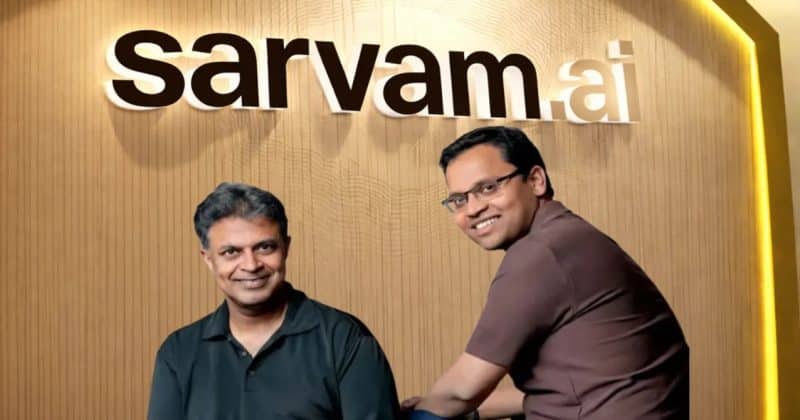
India’s artificial intelligence ecosystem has reached a significant milestone.
Bengaluru-based AI startup Sarvam has officially entered the unicorn club after raising $234 million in a funding round led by HCLTech and Bessemer Venture Partners, taking the company’s valuation to approximately $1.5 billion. The development makes Sarvam one of India’s most valuable pure-play AI companies and marks a turning point in the country’s efforts to build indigenous artificial intelligence capabilities.
But Sarvam’s journey is about more than venture capital and startup valuations.
It represents India’s growing determination to become a creator of foundational AI technologies rather than merely a consumer of global platforms.
The Rise of India’s AI Champion
Founded in 2023 by Vivek Raghavan and Pratyush Kumar, Sarvam was created with a bold vision: to build AI systems designed specifically for India’s linguistic, cultural, and technological realities. Unlike many startups focused on applications built on top of existing large language models, Sarvam chose the far more challenging path of developing foundational AI models and infrastructure.
The company’s mission aligns closely with a growing global trend known as “AI Sovereignty”—the belief that nations should possess the capability to build, train, deploy, and govern critical AI systems within their own strategic frameworks.
For India, with its linguistic diversity, massive digital population, and rapidly growing technology sector, the importance of sovereign AI has become increasingly evident.
Why Sarvam Matters
For years, the global AI conversation has been dominated by companies such as OpenAI, Google, Anthropic, Meta, and xAI.
While these organizations have pushed the boundaries of artificial intelligence, they have also highlighted a strategic challenge for countries worldwide: dependence on foreign AI infrastructure.
Recent developments involving restrictions, export controls, and increasing government scrutiny of frontier AI models have underscored the risks associated with relying entirely on external providers.
In this context, Sarvam’s emergence is particularly significant.
The company is building AI models optimized for Indian languages, voice-first interactions, and local deployment scenarios. This is critical in a country where hundreds of millions of citizens interact with technology in languages other than English.
India’s AI challenge has never been simply about building another chatbot.
It has been about enabling digital inclusion for over a billion people.
The Funding Milestone
Sarvam’s recent funding round raised $234 million in its first close, valuing the company at approximately $1.5 billion and officially granting it unicorn status. HCLTech emerged as the lead strategic investor, acquiring a significant stake in the company while signaling strong confidence in India’s foundational AI ecosystem.
The investment is noteworthy for several reasons.
First, it represents one of the largest funding rounds for an Indian AI startup.
Second, it demonstrates that traditional technology companies are increasingly viewing AI infrastructure as a strategic priority rather than merely a future opportunity.
Third, it highlights the growing convergence between India’s IT services industry and the next generation of AI-native companies.
The message from investors is clear:
India’s AI future deserves long-term capital and strategic backing.
Building AI for India
One of Sarvam’s key differentiators is its focus on India’s unique requirements.
Unlike many global models primarily optimized for English-language interactions, Sarvam has concentrated on multilingual and voice-based AI systems designed for Indian users. The company has released models trained specifically for Indian languages and has invested heavily in localized datasets and language technologies.
This approach addresses a fundamental challenge in India’s digital transformation journey.
A large percentage of India’s population prefers interacting through voice rather than text. Additionally, language diversity creates barriers that generic global AI systems often struggle to overcome effectively.
By focusing on these realities, Sarvam is attempting to create AI that is not merely available in India but genuinely built for India.
Beyond Language Models
Sarvam’s ambitions extend beyond language models alone.
The company has indicated plans to invest in next-generation AI systems focused on:
- Agentic AI
- Advanced reasoning systems
- Coding assistants
- Cybersecurity applications
- Enterprise AI platforms
- Voice technologies
- Multimodal AI capabilities
The fresh capital will support model training, infrastructure expansion, compute acquisition, and research into frontier AI systems.
This positions Sarvam not merely as a language AI company but as a potential full-stack AI platform.
The Strategic Importance of Sovereign AI
Sarvam’s rise comes at a time when AI has increasingly become a geopolitical issue.
Countries worldwide are recognizing that artificial intelligence may become as strategically important as telecommunications, semiconductors, cloud infrastructure, and cybersecurity.
The question facing governments is no longer whether AI matters.
The question is who controls it.
Recent global developments have reinforced concerns around access, governance, security, and dependence on foreign technology platforms. As nations seek greater control over critical digital infrastructure, sovereign AI initiatives have gained momentum across Europe, the Middle East, and Asia.
India’s response is beginning to take shape through initiatives such as IndiaAI and the emergence of companies like Sarvam.
Challenges Ahead
While achieving unicorn status is a significant accomplishment, it may ultimately prove to be the easiest part of Sarvam’s journey.
The real challenge lies ahead.
The company must now demonstrate that it can:
- Build globally competitive foundation models
- Scale enterprise adoption
- Sustain innovation
- Attract top AI talent
- Secure sufficient compute infrastructure
- Compete with trillion-dollar global technology firms
The gap between becoming a unicorn and becoming a globally influential AI company remains substantial.
Success will require not only capital but also sustained execution, research excellence, and ecosystem support.
A Signal for India’s Startup Ecosystem
Sarvam’s success sends an important message to India’s startup ecosystem.
For years, Indian startups were often associated with e-commerce, fintech, logistics, and SaaS.
The emergence of Sarvam demonstrates that India is increasingly capable of producing deep-technology companies operating at the frontier of global innovation.
It also signals that investors are willing to back ambitious research-driven ventures tackling some of the world’s most complex technological challenges.
The era of India as merely a services destination is gradually giving way to an era in which India seeks to become a creator of foundational technologies.
The Road Ahead
Sarvam’s unicorn status is not merely a startup success story.
It is a reflection of India’s broader AI ambitions.
The company’s future will likely serve as a test case for whether India can successfully build sovereign AI systems that compete on a global stage while addressing local challenges at scale.
If successful, Sarvam could become far more than a unicorn.
It could become a cornerstone of India’s emerging AI infrastructure.
In a world increasingly defined by artificial intelligence, that possibility may be far more important than the valuation itself.