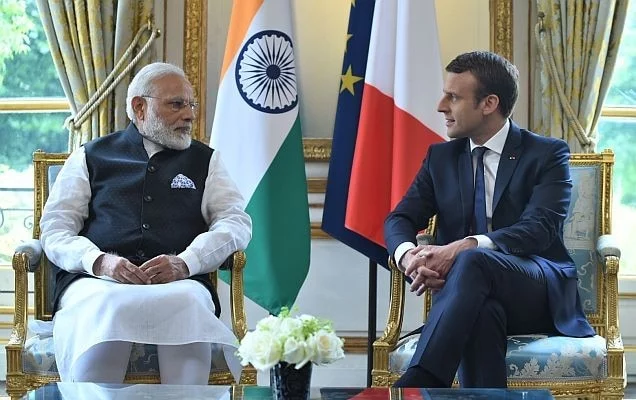
When Prime Minister Narendra Modi landed in France this month, the headlines largely focused on diplomacy, strategic partnerships, and bilateral engagements. Yet beneath the formal ceremonies, official photographs, and diplomatic protocols, another story was quietly unfolding—one that may prove far more consequential in the years ahead.
That story was about Artificial Intelligence.
Not long ago, discussions between nations revolved around oil, trade routes, military alliances, and nuclear agreements. Today, another asset is joining that list: compute power, foundation models, data infrastructure, and AI capabilities. The recent France visit demonstrated that artificial intelligence has moved from research labs and startup incubators to the highest levels of global diplomacy.
The symbolism was hard to miss.
France, one of Europe’s strongest advocates for technological sovereignty, and India, one of the world’s fastest-growing digital economies, found themselves discussing a future increasingly shaped by algorithms rather than assembly lines.
The centerpiece of this emerging partnership was Bharat Innovates 2026 in Nice, jointly inaugurated by Prime Minister Modi and French President Emmanuel Macron. On the surface, it was an innovation showcase. In reality, it represented something much larger.
For years, India has often been viewed as a technology adopter. The world saw India as a market for software, a destination for IT services, and a nation rapidly digitizing its economy. But the narrative being presented in France was different.
India was no longer introducing itself as a user of technology.
India was introducing itself as a builder.
Walking through exhibitions showcasing startups, deep-tech companies, AI innovators, and digital public infrastructure, one could sense the message New Delhi wanted to send to the world. India intends to participate in the creation of the next generation of technologies rather than simply consuming them.
Prime Minister Modi repeatedly emphasized innovation, entrepreneurship, and collaboration. However, the subtext was clear. The future economic and strategic influence of nations will increasingly be determined by their ability to build and govern artificial intelligence systems.
The timing of these conversations was particularly significant.
Around the world, AI has become a subject of intense geopolitical competition. The race is no longer simply about who can produce the smartest chatbot. It is about who controls the underlying infrastructure of intelligence itself.
Questions that seemed academic only a few years ago are now matters of national strategy.
Who owns the most advanced models?
Who controls access to them?
Where is the compute infrastructure located?
What happens when access is restricted?
Can nations truly rely on AI systems developed elsewhere?
Recent global developments have amplified these concerns. Governments are increasingly viewing advanced AI systems as strategic assets comparable to semiconductors, telecommunications networks, and critical infrastructure. In this environment, AI sovereignty has become one of the most discussed concepts in technology policy circles.
France understands this challenge well.
Europe has spent years debating technological dependence and strategic autonomy. The continent has sought greater control over cloud infrastructure, semiconductor supply chains, and digital platforms. Artificial intelligence is now becoming part of that broader conversation.
India finds itself confronting similar questions.
With over a billion citizens, hundreds of languages, and one of the world’s most ambitious digital transformation programs, dependence on external AI systems carries both opportunities and risks. The country’s answer has increasingly centered around building indigenous capabilities through initiatives such as IndiaAI, domestic startup ecosystems, and language technology programs.
This convergence of interests explains why AI occupied such a prominent place during the visit.
What makes India’s position particularly interesting is that it is attempting to approach AI from a fundamentally different perspective than many technology powers.
Much of the global AI conversation revolves around productivity, enterprise software, and consumer applications. India’s experience has been different.
Technology in India often operates at population scale.
Digital public infrastructure platforms such as Aadhaar, UPI, DigiLocker, and CoWIN have demonstrated that technology can serve hundreds of millions of citizens simultaneously. As a result, India’s vision for AI increasingly focuses on inclusion, accessibility, and public service delivery.
Artificial intelligence is not merely seen as a business opportunity.
It is increasingly viewed as a tool for governance.
This philosophy resonated strongly throughout the discussions in France.
Another recurring theme was language.
While many frontier AI systems continue to prioritize English and a handful of globally dominant languages, India faces a unique challenge. Meaningful AI adoption in India requires systems capable of understanding and communicating across dozens of languages and dialects.
This is where India’s investments in multilingual AI become strategically significant.
Initiatives such as BHASHINI have demonstrated that language technology can become a form of digital public infrastructure. Rather than forcing citizens to adapt to technology, technology can adapt to citizens.
For France, which has long emphasized cultural and linguistic preservation, this vision carries particular appeal.
Both countries recognize that the future of AI should not be limited to a small number of dominant languages and cultures.
The conversations also reflected a broader shift occurring internationally.
The world is gradually moving beyond discussions of AI capability toward discussions of AI governance.
How should powerful models be regulated?
How can innovation be encouraged without compromising safety?
What responsibilities do governments have?
What responsibilities do technology companies have?
These questions have become increasingly urgent as AI systems grow more capable.
India’s approach has generally emphasized balancing innovation with responsibility. Rather than advocating restrictive frameworks, New Delhi has consistently argued for enabling innovation while ensuring that AI remains human-centric, inclusive, and trustworthy.
This perspective was visible throughout the visit.
Rather than presenting AI as a threat to be controlled, the discussions framed it as a capability to be shaped responsibly.
Perhaps the most important takeaway from the visit was not any single announcement, partnership, or investment.
It was the realization that AI has become a permanent component of international relations.
Just as countries maintain dialogues on defense, energy, climate, and trade, they are now beginning to develop dedicated relationships around artificial intelligence.
The implications are profound.
Future diplomatic engagements may increasingly involve discussions on foundation models, compute infrastructure, AI safety standards, semiconductor access, and digital sovereignty.
Technology policy is becoming foreign policy.
For India, this transition presents both an opportunity and a responsibility.
The country possesses many of the ingredients required to become a major AI power: a large talent pool, an enormous digital economy, extensive public datasets, a thriving startup ecosystem, and growing government support. The challenge now is transforming these advantages into globally competitive AI capabilities.
As Prime Minister Modi concluded his engagements in France, it became evident that the visit was about much more than bilateral relations.
It offered a glimpse into the future of international diplomacy.
A future where nations compete not only through economic output and military strength but through intelligence infrastructure.
A future where algorithms influence geopolitical influence.
A future where artificial intelligence is not merely a technology sector but a strategic pillar of national power.
And in that future, India made it clear that it intends not merely to participate—but to help shape the rules of the game.